




Survey: Americans Largely Unaware of Truck Parking Shortage
A CloudTrucks survey found that while Americans generally had a positive perception of trucking, more than half were unaware about the challenges of truck parking.

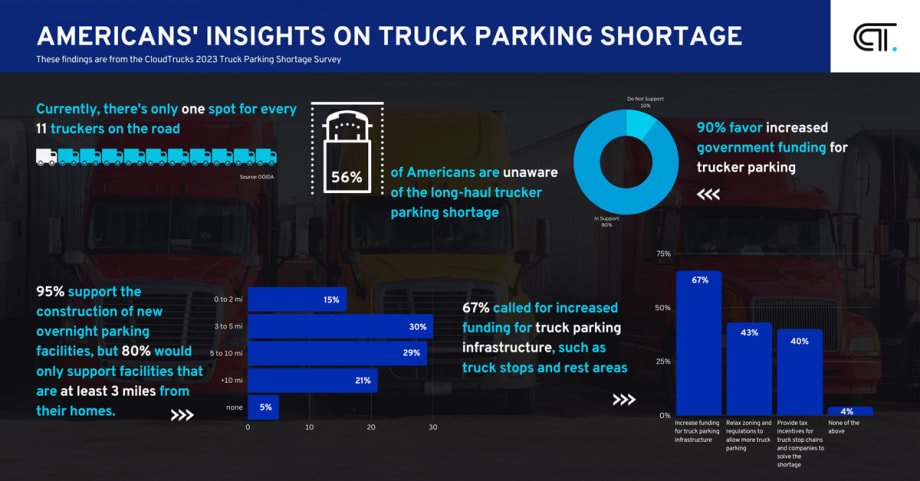
A CloudTrucks survey found that while Americans generally had a positive perception of trucking, more than half were unaware about the challenges of truck parking.
Graphic: CloudTrucks
CloudTrucks conducted a survey of 1,000 U.S. adults about their perception of truck drivers and their knowledge of truck parking issues. The survey found that while Americans generally had a positive perception of trucking, more than half were unaware about the challenges of truck parking.
Most people (56%) surveyed were unaware of the challenges drivers face in finding parking facilities, and that there was a nationwide shortage of parking for long-haul truck drivers.
Many respondents underestimated how many hours a trucker is permitted to drive in a day, and more than one in five respondents (21%) did not know that drivers sleep in a berth in their trucks.
A little more than halfway through the survey, respondents were given information about the parking shortage. After that, 86% of respondents agreed the parking challenges were a “critical” (48%) or “significant” (38%) problem, compared to 10% who said it was a “minor” (8%) problem or “not a problem” (2%), and 4% who said they were not sure.
Those surveyed expressed a desire for more Americans to learn about the parking shortage.
90% of respondents said that increased public awareness of the crisis is needed.
90% of those surveyed said that federal, state, and/or local governments should devote more funding to the problem.
57% of respondents recommended that the federal government serve as a source of funds.
67% said that the government should “increase funding for truck parking infrastructure, such as rest areas and truck stops."
43% favored “relaxed zoning and land use regulations”
40% supported “tax incentives for truck stop chains, trucking companies, and other private companies.”
About 80% of respondents only support facilities that are at least three miles from their homes, and 5% said they did not support new construction at all. 15% said they are comfortable with facilities being within 2 miles of their homes.
What is the Public Perception of Truck Drivers?
“While some commentators have expressed the concern that negative perceptions of truck drivers might influence public opinion on truck parking and other industry issues, the survey showed that Americans hold an overwhelmingly favorable view of drivers—saying they are safe drivers who are both overworked and underpaid,” CloudTrucks officials said in blog post analyzing the survey data.
Key findings include:
82% of respondents said drivers are “overworked”, compared to 4% who answered “underworked.” The remaining respondents (14%) answered “neither overworked nor underworked.”
When asked whether truck drivers are overpaid or underpaid, 58% of respondents answered “underpaid” compared to just 13% who answered “overpaid.” The remaining respondents answered “neither overpaid nor underpaid.”
50% of respondents said truckers are “safer drivers than the general public” and 36% said they are “neither safer nor less safe as drivers than the general public.” Only 14% said that truckers are “less-safe drivers than the general public.”
When asked why they think people choose to become truck drivers, respondents ascribed largely positive motivations, with 56% of respondents saying it was because they enjoy “the freedom of the open road” or “traveling to new places.” Another 31% said it was to “earn a high salary compared to other jobs available.”
More Fleet Management

Color Match Smarter: Tools That Restore & Perform
For fleet managers and collision repair professionals keeping heavy-duty trucks on the road, getting the color right the first time isn't just about appearance — it's about efficiency, turnaround time, and bottom-line results. Discover how today's digital color tools are transforming the repair process from guesswork to precision.
Read More →
FMCSA Pauses Biennial-Update Enforcement Amid Motus Transition
Carriers whose updates were due on or after June 1 have more time, while FMCSA works to stabilize its new registration system and warns of phishing sites impersonating its new carrier registration system, Motus.
Read More →
2026 Blueprint for Countering Smarter Supply Chain Theft
Cargo theft is no longer just the cost of doing business. It's a multi-billion-dollar criminal enterprise exploiting vulnerabilities across your fleet, drivers, and supply chain.
Read More →


How Telematics Improves Visibility, Control, and Performance in Refrigerated Fleets
Explore how telematics help refrigerated fleets improve visibility, uptime, efficiency, compliance, and cargo protection across connected cold chain operations.
Read More →
What the U.S.-Canada Trade War Means for Trucking
Escalating U.S.-Canada tariffs could disrupt cross-border freight, reduce truck volumes, raise costs, and create new uncertainty for carriers on both sides of the border.
Read More →
What Are Trucking’s Top Concerns for 2026?
The American Transportation Research Institute wants to know what's worrying trucking fleet managers, drivers, and other stakeholders in its annual Industry Issues survey.
Read More →
American Trucking Associations Looks for a New Leader
ATA President and CEO Chris Spear abruptly left his job at the association on August 21, at a pivotal time for the trucking industry.
Read More →
Public Wi-Fi Cybersecurity Risks: How Truck Drivers and Fleets Can Protect Their Data
Public Wi-Fi can expose truck drivers and fleets to credential theft, malware, and other cyber threats. Here’s how to reduce the risk on the road.
Read More →
For Nicky Cupp, Fleet Innovation Starts With Frustration
HDT Truck Fleet Innovator Nicky Cupp turns everyday pain points at Fraley & Schilling into opportunities for better technology and smarter processes.
Read More →
Adam Buttgenbach’s Approach to Electric Trucks: Start With Where They Fit
HDT Truck Fleet Innovator Adam Buttgenbach helped PepsiCo build one of North America’s largest EV fleets by focusing on where electric trucks make operational sense.
Read More →