




State Department Issues Permit for New Bridge Between U.S. and Canada
The building of a second bridge connecting Detroit with Windsor, Ontario, has moved another step closer to reality with U.S. federal approval, but opposition to the plans still exist, including in the form of lawsuits.

The building of a second bridge connecting Detroit with Windsor, Ontario, has moved another step closer to reality with U.S. federal approval, but opposition to the plans still exist, including in the form of lawsuits.
The U.S. State Department issued a building permit late last week, nearly a year after it was submitted by Michigan for the New International Trade Crossing.
The State Department said in its statement that the bridge “contributes to ensuring that our border infrastructure supports increased competitiveness, job creation and broad-based prosperity in the United States and Canada. The NITC will help to meet future capacity requirements in a critical travel corridor, promote cross-border trade and commerce, and advance our vital bilateral relationship with Canada."
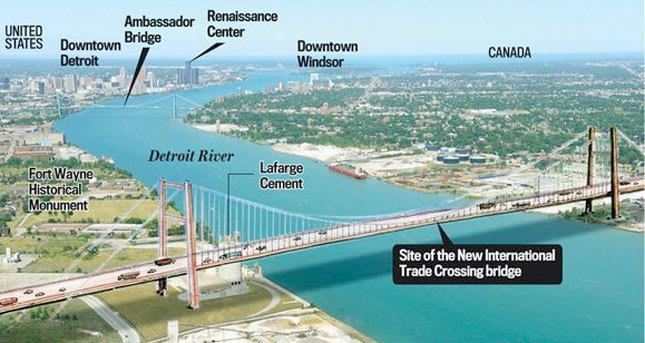
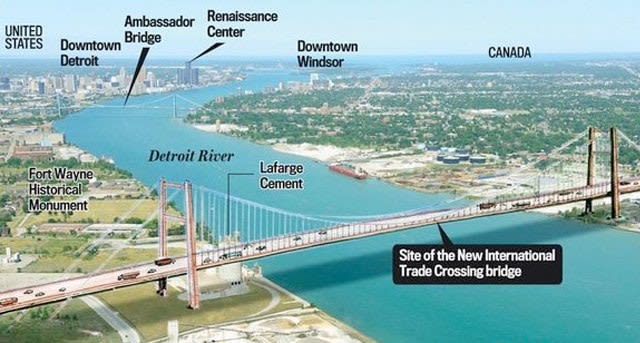
The move also comes following voters in Michigan last year rejecting a ballot initiative to get the public’s approval for construction of the span that will be downstream of the Ambassador Bridge, currently linking the two cities.
It’s opposed by the private owner of the Ambassador Bridge, Matty Moroun, who says it is not needed and in a federal lawsuit says his company has an exclusive right to operate the crossing without competition in a federal lawsuit.
TollRoadNews.com reports formal ownership of the bridge on the U.S. side of the river border will be by the state of Michigan but the Canadian government will pay for the bridge plus connections, inspection plaza facilities and the interchange with I-75 in Detroit as well as facilities on the Canadian side. Tolls will be collected by the Canadians on its side of the Detroit River.
It’s expected to take seven years to build the span and should be completed around 2020 or 2021 if there are no delays, but that could change.
Michigan representative Fred Durhal, who is running for mayor of Detroit and has reportedly has received campaign contributions from the Mouron family, has filed a lawsuit seeking to overturn building of the bridge on the grounds that Michigan Governor Rick Snyder exceeded his authority when he negotiated building of the span with the Canadian government, but did not get authority from state lawmakers.
Related Stories:
November 2012: Vote Clears Path for New Border Bridge in Detroit
More Drivers

From One Generation to the Next: How Mentorship Builds Safer Truck Drivers
After three decades in trucking, Harold Perry shares what he's learned about driver safety, mentorship, and helping the next generation build confidence behind the wheel.
Read More →
Truck Drivers Need More Than Another Alert
Fleets have more visibility into truck health, safety events, and driver activity than ever. The next challenge is turning all that information into useful guidance for the person who has to decide what to do next.
Read More →
FMCSA Removes 110 Truck Driver Training Schools from Certified ELDT List
Federal regulators also are targeting more than 160 additional training providers and launching a nationwide audit of third-party CDL skills testers as part of a broader crackdown on trucking fraud.
Read More →
Hours of Service Pilot Programs: FMCSA Readies for 2027 Rollout
Two pilot programs could eventually reshape hours-of-service rules, giving truck drivers options to pause their 14-hour clock or use longer split sleeper rest periods.
Read More →
Medical Cards, English Proficiency Reshape Roadcheck Violations
Medical-card violations jumped to the top of the driver out-of-service list during CVSA’s 2026 International Roadcheck, while English-language proficiency violations appeared among the leading violations for the first time.
Read More →
Driver Trust Can Make or Break the Success of Fleet Safety Technology
New Teletrac Navman research suggests that onboarding, transparency about driver data, and positive feedback can play a significant role in how commercial drivers respond to safety and coaching technology.
Read More →
EEOC Sues KLLM Over Alleged Sex Discrimination in Driver Training
KLLM is facing a federal sex-discrimination lawsuit over policies the EEOC alleges put female truck driver trainees at a disadvantage.
Read More →
FMCSA Moves to Codify English Language Requirements for Commercial Drivers
By changing regulations on English-language proficiency requirements for commercial drivers, rather than relying on a guidance memo, the FMCSA said future administrations won't be able to walk back the Trump administration's stricter enforcement with just a memo.
Read More →
Drivers Put Western Star Trucks to the Test at Star Nation Experience
Watch to get an inside look at the Western Star trucks, technology, and community behind the Star Nation Experience 2026!
Read More →
Trump Administration Looks to Put More Veterans Behind the Wheel
The Freedom Haulers program pulls together existing and expanded programs at several federal agencies to recruit veterans to drive commercial heavy-duty trucks and cut the red tape for them to get a CDL, training, and employment.
Read More →