




Bridge Deal Reached for New Windsor-Detroit Border Crossing
An agreement has finally been reached on a $4 billion project to build a second bridge linking Windsor, Ontario and Detroit, Mich. to take pressure off the crowded Ambassador Bridge border crossing, the busiest trade crossing on the U.S.-Canada border
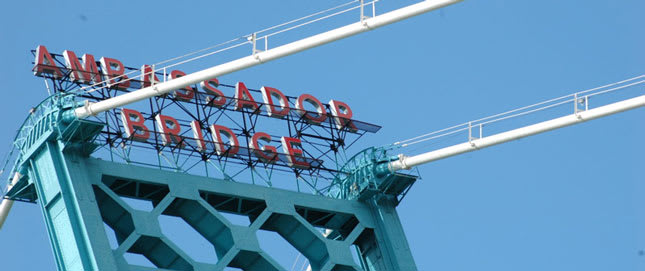
Proponents of the new crossing say the existing Ambassador Bridge will not be able to handle increased cross-border trade.
An agreement has finally been reached on a $4 billion project to build a second bridge linking Windsor, Ontario and Detroit, Mich. to take pressure off the crowded Ambassador Bridge border crossing, the busiest trade crossing on the U.S.-Canada border.
The announcement of the New International Trade Crossing was made Friday by Canadian Prime Minister Stephen Harper and Michigan Gov. Rick Snyder.
A new direct connection between I-75 in Michigan and Highway 401 in Canada will ease traffic congestion at the border and allow trucks to bypass residential communities. The existing bridge at the Detroit-Windsor crossing is the No. 1 traffic bottleneck in the entire Pan-American Freeway system.
According to the Public Border Operators Association, the current 83-year-old Ambassador Bridge saw 2.6 million truck crossings last year. About 25% of the goods (valued at about $1.5 billion per day) traded between Canada and the U.S. crosses over the Windsor-Detroit border. Truck traffic is projected to increase 128% over the next 30 years, surpassing current capacity by 2033.
Snyder said on Friday that 8,000 trucks cross the current bridge each day, and traffic jams created by the trucks and passenger cars impede expansion of trade and economic opportunities for Ontario and Michigan.
Creative Financing for New Border Bridge
Gov. Snyder has been stymied in obtaining approval for the project in the Michigan legislature thanks to intense lobbying from the owners of the Ambassador Bridge, which currently enjoys a monopoly. So the governor decided to use his executive authority to reach an accord with Canada, under which Canada will pay Michigan's $550-million share of the bridge.
The political agreement to build the bridge and the connecting highways between the federal government, the Government of Ontario (which has responsibility for constructing the highway linkages that are already under way) and the City of Windsor was attained some time ago. Up until Friday, the green light from Michigan remained the missing piece of the puzzle.
The agreement allows for the creation of an International Authority to oversee the letting of bids to privately design, develop, finance, construct and operate the NITC. The Authority will be comprised of three members appointed by Canada and three members appointed by Michigan.
No tolls will be charged in Michigan for use of the bridge. Canada will charge tolls, which will be used to reimburse the Canadian government for the funds it advances related to the NITC and for its annual availability payments to the concessionaire.
The Battle Over the Bridge
Opponents who have been battling bridge planners on both sides of the border, such as the owners of the private Ambassador Bridge, are unlikely to give up their fight and could challenge the accord. Manuel "Matty" Moroun, the billionaire owner of the Ambassador Bridge and long-time opponent of a second span, vowed to continue to fight the new bridge.
Opponents say traffic on the Ambassador Bridge is down 40% since 1999 and that the governor has not made a solid case for the need for a second crossing. Canadian officials say there's a need to look beyond short-term statistics and prepare long-term solutions for increased trade over the Detroit River.
It's still unknown exactly when shovels will be ready to hit the ground, but environmental approval to build the bridge across the Detroit River in the Brighton Beach-Delray industrial corridor has already been granted under the lengthy bi-national study process.
Several Canadian officials said construction of the new bridge will take four to five years, and one Canadian official said planning plus construction of the bridge will take six to seven years, according to Reuters.
Canadian Truckers Pleased
The Canadian Trucking Alliance is giving a thumbs-up to the announcement.
"It's been a long road to get to this day, with even more stops and starts than on Huron Church Rd.," says CTA president David Bradley, referring to the years of political wrangling that have delayed progress and the fact that trucks have to negotiate 16 stop lights on the Windsor road leading to the current bridge crossing. "So we are thrilled the new crossing will become a reality."
When constructed, says Bradley, the bridge "will provide freeway-to-freeway access to the border on both sides, provide redundancy in the event of an emergency shutdown at any of the Windsor-Detroit crossings, and enhance the efficiency and predictability of the North American supply chain, which in turn will attract future direct investment and stimulate economic growth in the region."
More Drivers

From One Generation to the Next: How Mentorship Builds Safer Truck Drivers
After three decades in trucking, Harold Perry shares what he's learned about driver safety, mentorship, and helping the next generation build confidence behind the wheel.
Read More →
Truck Drivers Need More Than Another Alert
Fleets have more visibility into truck health, safety events, and driver activity than ever. The next challenge is turning all that information into useful guidance for the person who has to decide what to do next.
Read More →
FMCSA Removes 110 Truck Driver Training Schools from Certified ELDT List
Federal regulators also are targeting more than 160 additional training providers and launching a nationwide audit of third-party CDL skills testers as part of a broader crackdown on trucking fraud.
Read More →
Hours of Service Pilot Programs: FMCSA Readies for 2027 Rollout
Two pilot programs could eventually reshape hours-of-service rules, giving truck drivers options to pause their 14-hour clock or use longer split sleeper rest periods.
Read More →
Medical Cards, English Proficiency Reshape Roadcheck Violations
Medical-card violations jumped to the top of the driver out-of-service list during CVSA’s 2026 International Roadcheck, while English-language proficiency violations appeared among the leading violations for the first time.
Read More →
Driver Trust Can Make or Break the Success of Fleet Safety Technology
New Teletrac Navman research suggests that onboarding, transparency about driver data, and positive feedback can play a significant role in how commercial drivers respond to safety and coaching technology.
Read More →
EEOC Sues KLLM Over Alleged Sex Discrimination in Driver Training
KLLM is facing a federal sex-discrimination lawsuit over policies the EEOC alleges put female truck driver trainees at a disadvantage.
Read More →
FMCSA Moves to Codify English Language Requirements for Commercial Drivers
By changing regulations on English-language proficiency requirements for commercial drivers, rather than relying on a guidance memo, the FMCSA said future administrations won't be able to walk back the Trump administration's stricter enforcement with just a memo.
Read More →
Drivers Put Western Star Trucks to the Test at Star Nation Experience
Watch to get an inside look at the Western Star trucks, technology, and community behind the Star Nation Experience 2026!
Read More →
Trump Administration Looks to Put More Veterans Behind the Wheel
The Freedom Haulers program pulls together existing and expanded programs at several federal agencies to recruit veterans to drive commercial heavy-duty trucks and cut the red tape for them to get a CDL, training, and employment.
Read More →