




Senate Hearing on Employee Misclassification Emphasizes State Efforts
During a Senate Health, Education, Labor and Pensions Committee hearing on the Employee Misclassification Prevention Act held last Thursday, speakers stressed the importance of state efforts to combat misclassification of independent contractors
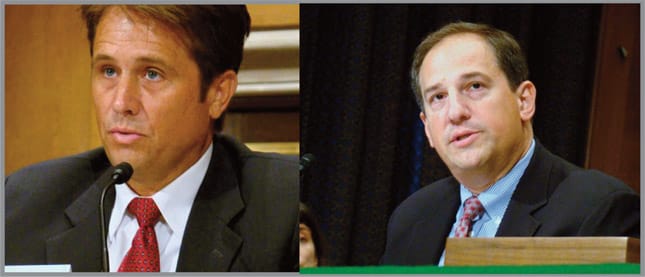
Gary Uber (L) of Family Private Care Inc. outlined some of the negative impacts the rule could have on businesses and contractors. The DOL's Seth Harris (R) said misclassification is depriving employees of benefits and hurting government.
During a Senate Health, Education, Labor and Pensions Committee hearing on the Employee Misclassification Prevention Act held last Thursday, speakers stressed the importance of state efforts to combat misclassification of independent contractors.
The legislation, introduced by Sen. Sherrod Brown (D-Ohio) along with Sens. Tom Harkin (D-Iowa), Dick Durbin (D-Ill.), Patty Murray (D-Wash.), Bob Casey (D-Pa.), Jeff Merkley (D-Ore.), Barbara Mikulski (D-Md.) and Al Franken (D-Minn.), would set up additional record keeping requirements that employers must keep on independent contractors. It would also increase the penalties on businesses found to have misclassified employees as independent contractors. This could greatly affect a number of trucking companies that hire independent contractors as drivers.
In his statement during the hearing, Seth Harris, deputy secretary of the U.S. Department of Labor, said the department held a forum last month to hear about what states have been doing about misclassification. "The importance of working with the states on employee misclassification cannot be overemphasized."
Colleen Gardner, commissioner of the New York State Department of Labor, also spoke at the hearing, outlining New York's problems related to misclassification and some of the efforts of the New York State Joint Enforcement Task Force on Employee Misclassification.
In addition to emphasizing the need for state involvement, most of the hearing's testimonies stressed that misclassification is costing the government billions in unreported tax revenue and is depriving workers of compensation and benefits.
"Misclassification hurts workers who are deprived of their employment rights under state and federal law," Gardner said. "It also hurts legitimate businesses that have to compete against businesses that illegally cut their costs through the misclassification of workers. Finally, it hurts government which does not receive appropriate employment and income taxes."
Harris made a similar comment.
One testimony, however, laid out some of the issues with the legislation. Gary Uber, co-founder of Family Private Care Inc., said that companies that do business with independent contractors may decide that the risks are not worth it. "If that were to occur, the millions of legitimate independent contractors, who -- like any other business -- need clients to survive, would begin to close their businesses and start looking for employment," he said.
Uber also said the decision to work as an independent contractor is not always made by the firm; individuals often choose to work independently, as it can offer many benefits.
"A principal attraction for caregivers to work as independent contractors is that they can make more money as independent contractors, because they receive a much larger portion of a client payment than a caregiver who works as an employee of an agency," he said. "Also, caregivers have more control over when they work and for whom they work, since registries merely offer them client opportunities, and they alone decide which opportunities to pursue."
During his testimony, Uber also said the legislation would impose unworkable recordkeeping requirements.
More Drivers

Truck Drivers Need More Than Another Alert
Fleets have more visibility into truck health, safety events, and driver activity than ever. The next challenge is turning all that information into useful guidance for the person who has to decide what to do next.
Read More →
FMCSA Removes 110 Truck Driver Training Schools from Certified ELDT List
Federal regulators also are targeting more than 160 additional training providers and launching a nationwide audit of third-party CDL skills testers as part of a broader crackdown on trucking fraud.
Read More →
Hours of Service Pilot Programs: FMCSA Readies for 2027 Rollout
Two pilot programs could eventually reshape hours-of-service rules, giving truck drivers options to pause their 14-hour clock or use longer split sleeper rest periods.
Read More →
Medical Cards, English Proficiency Reshape Roadcheck Violations
Medical-card violations jumped to the top of the driver out-of-service list during CVSA’s 2026 International Roadcheck, while English-language proficiency violations appeared among the leading violations for the first time.
Read More →
Driver Trust Can Make or Break the Success of Fleet Safety Technology
New Teletrac Navman research suggests that onboarding, transparency about driver data, and positive feedback can play a significant role in how commercial drivers respond to safety and coaching technology.
Read More →
EEOC Sues KLLM Over Alleged Sex Discrimination in Driver Training
KLLM is facing a federal sex-discrimination lawsuit over policies the EEOC alleges put female truck driver trainees at a disadvantage.
Read More →
FMCSA Moves to Codify English Language Requirements for Commercial Drivers
By changing regulations on English-language proficiency requirements for commercial drivers, rather than relying on a guidance memo, the FMCSA said future administrations won't be able to walk back the Trump administration's stricter enforcement with just a memo.
Read More →
Drivers Put Western Star Trucks to the Test at Star Nation Experience
Watch to get an inside look at the Western Star trucks, technology, and community behind the Star Nation Experience 2026!
Read More →
Trump Administration Looks to Put More Veterans Behind the Wheel
The Freedom Haulers program pulls together existing and expanded programs at several federal agencies to recruit veterans to drive commercial heavy-duty trucks and cut the red tape for them to get a CDL, training, and employment.
Read More →
Putting Mack’s Command Steer to the Test
A test drive of Mack’s Command Steer active steering system evaluates how it can make truck driving easier and less tiring.
Read More →