




Reyco Granning Debuts Auxiliary Lift-Axle Suspensions
Reyco Granning introduced its new LiftMaster family of auxiliary lift-axle suspensions at the NTEA Work Truck Show— the ALAP-13 (PS) steerable and ALAP-13 (NS) non-steerable-- for heavy-duty Class 7/8 trucks.
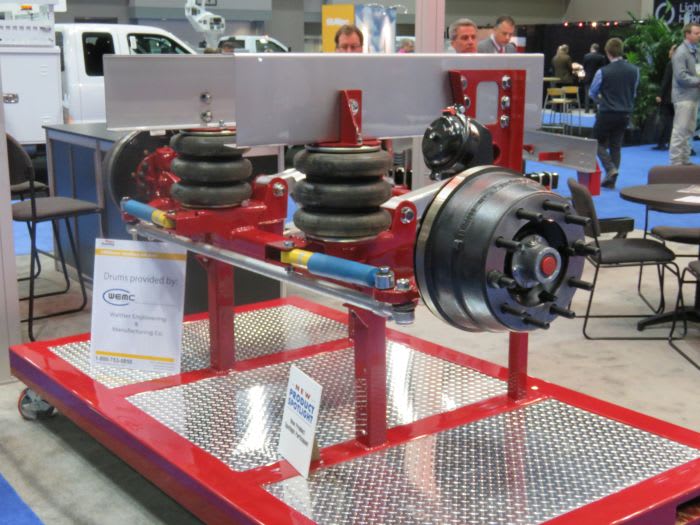
Photo: David Cullen
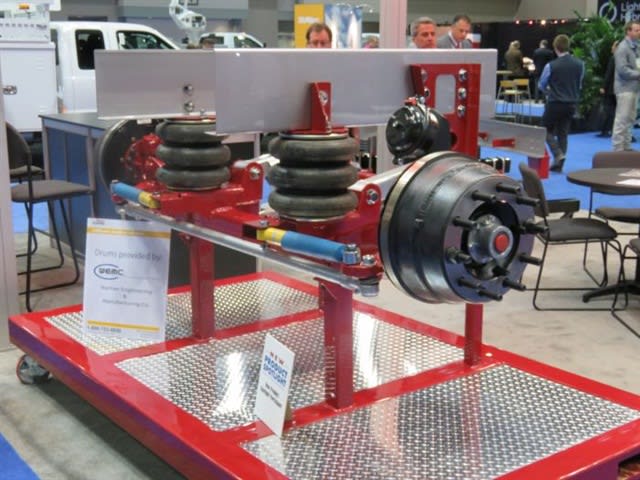
Photo: David Cullen
Reyco Granning introduced its new LiftMaster family of auxiliary lift-axle suspensions at the NTEA Work Truck Show— the ALAP-13 (PS) steerable and ALAP-13 (NS) non-steerable. The new suspensions are designed for the heavy-duty Class 7/8 market and are rated at 13,200 lb. capacity.
According to Drake Sarault, director of powered vehicles, the new models take the place of previous Reyco Granning models L132 (steerable) and L130 (non-steerable). “These new suspensions are an outcome of our continuous improvement process,” he said. “We listen to customer feedback, analyze what our competitors are doing and challenge our engineers to create the best suspensions they know how.”
One of those was how to remove weight yet maintain strength and durability. “Fleets are always looking for ways to increase payload and therefore more revenue, but they don’t want that at the expense of higher maintenance costs,” said John Hinz, chief engineer for powered vehicles. “We were able to remove 75 lbs. in the steerable version and approximately 100 lbs. from the non-steerable version. And we did it while still passing our most stringent tests for vertical, lateral and longitudinal forces.”
Customer feedback also played a role in the steering stabilizer design. “Some self-steering auxiliary axles use a coil spring for stabilization,” said Hinz. “But customers complain that the coils can become packed with mud or concrete and become inoperative. Some other designs use a horizontal shock damper but the damper is under-sized and the fluid can cavitate and lose its effectiveness.”
Hinz said Reyco Granning solved the stabilizer issue with a large Bilstein gas-charged, monotube steer damper. “This eliminates heat build-up and cavitation and maintains constant control of the steering mechanism.”
Other LiftMaster standard features include an automatic lift function in reverse, eliminating the chance that a driver might forget to manually lift the axle, he noted.
The LiftMaster series is covered by a 36 month (300,000) mile parts only and a 12 month (100,000) mile labor warranty for the main structural components, including hangers, beams, clip plates and axle saddles, torque arms and bellow pads.
The new lift axles are also covered by 12 month (100,000) parts only, and 6 month (12,000) mile labor, for other air spring lift axle suspension components, such as valves, fasteners, bushings, and components not stated specifically that are provided by Reyco Granning.
More Equipment

How Volvo Updated Its D13 for EPA 2027 [Watch]
Volvo’s updated D13 promises lower emissions without sacrificing performance or fuel economy. Take a closer look at what changed inside the engine in this HDT Spotlight video.
Read More →
Michelin Tire Improves Efficiency and Durability for Regional Fleets
The Michelin X Multi Energy D2 is a regional haul drive tire engineered to help fleets improve fuel efficiency, durability and traction in demanding stop-and-go operations.
Read More →
ZF Expands Commercial Vehicle Push in North America
ZF is expanding its North American commercial-vehicle presence with new transmission applications, electrification, trailer technology and autonomous-driving systems.
Read More →
Tesla Wants a Self-Driving Semi. Are Cameras Enough?
Could Tesla’s camera-only autonomous driving technology work on an 80,000-pound Semi? In this commentary, HDT's Deborah Lockridge takes a look at Tesla, Cybercab, and how autonomous trucks see the road.
Read More →
Kodiak: Driverless Long-Haul Truck Launch on Track for 2026
Kodiak AI says its driverless long-haul safety case is 93% complete and it remains on track to begin commercial operations by year-end 2026.
Read More →
What DOT’s Automated Vehicle Strategy Means for Trucking
The U.S. Department of Transportation issued a new automated-vehicle strategy that outlines plans for driverless-truck regulations, cross-state freight corridors, and federal safety standards.
Read More →
East Coast Port Launches $45M Electric Truck Push
The Port Authority of New York and New Jersey announced millions in incentives for zero-emission drayage trucks, yard tractors, and new charging hubs near the port.
Read More →
PlusAI Going Public to Fund Autonomous Truck Launch
A SPAC deal could provide PlusAI with up to $300 million as it works toward a 2027 commercial launch of factory-built autonomous trucks.
Read More →
NHTSA Moves to Rewrite Truck Fuel-Economy Rules
The National Highway Traffic Safety Administration says it lacks authority to regulate medium- and heavy-duty truck engines separately from complete vehicles, but the existing standards have not yet been eliminated.
Read More →
Detroit Opens Orders for EPA 2027 Engines
Detroit isn’t starting from scratch to meet EPA 2027 diesel emissions standards. Its Gen 6 DD13 and DD15 engines keep much of today’s platform while updating the fuel and aftertreatment systems.
Read More →