




Related: Tire Makers Look for Alternatives to Natural Rubber
Research Shows Promise for New Source of Rubber for Tires
It’s possible you could see truck tires in the future made from rubber from a domestic plant rather than the traditional rubber tree, as a five-year study led by Cooper Tire & Rubber showed good results for passenger tires.
by Staff
August 11, 2017
Guayule is a shrub that grows in the Southwest and produces a rubber that can be used in tires.
2 min to read

Guayule is a shrub that grows in the Southwest and produces a rubber that can be used in tires.
You could see tires in the future made from rubber from a domestic plant rather than the traditional rubber tree, as a five-year study led by Cooper Tire & Rubber showed good results for passenger tires.
Guayule, a shrub grown in the U.S. Southwest, contains a type of rubber that can be processed to use in tires. Cooper worked with a consortium of researchers with a five-year grant to study the feasibility of using guayule in tires rather than Hevea natural rubber, sourced primarily from Southeast Asia.
The team created more than 450 concept tires made entirely of guayule and put them through extensive evaluation, including rigorous wheel and road tests, and says the tires were found to have overall performance at least as good as tires made with Hevea and synthetic rubber. And they performed significantly better in rolling resistance, wet handling and wet braking, according to Cooper.
“Based on our findings, Cooper could use guayule rubber in tire production tomorrow if enough material was available to meet our production needs at a competitive price. To make this happen, the combined effort of government, agriculture and industry is needed to grow the plants and create large-scale manufacturing operations to product the rubber for use in the tire industry.”
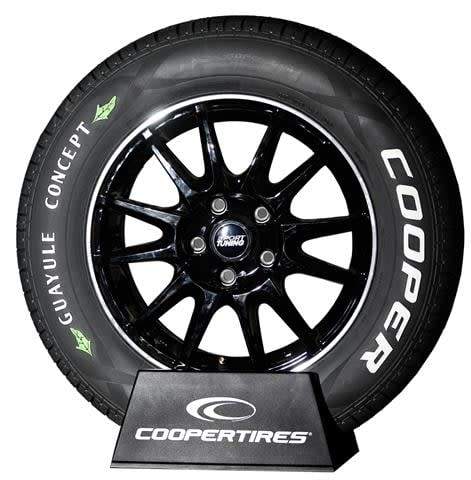
One of Cooper's concept tires made with guayule.Photo: Cooper Tire
In addition, consortium member Clemson University reported on a life cycle analysis on the environmental impact of producing tires from guayule and found 6% to 30% lower emissions.
In addition to Cooper and Clemson, the consortium included Cornell University, PanAridus (which supplied the raw material guayule rubber), and the U.S. Department of Agriculture’s research arm. The grant was from the USDA and the U.S. Department of Energy.
More Equipment

How Volvo Updated Its D13 for EPA 2027 [Watch]
Volvo’s updated D13 promises lower emissions without sacrificing performance or fuel economy. Take a closer look at what changed inside the engine in this HDT Spotlight video.
Read More →
Michelin Tire Improves Efficiency and Durability for Regional Fleets
The Michelin X Multi Energy D2 is a regional haul drive tire engineered to help fleets improve fuel efficiency, durability and traction in demanding stop-and-go operations.
Read More →
ZF Expands Commercial Vehicle Push in North America
ZF is expanding its North American commercial-vehicle presence with new transmission applications, electrification, trailer technology and autonomous-driving systems.
Read More →
Tesla Wants a Self-Driving Semi. Are Cameras Enough?
Could Tesla’s camera-only autonomous driving technology work on an 80,000-pound Semi? In this commentary, HDT's Deborah Lockridge takes a look at Tesla, Cybercab, and how autonomous trucks see the road.
Read More →
Kodiak: Driverless Long-Haul Truck Launch on Track for 2026
Kodiak AI says its driverless long-haul safety case is 93% complete and it remains on track to begin commercial operations by year-end 2026.
Read More →
What DOT’s Automated Vehicle Strategy Means for Trucking
The U.S. Department of Transportation issued a new automated-vehicle strategy that outlines plans for driverless-truck regulations, cross-state freight corridors, and federal safety standards.
Read More →
East Coast Port Launches $45M Electric Truck Push
The Port Authority of New York and New Jersey announced millions in incentives for zero-emission drayage trucks, yard tractors, and new charging hubs near the port.
Read More →
PlusAI Going Public to Fund Autonomous Truck Launch
A SPAC deal could provide PlusAI with up to $300 million as it works toward a 2027 commercial launch of factory-built autonomous trucks.
Read More →
NHTSA Moves to Rewrite Truck Fuel-Economy Rules
The National Highway Traffic Safety Administration says it lacks authority to regulate medium- and heavy-duty truck engines separately from complete vehicles, but the existing standards have not yet been eliminated.
Read More →
Detroit Opens Orders for EPA 2027 Engines
Detroit isn’t starting from scratch to meet EPA 2027 diesel emissions standards. Its Gen 6 DD13 and DD15 engines keep much of today’s platform while updating the fuel and aftertreatment systems.
Read More →