




Report: Refuse Fleets Could Reduce U.S. Methane Emissions with RNG
Tripling current production of RNG to 1.5 billion gallons a year would produce enough fuel for every refuse truck in the U.S. and cut methane emissions by 15%.

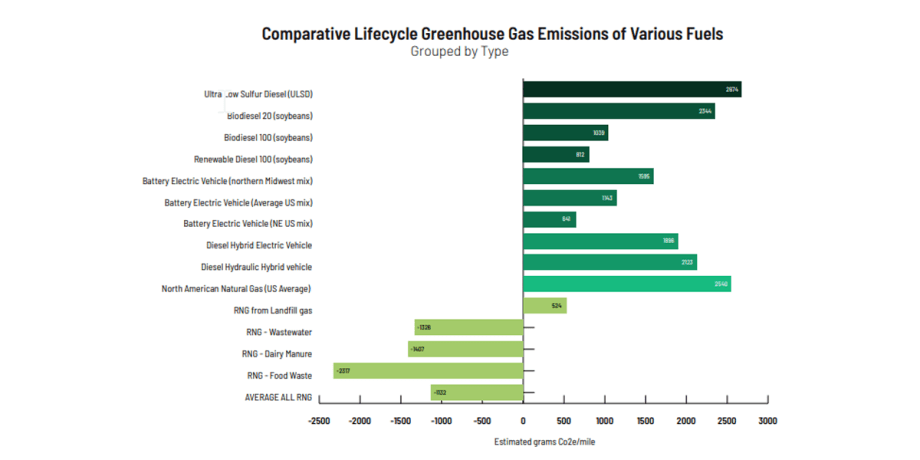
RNG trucks rated highest in terms of performance, cost, and cutting lifecycle GHG emissions, and health-damaging pollutants in Energy Vision's report.
Graph: Energy Vision
If refuse truck fleets operated on renewable natural gas made from organic waste, it could drastically reduce U.S. methane emissions, according to a new report from Energy Vision.
Energy Vision — which has been promoting the production and use of RNG since 2009 — published a new report to assess various alternative fuels and new vehicle technologies for reducing greenhouse gas emissions and other negative impacts from waste and recycling collection truck fleets.
The report examines nine options refuse fleets can use to lower their impacts, ranging from biodiesel and renewable diesel, to fossil and renewable natural gas, to hybrid technologies, to battery electric vehicles, DME, and hydrogen.
Of the nine strategies analyzed, the report found trucks equipped with natural gas engines powered by organic waste-derived RNG fuel achieved the greatest benefits at the lowest cost. RNG trucks rated highest in terms of performance, cost, and cutting lifecycle GHG emissions, and health-damaging pollutants.
Trucks running on RNG cut nitrogen oxides emissions 90% and significantly reduce particulate emissions compared to diesel.
“All the alternative fuel and technology options the report assessed had meaningful climate and clean air advantages over petroleum diesel,” said Matt Tomich, president of Energy Vision and lead author of the report. “Each one had benefits and drawbacks, and the varying needs of refuse fleets mean that right now there is no ‘one size fits all’ solution. However, some approaches turned out to be much more impactful than others.”
Cutting Methane Emissions with RNG
The report includes data on overall methane emissions related to waste disposal. Methane is at least 86 times more potent than carbon dioxide over a 20-year time frame, and landfills are the third largest source of methane emissions. That uniquely positions the waste and recycling industry to leverage significant climate benefits by reducing its methane footprint, Energy Vision officials said in a press release.
“RNG production turns what was previously discarded as waste in this country into a valuable energy resource, creating economic benefits,” Energy Vision officials wrote. “Organic wastes including food wastes, green clippings, and agricultural wastes have long been sent to landfills, which is costly and a major source of methane emissions. Diverting those wastes into RNG production turns them into a clean fuel which prevents methane emissions.”
Methane from decomposing organics in landfills, on farms, and at wastewater treatment plants account for 30% of total U.S. methane emissions. Currently, a portion of this methane is captured and refined to produce nearly 500 million gallons of RNG fuel a year, but that is roughly just 5% of overall potential RNG production.
Tripling current production to 1.5 billion gallons of RNG a year would produce enough fuel for every refuse truck in the U.S. Full potential RNG fuel production from all available feedstocks would be about 10 billion gallons of RNG a year.
The report finds that realizing this potential could power every urban bus and truck fleet in the country, displace a quarter of all on-road diesel fuel demand, and cut total U.S. methane emissions by 15%. That would get the U.S. halfway to the Methane Pledge target set by the Biden Administration to cut methane 30% by 2030.
Of the 180,000 refuse trucks currently operating in the U.S., there are approximately 10,000 refuse trucks powered by RNG, according to the report.
More Fuel Smarts

Wex Adds Cardless Fuel Payments for Over-the-Road Customers
A new fuel card feature for Wex customers offers convenience and security.
Read More →
New California Law Could Shed Light on Electric Truck Prices
Why do battery-electric Class 8 trucks remain so expensive? A California bill signed by Gov. Gavin Newsom would give fleets and state agencies more visibility into what manufacturers charge.
Read More →
How Volvo Updated Its D13 for EPA 2027 [Watch]
Volvo’s updated D13 promises lower emissions without sacrificing performance or fuel economy. Take a closer look at what changed inside the engine in this HDT Spotlight video.
Read More →

Diesel Price Spike Shortens Payback for Natural Gas Trucks, Report Says
Energy Vision estimates fleets could recover the higher purchase price of an RNG-fueled Class 8 tractor in 1.3 to 2.8 years under current fuel-price scenarios.
Read More →
Calstart Becomes Catalyst Mobility, Reflecting Broader Focus
Calstart is now Catalyst Mobility, reflecting the nonprofit’s growing national role in clean transportation, including zero-emission trucks, infrastructure and incentive programs.
Read More →
Record Diesel Prices Squeeze Trucking Fleets
Average U.S. diesel prices have climbed to nearly $6 a gallon, surpassing the 2022 record as tight refinery capacity and Middle East disruptions keep fuel costs elevated.
Read More →
How Fuel Delivery Shapes Engine Performance
Fuel delivery depends on more than what happens at the injector. For fleet, maintenance and technical professionals, looking at the full path from pump to injector can provide useful context for understanding engine performance.
Read More →
East Coast Port Launches $45M Electric Truck Push
The Port Authority of New York and New Jersey announced millions in incentives for zero-emission drayage trucks, yard tractors, and new charging hubs near the port.
Read More →
Detroit Opens Orders for EPA 2027 Engines
Detroit isn’t starting from scratch to meet EPA 2027 diesel emissions standards. Its Gen 6 DD13 and DD15 engines keep much of today’s platform while updating the fuel and aftertreatment systems.
Read More →
Zero-Emission Truck Corridor Planned for West Coast
California, Oregon, Washington, British Columbia and Baja California are coordinating plans for truck charging and hydrogen fueling from Canada to Mexico.
Read More →