




Report: CNG Competitive Against $2 Diesel
Despite the plunge in oil prices that has driven down the pump price of diesel, two of the three means of fueling trucks with compressed natural have remained competitive, according to consultant Jon T. Gabrielsen.

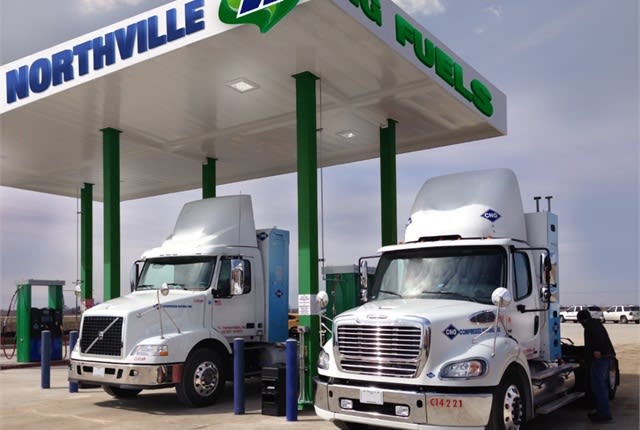
Trucks at CNG fuel station.
Trucks at CNG fuel station.
Despite the plunge in oil prices that has driven down the pump price of diesel, two of the three means of fueling trucks with compressed natural have remained competitive, according to Jon T. Gabrielsen, president and CEO of Atlanta-based J.T. Gabrielsen Consulting LLC.
“The unsung opportunity all long has been CNG,” said Gabrielsen, author of a report, “Alternatively Powered Commercial Vehicles: Global Markets,” just published by BCC Research.
The 350-page report discusses10 major alternative fuels for commercial vehicles used in North America, Latin America, Europe, the Middle East and Africa (EMEA), and the Asia-Pacific region. The fuels covered include CNG, LNG, LPG, DME, and Biodieel.
Even as diesel prices fell and stayed low, Gabrielsen said that CNG has stayed competitive for the entire time for those fleets that fuel centrally by compressing the fuel with their own compressors from their own natural gas utility-pipe connection as well as for those fleets that run on their own biogas sources— such as those in the waste collection landfill sector, and those engaged in agricultural animal-waste operations.
“Only retail CNG at truck stops became uncompetitive at the lowest [level of] oil and diesel prices,” he said, adding that that segment will “return to competitiveness the soonest, at the lower oil/diesel prices than for most other alternative fuels.”
Per Gabrielsen’s analysis in the BCC Research report, depending on a wide range of variables, such as annual driving distances and the additional initial vehicle costs to outfit for on-board CNG fuel storage and engine use of natural gas, the "added cost per diesel gallon equivalent (DGE) of CNG fuel is $0.36-0.48/DGE for a 3-year payback.
“So conservatively,” he stated, “any time that one can fuel a commercial vehicle with CNG for at least 50 cents per DGE less than with diesel fuel, then one will have at least a 3-year or shorter payback by having equipped [trucks] for CNG instead of diesel.”
Gabrielsen added that “even at the current low oil and diesel prices, self-compressed CNG provides very significant savings for commercial fleets. Even if one must purchase half of the annual CNG usage remotely at truck stop prices for CNG, one will still achieve a 3-year payback. And biogas is probably always a favorable proposition-- no matter how cheap diesel prices are.”
More Fleet Management

Why Private Fleets Are Taking More Freight
Private fleets are putting their own trucks on demanding customers and high-cost lanes as companies seek greater control over service, costs, and capacity.
Read More →
Color Match Smarter: Tools That Restore & Perform
For fleet managers and collision repair professionals keeping heavy-duty trucks on the road, getting the color right the first time isn't just about appearance — it's about efficiency, turnaround time, and bottom-line results. Discover how today's digital color tools are transforming the repair process from guesswork to precision.
Read More →
FMCSA Pauses Biennial-Update Enforcement Amid Motus Transition
Carriers whose updates were due on or after June 1 have more time, while FMCSA works to stabilize its new registration system and warns of phishing sites impersonating its new carrier registration system, Motus.
Read More →


2026 Blueprint for Countering Smarter Supply Chain Theft
Cargo theft is no longer just the cost of doing business. It's a multi-billion-dollar criminal enterprise exploiting vulnerabilities across your fleet, drivers, and supply chain.
Read More →
How Telematics Improves Visibility, Control, and Performance in Refrigerated Fleets
Explore how telematics help refrigerated fleets improve visibility, uptime, efficiency, compliance, and cargo protection across connected cold chain operations.
Read More →
What the U.S.-Canada Trade War Means for Trucking
Escalating U.S.-Canada tariffs could disrupt cross-border freight, reduce truck volumes, raise costs, and create new uncertainty for carriers on both sides of the border.
Read More →
What Are Trucking’s Top Concerns for 2026?
The American Transportation Research Institute wants to know what's worrying trucking fleet managers, drivers, and other stakeholders in its annual Industry Issues survey.
Read More →
American Trucking Associations Looks for a New Leader
ATA President and CEO Chris Spear abruptly left his job at the association on August 21, at a pivotal time for the trucking industry.
Read More →
Public Wi-Fi Cybersecurity Risks: How Truck Drivers and Fleets Can Protect Their Data
Public Wi-Fi can expose truck drivers and fleets to credential theft, malware, and other cyber threats. Here’s how to reduce the risk on the road.
Read More →
For Nicky Cupp, Fleet Innovation Starts With Frustration
HDT Truck Fleet Innovator Nicky Cupp turns everyday pain points at Fraley & Schilling into opportunities for better technology and smarter processes.
Read More →