




Renewable Diesel First Fill for all New Volvo and Mack Trucks
Volvo Trucks North America and Mack Trucks announced all new ICE trucks built at their plants will receive renewable diesel for their first fuel fill-ups.

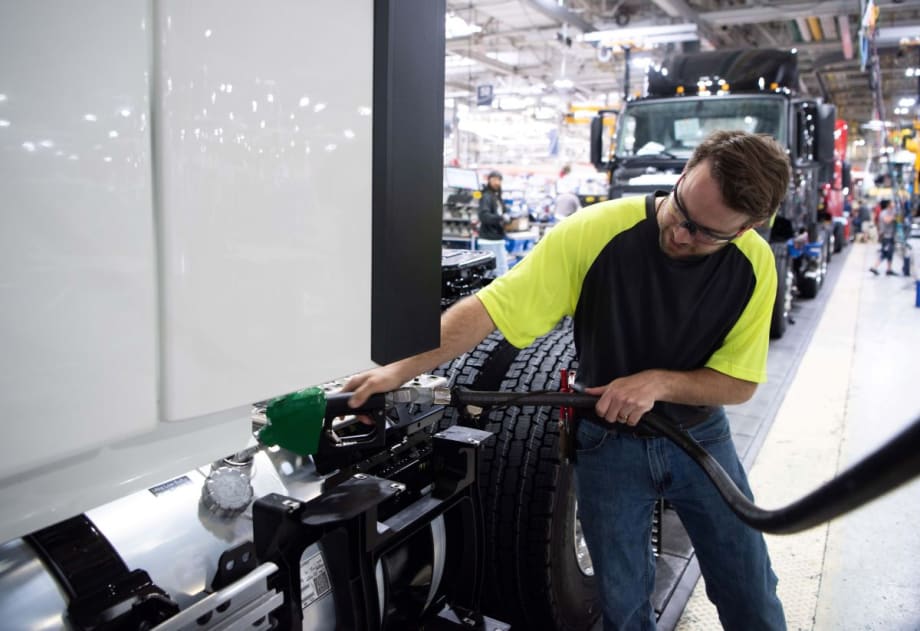
In an effort to further reduce upstream CO2 emissions, Volvo will begin fueling brand-new trucks with renewable diesel fuel when the roll off the assembly line.
Photo: Volvo Trucks North America
Volvo Trucks North America and Mack Trucks announced they will now fuel newly assembled trucks with Hydrotreated Vegetable Oil (HVO). HVO is a renewable fuel commonly called renewable diesel fuel in North America.
According to Volvo and Mack, HVO is a renewable fuel that can be used in the same engine as fossil-based diesel without requiring engine modifications.
Produced from renewable sources such as waste vegetable oils and animal fats, HVO has the same chemical structure as fossil-based diesel so it can be used as a direct replacement to reduce greenhouse gas emissions while maintaining engine performance. By utilizing these waste products as feedstocks, HVO production can promote a more sustainable circular economy by converting waste into valuable fuel.
Unlike first-generation biofuels, the OEMs said, these raw sources are processed using a sophisticated hydrotreatment to achieve high levels of purity allowing HVO to be stored, used, pumped, and handled virtually the same way as fossil-based diesel products.
Because HVO is hydrogenated, it doesn’t contain oxygen and does not present the challenges of first-generation biofuels (including biodiesel) relating to extreme temperature and storage. This is an added benefit of HVO as it does not require separate storage or fueling infrastructure.
HVO can be used interchangeably with petroleum diesel. Renewable diesel at any blend up to a maximum of 100% (RD100) that conforms to ASTM D975 or EN15940 will not adversely affect engine or aftertreatment performance or durability.
Volvo’s Three-Pillar Decarbonization Plan
All Volvo trucks for the North American market are currently produced at the Volvo Trucks New River Valley Assembly Operations in Dublin, Virginia. The OEM just announced it is building an all-new truck plant in Mexico to boost production.
The new biofuel initiative is part of Volvo Trucks’ broader strategy to decarbonize the industry through a three-pillar approach: enhancing internal combustion engine efficiency and drop-in renewable fuels to make the largest immediate emissions reductions while continuing to scale the Class 8 Volvo VNR Electric and developing hydrogen fuel cell trucks.
“Today and for the foreseeable future there will not be a one-size fits all approach to decarbonizing transportation,” said Peter Voorhoeve, president, Volvo Trucks North America. “That is why, at Volvo Trucks, we are focused on the three-pillar strategy with battery electric, hydrogen fuel cell and renewable fuels in the internal combustion engine.
"With the all-new Volvo VNL and by utilizing HVO, we can make the most substantial and immediate impact today. There is a future for the ICE and we’re happy to be doing all factory fills with renewable fuel, an important step towards walking the talk in our sustainability journey.”
Volvo Trucks is fueling new trucks leaving the NRV plant with 20 to 25 gallons of HVO per tank, with full tanks provided for trucks destined directly to customers. This initiative is expected to replace more than 1 million gallons of fossil-based diesel annually, achieving an estimated 75% to 85% reduction in CO2 emissions for Volvo Trucks' operations in North America.
18% Emissions Reduction in Lehigh Valley
Mack has two truck manufacturing plants. All Mack Class 8 models for North America and export are produced at its plant in Lehigh Valley, Pennsylvania. This plant has already been fueling new trucks with HVO. Mack estimates that by using HVO, it has already been able to reduce carbon emissions at that facility by about 18%.
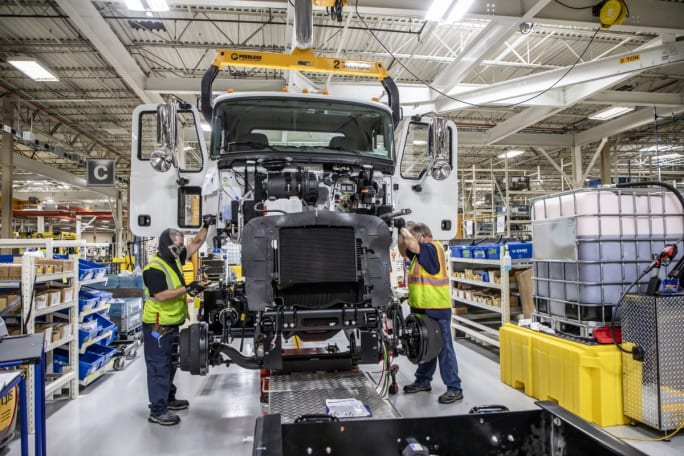
Mack said its MD Series Roanoke Valley manufacturing plant in Virginia will begin initial fuel fills with renewable diesel later this year.
Photo: Mack Tricks
The Mack MD Series is produced at Roanoke Valley Operations in Salem, Virginia. Use of LVO for first fills will begin there later this year, the OEM said.
“The utilization of HVO will help Mack in its journey to promote the decarbonization of the transportation industry,” said Jonathan Randall, president of Mack Trucks North America. “Whether it’s through the use of HVO, or through the development of Mack battery-electric vehicles (BEVs), such as the Mack LR Electric refuse and Mack MD Electric models, Mack is committed to reducing its carbon footprint and achieving our sustainability goals.”
More Fuel Smarts

How Volvo Updated Its D13 for EPA 2027 [Watch]
Volvo’s updated D13 promises lower emissions without sacrificing performance or fuel economy. Take a closer look at what changed inside the engine in this HDT Spotlight video.
Read More →
Diesel Price Spike Shortens Payback for Natural Gas Trucks, Report Says
Energy Vision estimates fleets could recover the higher purchase price of an RNG-fueled Class 8 tractor in 1.3 to 2.8 years under current fuel-price scenarios.
Read More →
Calstart Becomes Catalyst Mobility, Reflecting Broader Focus
Calstart is now Catalyst Mobility, reflecting the nonprofit’s growing national role in clean transportation, including zero-emission trucks, infrastructure and incentive programs.
Read More →

Record Diesel Prices Squeeze Trucking Fleets
Average U.S. diesel prices have climbed to nearly $6 a gallon, surpassing the 2022 record as tight refinery capacity and Middle East disruptions keep fuel costs elevated.
Read More →
How Fuel Delivery Shapes Engine Performance
Fuel delivery depends on more than what happens at the injector. For fleet, maintenance and technical professionals, looking at the full path from pump to injector can provide useful context for understanding engine performance.
Read More →
East Coast Port Launches $45M Electric Truck Push
The Port Authority of New York and New Jersey announced millions in incentives for zero-emission drayage trucks, yard tractors, and new charging hubs near the port.
Read More →
California Bill Could Shed Light on Electric Truck Prices
Why do battery-electric Class 8 trucks remain so expensive? A California bill headed to Gov. Gavin Newsom would give fleets and state agencies more visibility into what manufacturers charge.
Read More →
Detroit Opens Orders for EPA 2027 Engines
Detroit isn’t starting from scratch to meet EPA 2027 diesel emissions standards. Its Gen 6 DD13 and DD15 engines keep much of today’s platform while updating the fuel and aftertreatment systems.
Read More →
Zero-Emission Truck Corridor Planned for West Coast
California, Oregon, Washington, British Columbia and Baja California are coordinating plans for truck charging and hydrogen fueling from Canada to Mexico.
Read More →
A Closer Look at Kenworth’s Electric T880E Vocational Truck [Video]
Learn more about Kenworth's T880E battery-electric vocational truck at the Paccar Technical Center, including its range, applications, upfitting considerations, and PTO options, in this HDT Spotlight video.
Read More →