





You Also Might Like: 4 Keys to Spec'ing the Right Liftgate for your Truck or Trailer
RelGen Charges Truck Liftgate, HVAC Batteries without Idling
Blackburn Energy’s RelGen onboard charging system captures untapped kinetic energy to charge accessory batteries with a faster and fuller charge.
December 12, 2022
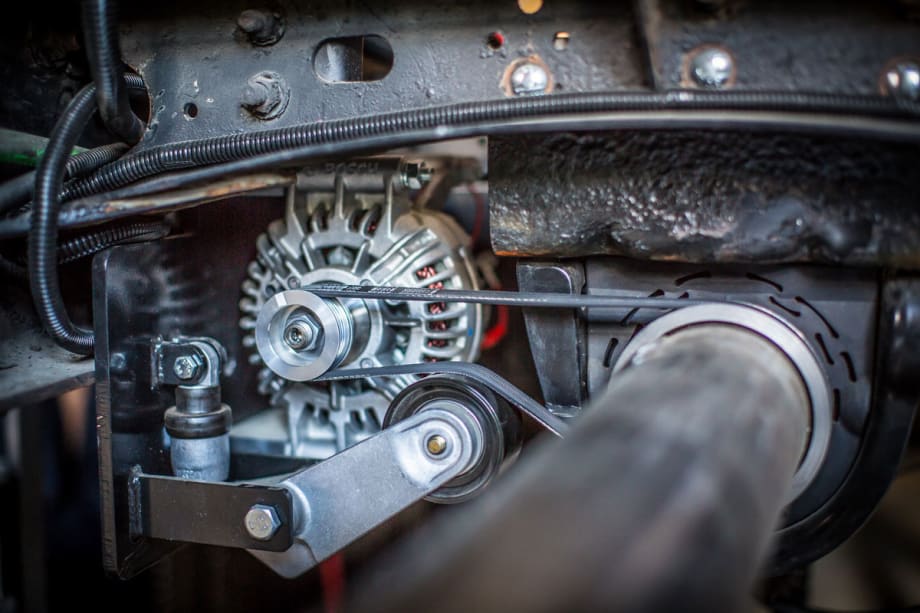
RelGen, from Blackburn Energy, solves low-voltage problems by providing 200 amps of additional dedicated charging for your liftgate batteries.
Photo: Blackburn Energy
3 min to read
Blackburn Energy has developed an on-board charging system for heavy electrical loads such as battery-powered HVAC units and liftgates. Using a 200-amp alternator driven from the truck’s driveshaft, the RelGen system can eliminate idling for charging purposes while charging auxiliary batteries three times faster than a standard engine-mounted alternator, according to the company.
Blackburn’s RelGen uses a high-efficiency 200-amp alternator mounted on the inside of the frame rail just behind the transmission. It is driven by the truck’s driveshaft through a specially designed center bearing. The alternator and the drive mechanism are protected from the elements by a stainless steel cover and powder coated steel mounting plates.
CEO and founder Andrew Amigo says there are several advantages to drawing on a kinetic power source other than the engine.
At highway speeds, the drive shaft turns faster than the alternator drive on the engine — thus more energy can be captured.
The mid-ship position places the alternator closer to the batteries, shortening the cable run and minimizing voltage drop.
To match the output of the RelGen system, truck owners would need to upgrade the stock alternator and re-cable the charging system to accommodate the higher amperage.
“For the same price as upgrading the alternator and re-cabling the entire truck, you can install RelGen Hybrid Charging and get the maximum performance from your HVAC system or liftgate batteries,” Amigo says.
Powering Liftgates and Truck HVAC
To validate its claims, Blackburn Energy commissioned the Department of Mechanical Engineering at the University of Massachusetts–Lowell to verify the performance of the RelGen technology. Researchers found that with the truck’s starting batteries and alternator completely disconnected from the RelGen and its battery load, in a liftgate application, the battery state of charge never dropped below 80% at the end of the day over a 30-day period. Based on eliminating idling to keep the liftgate batteries charged, researchers estimated fuel savings alone would provide a payback in less than a year.
Evaluations with an electric HVAC system showed RelGen could fully recharge a depleted four-battery AGM pack after less than four hours of driving — roughly half the time it takes for a standard factory-installed alternator to charge the hotel-load batteries.
With a dedicated hotel-load battery pack, there’s no need to maintain a reserve charge for starting, so it can provide longer run times for the HVAC system.
The system is also available in a hybrid configuration that charges only when the truck is coasting or braking to produce zero-emissions energy for the batteries. That setup comes with a telematics unit that records times, locations, and duration of the charging events for carbon credit reporting.
For fleets considering an alternator upgrade to support electric HVAC or liftgate charging, Blackburn Energy says RelGen is a more cost-effective option from the start, and it provides greater charging capacity than typical high-output alternator configuration — while reducing charging related idling to charge batteries. It can be installed by skilled mechanics in about four hours or at dealer mod shops, according to the company.
More Equipment

Used-Truck Remarketing Math Is Changing
Used-truck value is no longer just a concern at trade-in. Decisions made throughout a truck’s first life can influence what it’s worth years later.
Read More →
How Volvo Updated Its D13 for EPA 2027 [Watch]
Volvo’s updated D13 promises lower emissions without sacrificing performance or fuel economy. Take a closer look at what changed inside the engine in this HDT Spotlight video.
Read More →
Michelin Tire Improves Efficiency and Durability for Regional Fleets
The Michelin X Multi Energy D2 is a regional haul drive tire engineered to help fleets improve fuel efficiency, durability and traction in demanding stop-and-go operations.
Read More →
ZF Expands Commercial Vehicle Push in North America
ZF is expanding its North American commercial-vehicle presence with new transmission applications, electrification, trailer technology and autonomous-driving systems.
Read More →
Tesla Wants a Self-Driving Semi. Are Cameras Enough?
Could Tesla’s camera-only autonomous driving technology work on an 80,000-pound Semi? In this commentary, HDT's Deborah Lockridge takes a look at Tesla, Cybercab, and how autonomous trucks see the road.
Read More →
Kodiak: Driverless Long-Haul Truck Launch on Track for 2026
Kodiak AI says its driverless long-haul safety case is 93% complete and it remains on track to begin commercial operations by year-end 2026.
Read More →
What DOT’s Automated Vehicle Strategy Means for Trucking
The U.S. Department of Transportation issued a new automated-vehicle strategy that outlines plans for driverless-truck regulations, cross-state freight corridors, and federal safety standards.
Read More →
East Coast Port Launches $45M Electric Truck Push
The Port Authority of New York and New Jersey announced millions in incentives for zero-emission drayage trucks, yard tractors, and new charging hubs near the port.
Read More →
PlusAI Going Public to Fund Autonomous Truck Launch
A SPAC deal could provide PlusAI with up to $300 million as it works toward a 2027 commercial launch of factory-built autonomous trucks.
Read More →
NHTSA Moves to Rewrite Truck Fuel-Economy Rules
The National Highway Traffic Safety Administration says it lacks authority to regulate medium- and heavy-duty truck engines separately from complete vehicles, but the existing standards have not yet been eliminated.
Read More →