




Quarterly Intermodal Growth Streak Ends
Overall intermodal traffic recorded its first volume decline in the second quarter of the year following 25 consecutive quarters of growth, according to a new report from the Intermodal Association of North America.

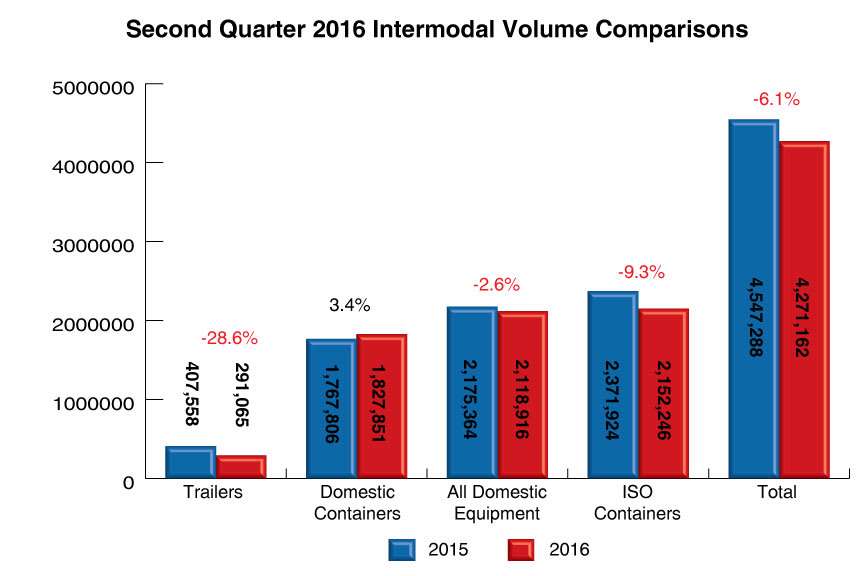
Graphic: IANA

Graphic: IANA
Overall intermodal traffic recorded its first volume decline in the second quarter of the year following 25 consecutive quarters of growth, according to new report from the Intermodal Association of North America.
IANA found that Intermodal trailer volumes dropped 28.6%, continuing a multi-year downward trend, while international shipments fell 9.3%. Domestic container loads gained 3.4%, tempering the overall loss to 6.1%. The total number of intermodal loads fell to 4.28 million from 4.55 million a year earlier.
"The second quarter intermodal volume numbers reflected current market conditions," said Joni Casey, president and CEO of IANA. "Year-end projections are still tracking for growth in both the domestic container and international volumes, however."
The seven highest-density trade corridors, accounting for nearly two-thirds of total intermodal volume, collectively dropped 5.9% year-over-year, with each corridor showing a loss. In the Southeast-Southwest and the Northeast- Midwest lanes, container performance offset the drop in trailer volumes, resulting in the smallest declines of all the corridors. Containers did the opposite in the South Central-Southwest corridor, which finished the quarter in negative territory by 17.6%.
Likewise, every region showed second quarter declines, ranging from 1.6% in Mexico to 14.9% in the South Central. The fall in international shipments between the Southwest and South Central regions was enough to pull down the overall international numbers for the quarter, according to IANA. Regional results also varied by exposure to trailers. Regions that saw the least trailer activity, including Mexico, the Northwest and Western Canada, came the closest to breaking even.
Intermodal service providers again demonstrated clear gains in the highway sector, up 17% from the previous year, thanks to excess trucking capacity. Intermodal loads fell 18.1% The net result was a total volume decrease of 3.2%.
More Fleet Management

Color Match Smarter: Tools That Restore & Perform
For fleet managers and collision repair professionals keeping heavy-duty trucks on the road, getting the color right the first time isn't just about appearance — it's about efficiency, turnaround time, and bottom-line results. Discover how today's digital color tools are transforming the repair process from guesswork to precision.
Read More →
FMCSA Pauses Biennial-Update Enforcement Amid Motus Transition
Carriers whose updates were due on or after June 1 have more time, while FMCSA works to stabilize its new registration system and warns of phishing sites impersonating its new carrier registration system, Motus.
Read More →
2026 Blueprint for Countering Smarter Supply Chain Theft
Cargo theft is no longer just the cost of doing business. It's a multi-billion-dollar criminal enterprise exploiting vulnerabilities across your fleet, drivers, and supply chain.
Read More →


How Telematics Improves Visibility, Control, and Performance in Refrigerated Fleets
Explore how telematics help refrigerated fleets improve visibility, uptime, efficiency, compliance, and cargo protection across connected cold chain operations.
Read More →
What the U.S.-Canada Trade War Means for Trucking
Escalating U.S.-Canada tariffs could disrupt cross-border freight, reduce truck volumes, raise costs, and create new uncertainty for carriers on both sides of the border.
Read More →
What Are Trucking’s Top Concerns for 2026?
The American Transportation Research Institute wants to know what's worrying trucking fleet managers, drivers, and other stakeholders in its annual Industry Issues survey.
Read More →
American Trucking Associations Looks for a New Leader
ATA President and CEO Chris Spear abruptly left his job at the association on August 21, at a pivotal time for the trucking industry.
Read More →
Public Wi-Fi Cybersecurity Risks: How Truck Drivers and Fleets Can Protect Their Data
Public Wi-Fi can expose truck drivers and fleets to credential theft, malware, and other cyber threats. Here’s how to reduce the risk on the road.
Read More →
For Nicky Cupp, Fleet Innovation Starts With Frustration
HDT Truck Fleet Innovator Nicky Cupp turns everyday pain points at Fraley & Schilling into opportunities for better technology and smarter processes.
Read More →
Adam Buttgenbach’s Approach to Electric Trucks: Start With Where They Fit
HDT Truck Fleet Innovator Adam Buttgenbach helped PepsiCo build one of North America’s largest EV fleets by focusing on where electric trucks make operational sense.
Read More →