




Private Fleets Back Higher Truck Weight Limit
The National Private Truck Council is now throwing its own weight behind the legislative effort to allow individual states to increase the federal vehicle weight limit to 91,000 pounds for tractor-trailers that are equipped with a sixth axle.

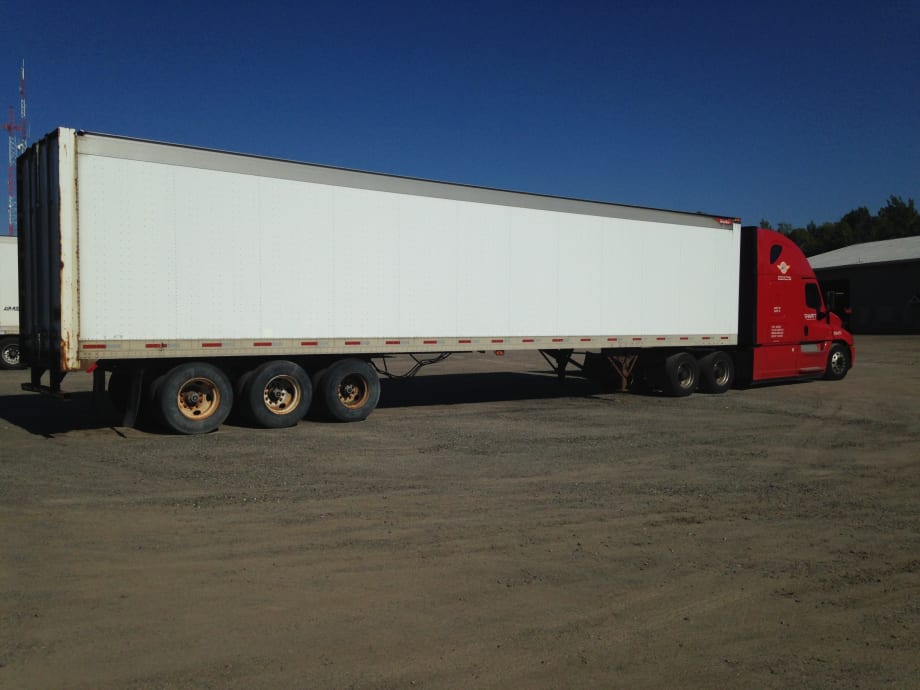
A House bill would let states set a 91,000-pound weight limit on highway rigs fitted with a sixth axle, similar to this truck built for operation in Maine.
A House bill would let states set a 91,000-pound weight limit on highway rigs fitted with a sixth axle, similar to this truck built for operation in Maine.
The National Private Truck Council is now throwing its own weight behind the legislative effort to allow individual states to increase the federal vehicle weight limit to 91,000 pounds for tractor-trailers that are equipped with a sixth axle.
Although NPTC is a member of the most active lobby for upping the federal GCW limit, the Coalition for Transportation Productivity, the association that represents some 600 private fleets said on October 9 that it has directly voiced its support for truck-weight reform in a letter sent to the members of the House Transportation and Infrastructure Committee.
That committee is charged with drawing up the House version of the long-overdue highway bill, which NPTC wants to see incorporate the Safe, Flexible and Efficient (SAFE) Trucking Act (H.R. 3488) introduced in September by Rep. Reid Ribble (R-WI).
NPTC contends that Ribble’s measure would give states the “flexibility to safely confront highway capacity issues” by letting carriers run heavier, six-axle trucks on Interstate highways within their borders.
“H.R. 3488 would improve options for enhancing productivity,” wrote Gary Petty, president and CEO of NPTC. He stressed that the association “would not support this legislation if our members thought that it might diminish safety or harm highway or bridge infrastructure.”
Petty also called out the railroad lobby's effort to derail Ribble’s proposal. “We understand that the railroad industry and their surrogates are opposed to this bill,” he wrote. “But railroad interests should not hold a veto over highway transportation policy. They should compete for freight in a free and fair marketplace that allows for productivity enhancements for all modes.”
He also made the point that H.R. 3488 “does not mandate anything. It would merely allow the state governments to permit truck combinations up to 91,000 pounds in a six-axle configuration to use the Interstate highways in their state. State agencies would retain the ability to limit or even prohibit use of these vehicles when safety dictates otherwise. Moreover, use of six-axle vehicles at 91,000 lbs. would not create additional harm for pavement or bridges.”
The NPTC letter is the latest word from a trucking-affiliated group that has publicly stated that it is either for, against, or (for lack of a better word) neutral on Ribble’s SAFE Act.
In a Sept. 16 letter sent to Ribble, the Truckload Carriers Association argued strongly against allowing the increase in the weight limit. Recognizing that the bill “attempts to improve trucking productivity on our highways,” TCA stated that it opposes the measure because “it clearly would only benefit a minority of the industry.”
The truckload group also contended that the cost to properly equip trailers and tractors to take advantage of the higher weight limit would not be compensated by rate increases, yet carriers would be compelled by customers to invest in the more costly equipment.
Like TCA, The Trucking Alliance, a coalition of trucking businesses that lobbies for safety improvements, does not support the bill. “This legislation wasn't written to benefit trucking companies, because it would drive up operating costs, drive down truck driver wages and curtail investments in safety technologies,” Lane Kidd, the Alliance’s Managing Director, told HDT.
When asked by HDT if the American Trucking Associations had any reaction to the bill, ATA spokesperson Sean McNally replied, “No, we don’t.”
More Equipment

How Volvo Updated Its D13 for EPA 2027 [Watch]
Volvo’s updated D13 promises lower emissions without sacrificing performance or fuel economy. Take a closer look at what changed inside the engine in this HDT Spotlight video.
Read More →
Michelin Tire Improves Efficiency and Durability for Regional Fleets
The Michelin X Multi Energy D2 is a regional haul drive tire engineered to help fleets improve fuel efficiency, durability and traction in demanding stop-and-go operations.
Read More →
ZF Expands Commercial Vehicle Push in North America
ZF is expanding its North American commercial-vehicle presence with new transmission applications, electrification, trailer technology and autonomous-driving systems.
Read More →
Tesla Wants a Self-Driving Semi. Are Cameras Enough?
Could Tesla’s camera-only autonomous driving technology work on an 80,000-pound Semi? In this commentary, HDT's Deborah Lockridge takes a look at Tesla, Cybercab, and how autonomous trucks see the road.
Read More →
Kodiak: Driverless Long-Haul Truck Launch on Track for 2026
Kodiak AI says its driverless long-haul safety case is 93% complete and it remains on track to begin commercial operations by year-end 2026.
Read More →
What DOT’s Automated Vehicle Strategy Means for Trucking
The U.S. Department of Transportation issued a new automated-vehicle strategy that outlines plans for driverless-truck regulations, cross-state freight corridors, and federal safety standards.
Read More →
East Coast Port Launches $45M Electric Truck Push
The Port Authority of New York and New Jersey announced millions in incentives for zero-emission drayage trucks, yard tractors, and new charging hubs near the port.
Read More →
PlusAI Going Public to Fund Autonomous Truck Launch
A SPAC deal could provide PlusAI with up to $300 million as it works toward a 2027 commercial launch of factory-built autonomous trucks.
Read More →
NHTSA Moves to Rewrite Truck Fuel-Economy Rules
The National Highway Traffic Safety Administration says it lacks authority to regulate medium- and heavy-duty truck engines separately from complete vehicles, but the existing standards have not yet been eliminated.
Read More →
Detroit Opens Orders for EPA 2027 Engines
Detroit isn’t starting from scratch to meet EPA 2027 diesel emissions standards. Its Gen 6 DD13 and DD15 engines keep much of today’s platform while updating the fuel and aftertreatment systems.
Read More →