




Port Newark Opens Electric Truck Charging Station
The charging station features four 350-kilowatt direct current (DC) fast chargers and offers compatibility with most widely available commercial electric truck models.

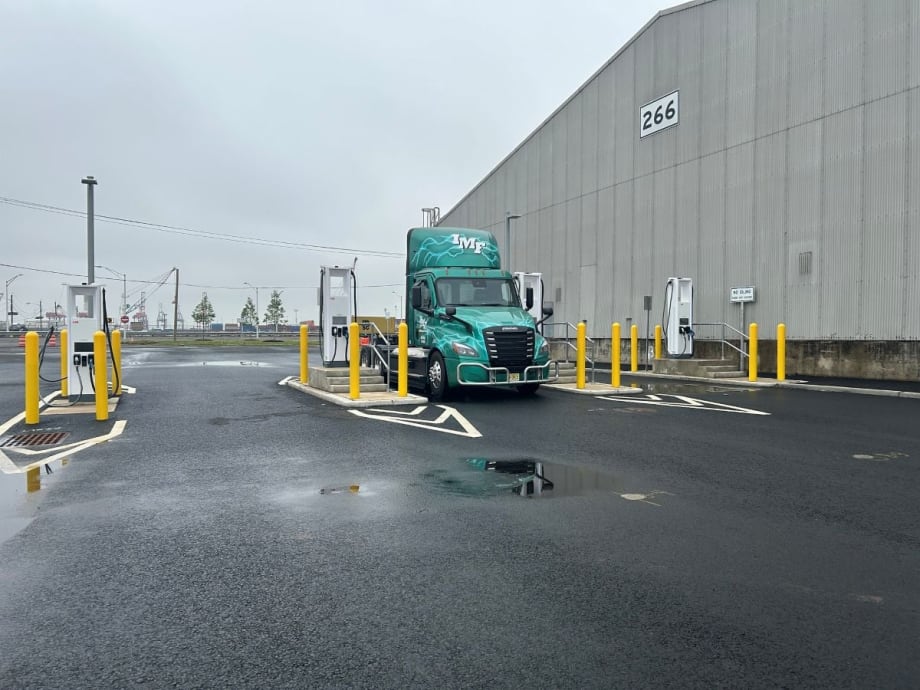
A new electric truck charging station at Port Newark is a key step in advancing zero-emission drayage trucking operations.
Photo: Port Authority of New York and New Jersey
The Port Authority of New York and New Jersey announced the opening of a new electric truck charging station at Port Newark. The new charging station is a key step in advancing zero-emission drayage trucking operations, the Port Authority said.
Designed to encourage more drivers to switch to electric trucks, the charging station supports cleaner, more sustainable freight movement while advancing the Port Authority’s ambitious environmental goals.
Opportunity Charging
The four direct current fast chargers are located at Port Newark’s truck welcome center at Marlin and Kellogg streets.
Drivers are able to give their trucks an opportunity to charge at the station, topping off their vehicles before returning to their primary charging location.
The new chargers complement a multitude of other sustainability initiatives at the seaport. The Port Authority has made it a priority to enable and entice all links in the supply chain, including ocean carriers, container terminals, and trucking companies to incorporate greener operations.
“What gets taken off these ships and loaded onto these trucks is ultimately what ends up in our closets, in our refrigerators, and in our garages,” said Port Authority chairman Kevin O’Toole. “It’s our duty to make sure every element of the critical work at the Port of New York and New Jersey is operating as efficiently and sustainably as possible. These chargers are an important piece of that puzzle as we usher in a more sustainable future for the thousands of trucks serving the East Coast’s busiest port every day.”
“Our promise to reach net-zero carbon emissions by 2050 reaches beyond the Port Authority itself to our operational partners,” said Port Authority Executive director Rick Cotton. “We want to add charging infrastructure wherever possible, from the East Coast’s busiest port to our airports and at Port Authority facilities across the region to help every facet of our transportation ecosystem become more environmentally friendly.”
“We enjoy an unparalleled level of cooperation and collaboration among the many entities that operate at the Port of New York and New Jersey, and the installation of this charging station strengthens that reputation further,” said Bethann Rooney, port director at the Port Authority of New York and New Jersey. “With these new chargers, we’re promising drayage operators that if they invest in electric trucks, we can help get them where they need to go.”
Fast-Charging to Extend EV Truck Range
The charging station features four 350-kilowatt direct current (DC) fast chargers. They offer compatibility with most widely available commercial electric truck models.
Drayage truck operations typically involve trucks moving shipping containers short distances, such as from a container terminal to an area warehouse. A 10–15-minute opportunity charge could offer an additional 20-40 miles of range, depending on the load and driving conditions, allowing truckers to minimize downtime and complete more trips during the workday.
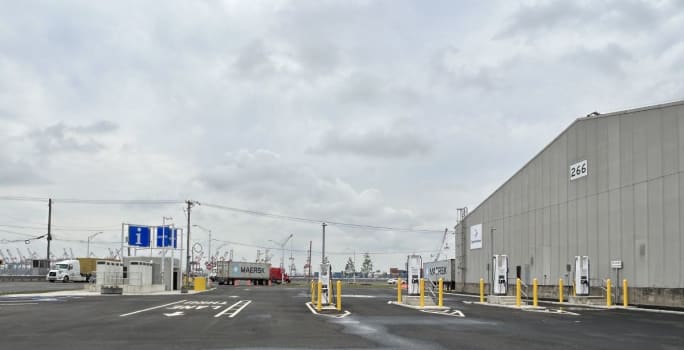
The new charging station allows operators to top off truck batteries quickly before returning to their primary charging location.
Photo: Port Authority of New York and New Jersey
As of the seaport’s latest air emissions inventory, drayage truck operations represent approximately 48 percent of port-wide greenhouse gas emissions, by far the largest share.
Convenient access to charging infrastructure within the Port Newark complex of the East Coast’s largest and busiest seaport may further entice drivers to switch to electric trucks as they become more widely available, the Port Authority said.
The installation involved extensive site preparation and infrastructure work. This included overhauling the underground electrical system in the area in partnership with PSE&G. The charging platform was also elevated to mitigate flood risk.
Additionally, nearby restrooms for truck drivers at Building 272 were recently renovated with refreshed paint, tiles and fixtures, as well as energy-efficient LED lighting.
Driver Amenities
The chargers will be available for use from 6 p.m. to 5 a.m. daily initially due to the ongoing Port Street Corridor Improvement Project, which is routing additional traffic through the area during the current phase of that project.
The station will be closed during peak hours to ensure smooth traffic flow entering and exiting the port complex.
Hours will be expanded to around-the-clock availability in late 2025. Charging cost is $0.45/kilowatt per hour plus tax. A $1 per minute idling fee may be enacted based on site utilization.
More Fuel Smarts

How Volvo Updated Its D13 for EPA 2027 [Watch]
Volvo’s updated D13 promises lower emissions without sacrificing performance or fuel economy. Take a closer look at what changed inside the engine in this HDT Spotlight video.
Read More →
Diesel Price Spike Shortens Payback for Natural Gas Trucks, Report Says
Energy Vision estimates fleets could recover the higher purchase price of an RNG-fueled Class 8 tractor in 1.3 to 2.8 years under current fuel-price scenarios.
Read More →
Calstart Becomes Catalyst Mobility, Reflecting Broader Focus
Calstart is now Catalyst Mobility, reflecting the nonprofit’s growing national role in clean transportation, including zero-emission trucks, infrastructure and incentive programs.
Read More →

Record Diesel Prices Squeeze Trucking Fleets
Average U.S. diesel prices have climbed to nearly $6 a gallon, surpassing the 2022 record as tight refinery capacity and Middle East disruptions keep fuel costs elevated.
Read More →
How Fuel Delivery Shapes Engine Performance
Fuel delivery depends on more than what happens at the injector. For fleet, maintenance and technical professionals, looking at the full path from pump to injector can provide useful context for understanding engine performance.
Read More →
East Coast Port Launches $45M Electric Truck Push
The Port Authority of New York and New Jersey announced millions in incentives for zero-emission drayage trucks, yard tractors, and new charging hubs near the port.
Read More →
California Bill Could Shed Light on Electric Truck Prices
Why do battery-electric Class 8 trucks remain so expensive? A California bill headed to Gov. Gavin Newsom would give fleets and state agencies more visibility into what manufacturers charge.
Read More →
Detroit Opens Orders for EPA 2027 Engines
Detroit isn’t starting from scratch to meet EPA 2027 diesel emissions standards. Its Gen 6 DD13 and DD15 engines keep much of today’s platform while updating the fuel and aftertreatment systems.
Read More →
Zero-Emission Truck Corridor Planned for West Coast
California, Oregon, Washington, British Columbia and Baja California are coordinating plans for truck charging and hydrogen fueling from Canada to Mexico.
Read More →
A Closer Look at Kenworth’s Electric T880E Vocational Truck [Video]
Learn more about Kenworth's T880E battery-electric vocational truck at the Paccar Technical Center, including its range, applications, upfitting considerations, and PTO options, in this HDT Spotlight video.
Read More →