





Related: Truck Platoons on the Horizon?
Truck Platooning Pilot in Germany Deemed Runaway Success
A platooning project conducted in Germany has demonstrated that the electronically linked system is “safe, technically reliable, and easily applicable in the routine of a logistics company,” according to the project's partners.
May 10, 2019
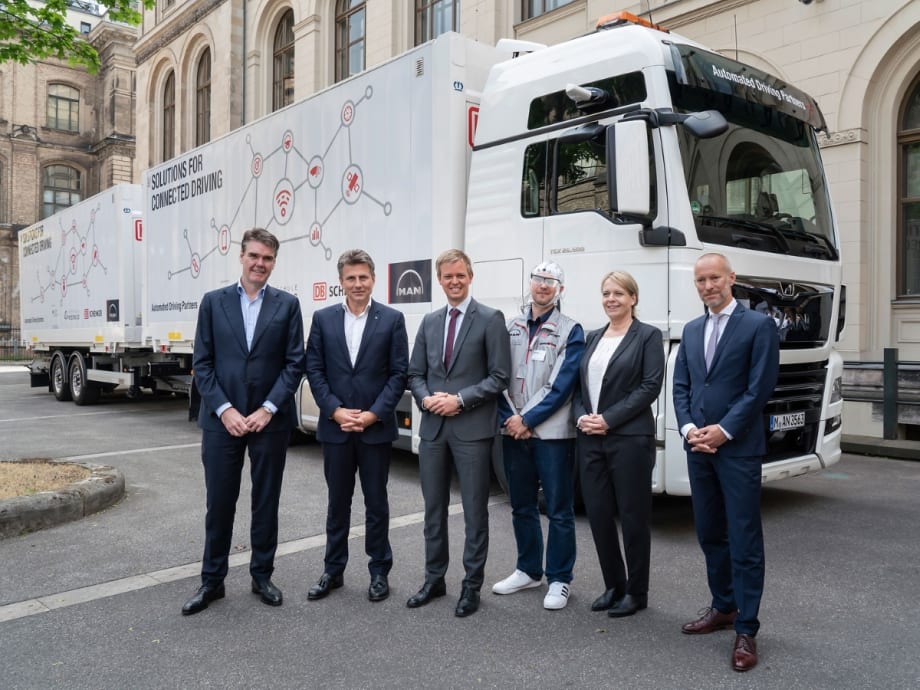
The partners in a pilot project that ran electronically connected trucks in Germany for seven months report that truck platoons could ensure more efficient use of space on highways to lessen congestion and increase safety.
Credit:
MAN Truck & Bus
3 min to read
A platooning project conducted in Germany jointly by global logistics supplier DB Schenker, MAN Truck & Bus, and Fresenius University of Applied Sciences has demonstrated that the electronically linked system is “safe, technically reliable, and easily applicable in the routine of a logistics company,” according to the three pilot partners.
As part of a research project sponsored by Germany’s Federal Ministry of Transport and Digital Infrastructure (BMVI), commercially licensed drivers drove two electronically linked vehicles on Autobahn 9 between DB Schenker’s Nuremberg and Munich branches over the course of seven months. BMVI provided funding of some 1.86 million euros to the project.
After running some 35,000 test kilometers (21,748 miles), the truck drivers-- who drove the European double-trailer rigs separated by distances of only 15 to 21 meters (16.5 to 23 yards)— “praised the driving comfort and the general sense of safety.”
The project found that the platooning system installed in the MAN trucks“operated smoothly” 98% of the time with active interventions by drivers needed only once every 2,000 kilometers, which was described as being “much less than expected.” The field test also demonstrated a 3% to 4% reduction in fuel consumption.
"We were able to show that platooning has the potential to contribute to the reduction of fuel consumption and CO2 emissions,” said Joachim Drees, chairman of the Management Board of MAN Truck & Bus. “We are pleased that the system works reliably and can increase safety on the motorway. Accordingly, platooning is an important step for us on the way to automation."
According to DB Schenker, the research indicates platooning can be used extensively in its logistics network. "We have analyzed our European transport network and it is safe to say that around 40% of the kilometers traveled could be carried out in platoons,” said Alexander Doll, member of the Management Board for Finance, Freight Transport and Logistics at Deutsche Bahn, parent firm of DB Schenker.
Clear Benefit
However, Doll added, for platooning to become that widespread, “further tests and ensuring the regulatory framework [allows it] would be necessary.” But the benefit would be clear: "With platooning, we can offer even more reliable transports."
It would seem no stone was left unturned: Scientists from the Fresenius University of Applied Sciences investigated the psychosocial and neurophysiological effects on the drivers. Experiencing platooning first-hand in the real world changed the previously skeptical attitude of the drivers.
"A general sense of safety and trust in the technology is echoed in the drivers' assessment of specific driving situations,” said Professor Sabine Hammer of the Institute for the Science of Complex Systems. “None of these were described as uncontrollable.”
The researchers regarded other motorists cutting in from adjacent lanes or cutting across multiple lanes as "disagreeable," but not critically so. "Due to the fast response times of the system, drivers would now prefer a distance of 10 to 15 meters [11 to 23 yards]," noted Hammer.
"The EEG measurements show no systematic differences between platoon runs and normal runs when it comes to the neurophysiological stress placed on drivers, i.e. in terms of concentration or fatigue," said Professor Christian Haas, director of IKS. For international use, the scientists recommend further research with longer periods in platooning mode.
The project partners said in a news release that they are “convinced that the potential of truck platooning can be further increased by future developments. In addition, new digital business models in logistics are conceivable.”
More Fuel Smarts

How Volvo Updated Its D13 for EPA 2027 [Watch]
Volvo’s updated D13 promises lower emissions without sacrificing performance or fuel economy. Take a closer look at what changed inside the engine in this HDT Spotlight video.
Read More →
Diesel Price Spike Shortens Payback for Natural Gas Trucks, Report Says
Energy Vision estimates fleets could recover the higher purchase price of an RNG-fueled Class 8 tractor in 1.3 to 2.8 years under current fuel-price scenarios.
Read More →
Calstart Becomes Catalyst Mobility, Reflecting Broader Focus
Calstart is now Catalyst Mobility, reflecting the nonprofit’s growing national role in clean transportation, including zero-emission trucks, infrastructure and incentive programs.
Read More →

Record Diesel Prices Squeeze Trucking Fleets
Average U.S. diesel prices have climbed to nearly $6 a gallon, surpassing the 2022 record as tight refinery capacity and Middle East disruptions keep fuel costs elevated.
Read More →
Sponsored•September 9, 2026
How Fuel Delivery Shapes Engine Performance
Fuel delivery depends on more than what happens at the injector. For fleet, maintenance and technical professionals, looking at the full path from pump to injector can provide useful context for understanding engine performance.
Read More →
East Coast Port Launches $45M Electric Truck Push
The Port Authority of New York and New Jersey announced millions in incentives for zero-emission drayage trucks, yard tractors, and new charging hubs near the port.
Read More →
California Bill Could Shed Light on Electric Truck Prices
Why do battery-electric Class 8 trucks remain so expensive? A California bill headed to Gov. Gavin Newsom would give fleets and state agencies more visibility into what manufacturers charge.
Read More →
Detroit Opens Orders for EPA 2027 Engines
Detroit isn’t starting from scratch to meet EPA 2027 diesel emissions standards. Its Gen 6 DD13 and DD15 engines keep much of today’s platform while updating the fuel and aftertreatment systems.
Read More →
Zero-Emission Truck Corridor Planned for West Coast
California, Oregon, Washington, British Columbia and Baja California are coordinating plans for truck charging and hydrogen fueling from Canada to Mexico.
Read More →
A Closer Look at Kenworth’s Electric T880E Vocational Truck [Video]
Learn more about Kenworth's T880E battery-electric vocational truck at the Paccar Technical Center, including its range, applications, upfitting considerations, and PTO options, in this HDT Spotlight video.
Read More →