





The Road to Zero Emissions is Paved with More Than Batteries [Commentary]
Peterbilt Displays Hydrogen Combustion Engine Demonstrator
Peterbilt displayed a Euro-style high cabover truck, a demonstrator model powered by a prototype hydrogen-fueled internal combustion engine, at the American Trucking Associations annual management conference.
October 24, 2023
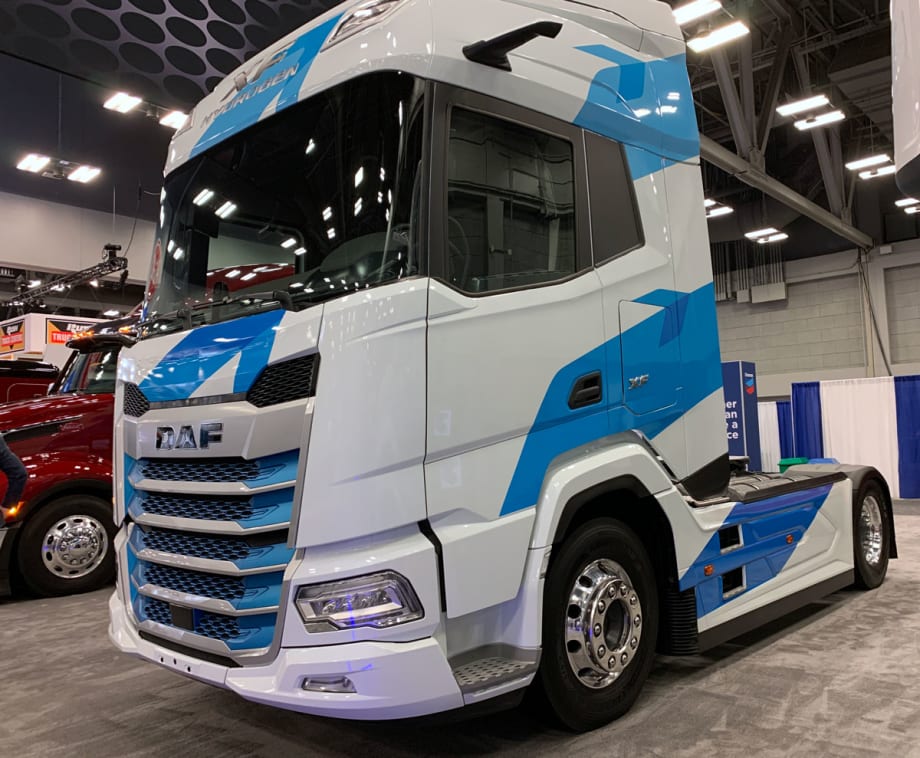
The DAF XF H2 demonstrator was equipped with a modified version of the Paccar MX-13 engine, with a Traxon 12-speed transmission.
Photo: Deborah Lockridge
3 min to read
Peterbilt displayed a Euro-style high cabover truck, a demonstrator model powered by a prototype hydrogen-fueled internal combustion engine, at the recent American Trucking Associations annual management conference in Austin, Texas.
There it was on the convention floor, parked between a red Peterbilt Model 579 UltraLoft with Epiq Max aero package and a white-and-blue Model 579EV, a DAF XF from Paccar’s European subsidiary, DAF Trucks.
The DAF XF was equipped with a modified version of the Paccar MX-13 engine, producing 295 hp and 1,250 lb.-ft.
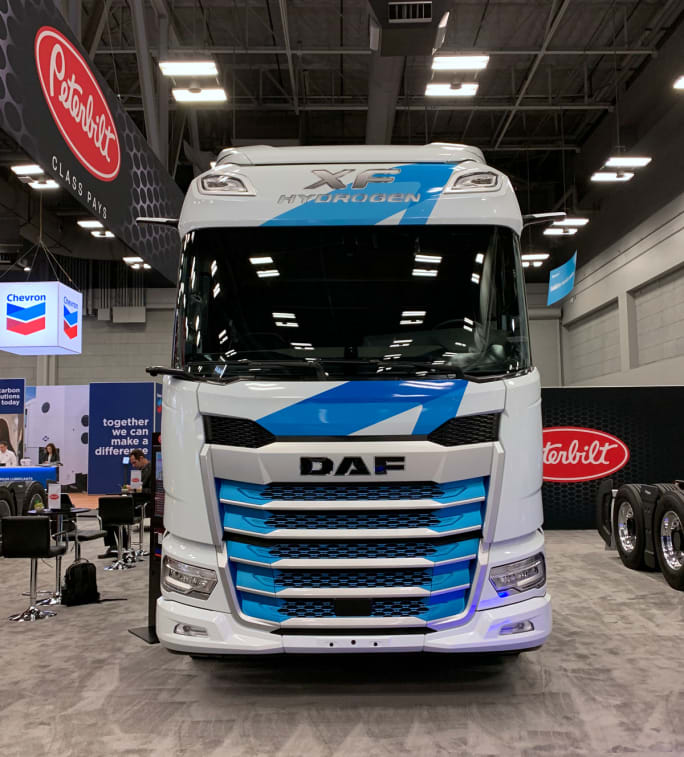
The demonstrator truck also had the DAF Digital Vision System that uses cameras instead of mirrors.
Photo: Deborah Lockridge
A hydrogen-powered engine requires spark ignition, which means it’s not entirely zero emissions — there is a small amount of NOx produced.
There are some questions as to whether that NOx will preclude hydrogen combustion engines from being classified as zero emissions. White said the U.S. Environmental Protection Agency currently recognizes it as zero emissions, but the California Air Resources Board is another story.
Modifications had to be made to the pistons and heads, as well as the fuel system, explained Jacob White, director of product marketing. There’s a different compression ratio, with a lower amount of pressure than that of a diesel.
The four 90-liter hydrogen tanks look similar to CNG tanks, but the hydrogen is under slightly higher pressure.
Pros and Cons of Hydrogen Combustion Engines
Using hydrogen to power a combustion engine rather than using it for a fuel-cell-electric truck would have several advantages, White said:
Lower acquisition cost because the truck is less complicated than an FCEV.
The fuel cost would likely be lower, because an internal combustion engine can run on a less-pure version of hydrogen than a fuel-cell-electric powertrain that has to run the H2 through an electrolyzer to turn it into energy.
Extending range is a matter of adding fuel tanks
The operation is similar to compressed natural gas trucks, which is more familiar to fleets.
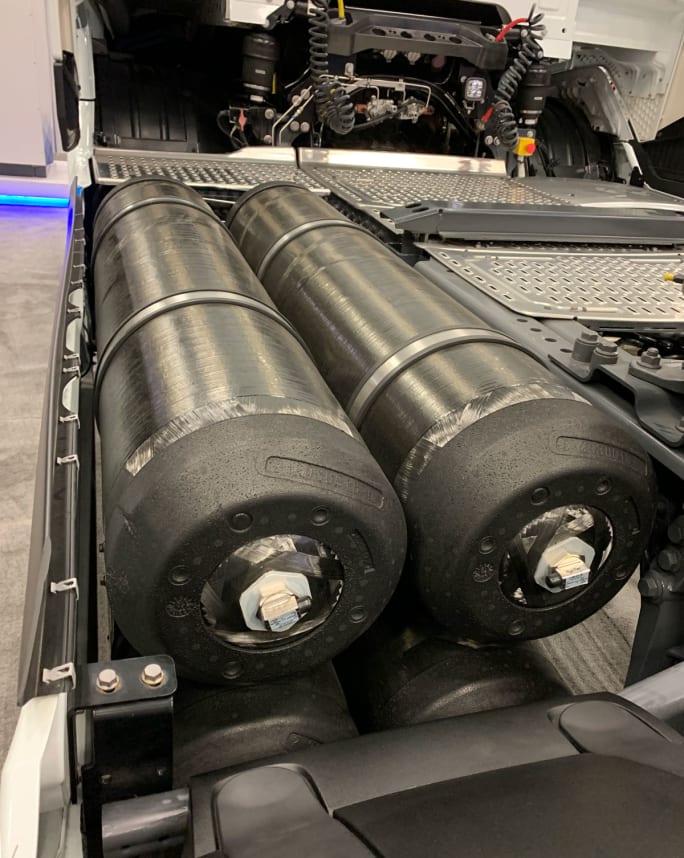
The four 90-liter hydrogen tanks look similar to CNG tanks, but the hydrogen is under slightly higher pressure.
Photo: Deborah Lockridge
Asked about drawbacks, White said, the energy density of hydrogen is lower than that of diesel. That means it needs more fuel to go the same distance as a diesel-powered truck.
The most obvious negative, of course, is a lack of hydrogen fueling infrastructure. Right now, Europe is ahead of the U.S. in developing the hydrogen infrastructure for H2 ICE or FCEV trucks, WhIte said.
“It will take time and investment,” he said.
Demonstrating What's Possible
It was the first U.S. outing for the truck, which nearly two years ago received the 2022 Truck Innovation Award from the International Truck of the Year program.
“The real purpose of this is to show it’s possible,” White said. “There’s a lot of conversation around EVs, FCEVs, but we need longer range.”
There’s still a lot of work to do before a production version, he added, but “it’s definitely on the product road map.”
More Fuel Smarts

New California Law Could Shed Light on Electric Truck Prices
Why do battery-electric Class 8 trucks remain so expensive? A California bill signed by Gov. Gavin Newsom would give fleets and state agencies more visibility into what manufacturers charge.
Read More →
How Volvo Updated Its D13 for EPA 2027 [Watch]
Volvo’s updated D13 promises lower emissions without sacrificing performance or fuel economy. Take a closer look at what changed inside the engine in this HDT Spotlight video.
Read More →
Diesel Price Spike Shortens Payback for Natural Gas Trucks, Report Says
Energy Vision estimates fleets could recover the higher purchase price of an RNG-fueled Class 8 tractor in 1.3 to 2.8 years under current fuel-price scenarios.
Read More →

Calstart Becomes Catalyst Mobility, Reflecting Broader Focus
Calstart is now Catalyst Mobility, reflecting the nonprofit’s growing national role in clean transportation, including zero-emission trucks, infrastructure and incentive programs.
Read More →
Record Diesel Prices Squeeze Trucking Fleets
Average U.S. diesel prices have climbed to nearly $6 a gallon, surpassing the 2022 record as tight refinery capacity and Middle East disruptions keep fuel costs elevated.
Read More →
Sponsored•September 9, 2026
How Fuel Delivery Shapes Engine Performance
Fuel delivery depends on more than what happens at the injector. For fleet, maintenance and technical professionals, looking at the full path from pump to injector can provide useful context for understanding engine performance.
Read More →
East Coast Port Launches $45M Electric Truck Push
The Port Authority of New York and New Jersey announced millions in incentives for zero-emission drayage trucks, yard tractors, and new charging hubs near the port.
Read More →
Detroit Opens Orders for EPA 2027 Engines
Detroit isn’t starting from scratch to meet EPA 2027 diesel emissions standards. Its Gen 6 DD13 and DD15 engines keep much of today’s platform while updating the fuel and aftertreatment systems.
Read More →
Zero-Emission Truck Corridor Planned for West Coast
California, Oregon, Washington, British Columbia and Baja California are coordinating plans for truck charging and hydrogen fueling from Canada to Mexico.
Read More →
A Closer Look at Kenworth’s Electric T880E Vocational Truck [Video]
Learn more about Kenworth's T880E battery-electric vocational truck at the Paccar Technical Center, including its range, applications, upfitting considerations, and PTO options, in this HDT Spotlight video.
Read More →