




More Tesla Semis Delivered to Pepsico
PepsiCo has added more electric Class 8 Tesla Semis at two of its California facilities.

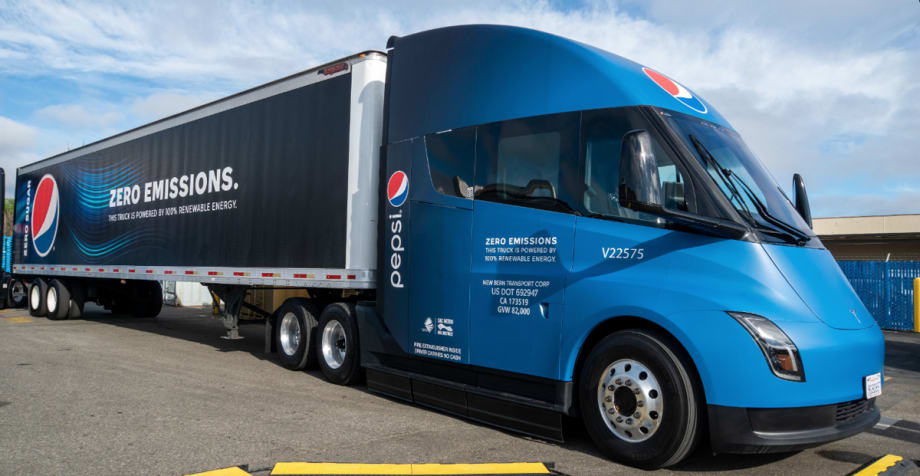
Eighteen of the 21 trucks delivered to PepsiCo were funded in part by $4.5 million in grants from Sacramento Metropolitan Air Quality Management District.
Photo: CARB Twitter
PepsiCo received delivery of 21 electric Class 8 Tesla Semis at its bottling facility in Sacramento, California. The EVs will roll out on local delivery routes. With another 15 now at its Modesto Frito-Lay facility, that brings the total to 36, according to published reports.
Eighteen of the 21 trucks at Sacramento, as well as charging infrastructure built at the PepsiCo facility, were funded in part by $4.5 million in grants from Sacramento Metropolitan Air Quality Management District, the Sacramento Bee reported.
.@PepsiCo is rolling out 18 #zeroemission@Tesla semi-trucks in South Sacramento thanks to an @AQMD grant made possible in part by CARB’s #AB617 Community Air Protection program, a @CAClimateInvest program prioritizing communities with greater #airpollution.#capandtradepic.twitter.com/rSCGt1SyNq
— CARB (@AirResources) April 11, 2023
According to reports from media that attended the delivery announcement event, Pepsi officials said a single Tesla Semi can drive 400 miles on a one-hour charge.
The District is proud to help fund the @Tesla semis & chargers unveiled today at @PepsiCo’s South Sac facility. This project will help transition #Sacramento to a green economy & improve #airquality for our most vulnerable residents! @CaClimateInvest@AlbertoAyalaPhD@EricZGuerrapic.twitter.com/AfYMBt5ncH
— Sac Metro Air District (@AQMD) April 11, 2023
PepsiCo was the first to receive the Tesla Semi at the end of 2022, five years after the introduction of the truck.
Frito-Lay Completes Third-Party EV Shipment
Meanwhile, PepsiCo’s Frito-Lay North America completed its first-ever third-party shipment on an electric vehicle with Schneider National.
Initial shipments on Schneider's growing Freightliner eCascadia fleet will be intermodal inbound and outbound dray moves in southern California, including service to Frito-Lay's Rancho Cucamonga distribution center.
This is the first third-party transportation shipment on an electric vehicle for PepsiCo globally and establishes Frito-Lay as the first to contract transport on Schneider's electric truck fleet of Freightliner eCascadias.

Frito-Lay North America completed its first-ever third-party shipment on an electric vehicle with Schneider National.
Photo: Frito-Lay
An emissions reduction of more than 70% is expected this year from the initial EV routes, versus the same shipments on diesel trucks, company officials said in a press release.
"As we roll out our fleet of almost 100 new battery electric trucks, we're thrilled to offer a cleaner mode of freight transportation to valued customers like Frito-Lay, who share our goal of operating in ways that are environmentally responsible," said Rob Reich, executive vice president and chief administrative officer at Schneider.
More Equipment

How Volvo Updated Its D13 for EPA 2027 [Watch]
Volvo’s updated D13 promises lower emissions without sacrificing performance or fuel economy. Take a closer look at what changed inside the engine in this HDT Spotlight video.
Read More →
Michelin Tire Improves Efficiency and Durability for Regional Fleets
The Michelin X Multi Energy D2 is a regional haul drive tire engineered to help fleets improve fuel efficiency, durability and traction in demanding stop-and-go operations.
Read More →
ZF Expands Commercial Vehicle Push in North America
ZF is expanding its North American commercial-vehicle presence with new transmission applications, electrification, trailer technology and autonomous-driving systems.
Read More →
Tesla Wants a Self-Driving Semi. Are Cameras Enough?
Could Tesla’s camera-only autonomous driving technology work on an 80,000-pound Semi? In this commentary, HDT's Deborah Lockridge takes a look at Tesla, Cybercab, and how autonomous trucks see the road.
Read More →
Kodiak: Driverless Long-Haul Truck Launch on Track for 2026
Kodiak AI says its driverless long-haul safety case is 93% complete and it remains on track to begin commercial operations by year-end 2026.
Read More →
What DOT’s Automated Vehicle Strategy Means for Trucking
The U.S. Department of Transportation issued a new automated-vehicle strategy that outlines plans for driverless-truck regulations, cross-state freight corridors, and federal safety standards.
Read More →
East Coast Port Launches $45M Electric Truck Push
The Port Authority of New York and New Jersey announced millions in incentives for zero-emission drayage trucks, yard tractors, and new charging hubs near the port.
Read More →
PlusAI Going Public to Fund Autonomous Truck Launch
A SPAC deal could provide PlusAI with up to $300 million as it works toward a 2027 commercial launch of factory-built autonomous trucks.
Read More →
NHTSA Moves to Rewrite Truck Fuel-Economy Rules
The National Highway Traffic Safety Administration says it lacks authority to regulate medium- and heavy-duty truck engines separately from complete vehicles, but the existing standards have not yet been eliminated.
Read More →
Detroit Opens Orders for EPA 2027 Engines
Detroit isn’t starting from scratch to meet EPA 2027 diesel emissions standards. Its Gen 6 DD13 and DD15 engines keep much of today’s platform while updating the fuel and aftertreatment systems.
Read More →