




PeopleNet Debuts Next Generation of Video Side Mirrors
PeopleNet launched its next-generation MirrorCam, a hood-mounted spot mirror with a built-in camera that gives drivers additional perspective into a truck’s blind spots.

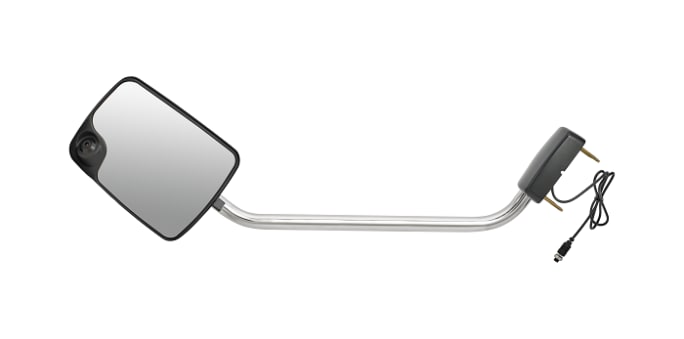
PeopleNet's MirrorCam is a hood-mounted spot mirror with a built in camera that provides more perspective of a vehicle's blind spots for drivers and fleet personnel. Photo: PeopleNet
PeopleNet launched its next-generation MirrorCam, a hood-mounted spot mirror with a built-in camera that gives drivers additional perspective into a truck’s blind spots.
The MirrorCam provides a 75-degree field of view of passing lanes and blind spots for drivers when connected to a PeopleNet display. Video captured by the MirrorCam can also be viewed by a fleet’s back office, giving visibility into onboard event recording-triggered events and providing additional context in the event of an accident.
The MirrorCam is part of PeopleNet’s Video Intelligence solution, which uses forward, side and rear-facing cameras usable to create a 360-degree view around the cab and trailer of the truck. In addition to its wide field of view, MirrorCam has an aerodynamic design that shields the camera from direct sunlight or vehicle headlights and reduces dirt or contaminant deposits on the mirror glass.
“The debut of the second generation MirrorCam represents the continued evolution of our vision to improve fleet safety with the Video Intelligence platform,” said Jim Angel, Vice President, Video Intelligence Solutions for PeopleNet. “We are continually looking for ways to improve and enhance our technology to give customers the tools they need to protect themselves in the event of an accident and potentially avoid one in the first place.”
Related: How to Make Data Work for You
More Safety & Compliance

FMCSA Pauses Biennial-Update Enforcement Amid Motus Transition
Carriers whose updates were due on or after June 1 have more time, while FMCSA works to stabilize its new registration system and warns of phishing sites impersonating its new carrier registration system, Motus.
Read More →
ZF Expands Commercial Vehicle Push in North America
ZF is expanding its North American commercial-vehicle presence with new transmission applications, electrification, trailer technology and autonomous-driving systems.
Read More →
Truck Drivers Need More Than Another Alert
Fleets have more visibility into truck health, safety events, and driver activity than ever. The next challenge is turning all that information into useful guidance for the person who has to decide what to do next.
Read More →
Tesla Wants a Self-Driving Semi. Are Cameras Enough?
Could Tesla’s camera-only autonomous driving technology work on an 80,000-pound Semi? In this commentary, HDT's Deborah Lockridge takes a look at Tesla, Cybercab, and how autonomous trucks see the road.
Read More →
What DOT’s Automated Vehicle Strategy Means for Trucking
The U.S. Department of Transportation issued a new automated-vehicle strategy that outlines plans for driverless-truck regulations, cross-state freight corridors, and federal safety standards.
Read More →
NYC Expands Speed, Pedestrian Safety Tech Across Fleet
New York City is expanding intelligent speed assistance and pedestrian-alert systems across its municipal fleet, moving the technologies from pilot programs into vehicle procurement and retrofit requirements.
Read More →
FMCSA Removes 110 Truck Driver Training Schools from Certified ELDT List
Federal regulators also are targeting more than 160 additional training providers and launching a nationwide audit of third-party CDL skills testers as part of a broader crackdown on trucking fraud.
Read More →
Beyond DOT Compliance: What Makes a Trucking Fleet Truly Safe?
A trucking fleet can follow every rule and still make unsafe decisions. The real test comes when safety conflicts with freight, productivity, or cost.
Read More →
Hours of Service Pilot Programs: FMCSA Readies for 2027 Rollout
Two pilot programs could eventually reshape hours-of-service rules, giving truck drivers options to pause their 14-hour clock or use longer split sleeper rest periods.
Read More →
New Guide Offers Pet Safety Tips for Truck Drivers
Hundreds of thousands of pets travel in truck cabs. A new safety guide from Volvo Trucks and the Center for Pet Safety offers practical advice for truck drivers who bring dogs and cats along for the ride.
Read More →