




Paccar, Volvo and Daimler Report Strong Earnings
Most of the nation’s heavy truck makers reported third quarter earnings this week, showing health profits, despite some showing a slip in sales compared to the same time a year ago.

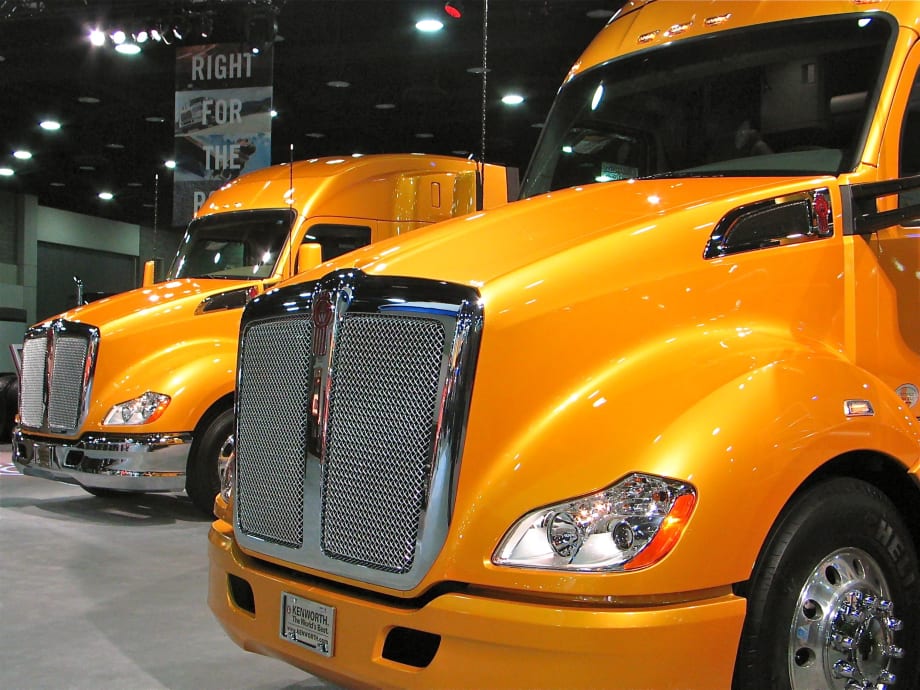
Kenworth trucks on display during this year's Mid-America Trucking Show. Photo: Evan Lockridge
Most of the nation’s heavy truck makers reported third quarter earnings this week, showing health profits, despite some showing a slip in sales compared to the same time a year ago.
Daimler
In the third quarter, Germany-based Daimler says it once again achieved significantly higher earnings than in the prior-year period. Net profit reached nearly 1.9 billion Euros/$2.6 billion compared to more than 1.2 billion Euros/$1.65 billion.
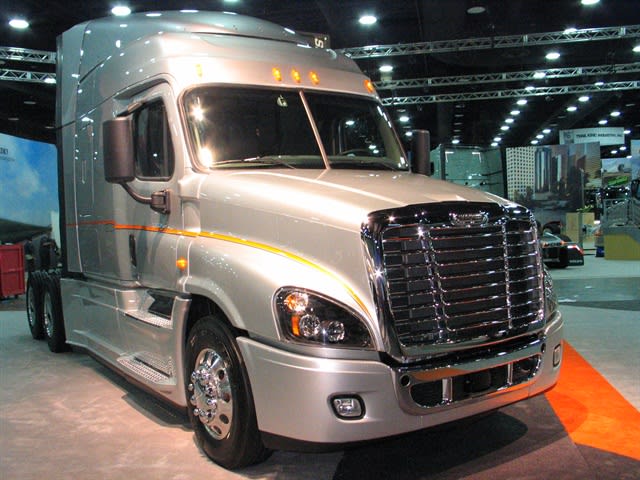
Freightliner's Cascadia Evolution on display during this year's Mid-America Trucking Show. Photo: Evan Lockridge
“Our earnings continued improving in the third quarter, compared with the year to date and compared with the prior-year period," said Dieter Zetsche, chairman of the board of management of Daimler AG. "This shows that the high investments we have made were money well spent. We will continue to invest in products and production sites in order to secure the group’s sustainable medium and long-term success."
Daimler Trucks’ third-quarter unit sales were 4% above the prior-year level at 124,500 vehicles. Revenue reached 8 billion Euros/$11.04 billon, a 1% drop from a year ago. Exchange-rate movements, in particular the depreciation of the Japanese yen, had a significant negative impact on the division’s revenue. Adjusted for exchange-rate effects, revenue increased by 8%, according to the company.
Daimler Trucks reported a third quarter profit of 522 million Euros/$721 million, a 4.2% increase over the same time a year earlier.
“Due to political uncertainty in the United States, no significant upward trend is likely for North America in the remaining months of the year,” the company said. “Daimler therefore continues to anticipate market contraction of up to 5% for the full year compared with 2012."
Daimler is the parent to Daimler Trucks North America, which produces equipment under the Freightliner, Western Star and Detroit brands.
More information is on the Daimler website.
Paccar
The parent to Peterbilt and Kenworth, Paccar, based in Washington state, earned $309.4 million for the third quarter of 2013, an increase of 32% compared to the $233.6 million earned in the third quarter last year.
Third quarter net sales and financial services revenues were $4.30 billion compared to $3.82 billion in 2012, a 13% increase.
For the first nine months of 2013, Paccar reported net income of $837.1 million, compared to the $858.1 million earned in the first nine months of 2012.
Net sales and financial services revenues for the first nine months of 2013 were $12.52 billion compared to $13.05 billion last year.
“Class 8 industry retail sales in the U.S. and Canada are expected to be in the range of 205,000-215,000 vehicles in 2013,” said Dan Sobic, Paccar executive vice president. “Truck demand is being driven primarily by the ongoing replacement of the aging truck population and an improving housing sector.
"Estimates for U.S. and Canada truck industry Class 8 retail sales in 2014 are in the range of 210,000-240,000 units, driven by ongoing fleet replacement and some expansion of industry fleet capacity reflecting modest overall economic growth.”
More details, including a playback of the company’s third quarter earnings webcast, are available on the Paccar website.
Volvo
The Volvo Group, the Sweden-based parent of Volvo and Mack Trucks along with other trucking and non-trucking brands, saw its net sales decrease by 5% from a year ago in the third quarter, to 64.9 billion kronor/$10.4 billion.
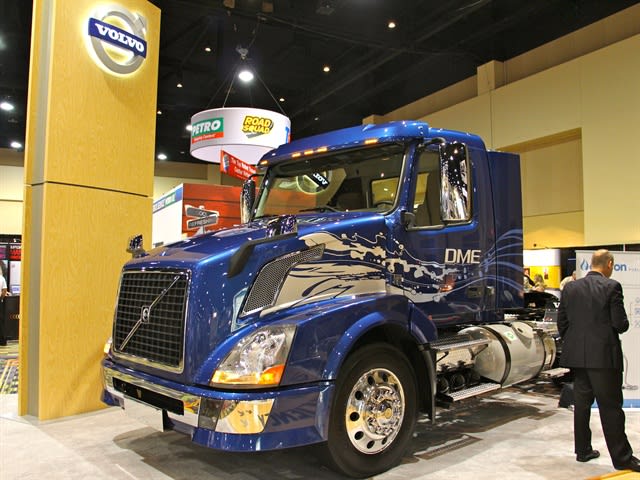
Volvo's DME-powered truck on display at the ATA Management Conference & Exhibition earlier this month. Photo: Evan Lockridge
Earnings before interest and taxes fell 18% to 2.4 billion kronor/$380 million from a year earlier. Third-quarter net income fell 0.9% to 1.39 billion kronor/$219 million.
Sales fell 4.9% with a 1% drop in truck-division revenue, contrasted with a 4.1% increase in deliveries to 43,248 vehicles. Orders amounted to 44,224 trucks.
As part of the previously announced company-wide efficiency program, a decision was announced to cut approximately 2,000 employees and consultants, saving 4 billion kronor/$630 million by 2015.
“The Volvo Group’s third quarter was characterized by the ongoing comprehensive product renewal in the group’s truck program and the fact that we entered a new phase of the Group’s development focused on taking actions to streamline and enhance the efficiency of our operations," said Olof Persson, president and CEO. "The product renewal is the largest in the history of the Volvo Group, and it means that we are going to enter 2014 with a highly competitive product range.”
More information is available on the Volvo Group website.
Navistar
Navistar International isn’t expected to report its latest earnings until December, when it reveals its fiscal fourth quarter numbers. It reported its fiscal third quarter earnings in September, showing a loss of $247 million.
More Equipment

How Volvo Updated Its D13 for EPA 2027 [Watch]
Volvo’s updated D13 promises lower emissions without sacrificing performance or fuel economy. Take a closer look at what changed inside the engine in this HDT Spotlight video.
Read More →
Michelin Tire Improves Efficiency and Durability for Regional Fleets
The Michelin X Multi Energy D2 is a regional haul drive tire engineered to help fleets improve fuel efficiency, durability and traction in demanding stop-and-go operations.
Read More →
ZF Expands Commercial Vehicle Push in North America
ZF is expanding its North American commercial-vehicle presence with new transmission applications, electrification, trailer technology and autonomous-driving systems.
Read More →
Tesla Wants a Self-Driving Semi. Are Cameras Enough?
Could Tesla’s camera-only autonomous driving technology work on an 80,000-pound Semi? In this commentary, HDT's Deborah Lockridge takes a look at Tesla, Cybercab, and how autonomous trucks see the road.
Read More →
Kodiak: Driverless Long-Haul Truck Launch on Track for 2026
Kodiak AI says its driverless long-haul safety case is 93% complete and it remains on track to begin commercial operations by year-end 2026.
Read More →
What DOT’s Automated Vehicle Strategy Means for Trucking
The U.S. Department of Transportation issued a new automated-vehicle strategy that outlines plans for driverless-truck regulations, cross-state freight corridors, and federal safety standards.
Read More →
East Coast Port Launches $45M Electric Truck Push
The Port Authority of New York and New Jersey announced millions in incentives for zero-emission drayage trucks, yard tractors, and new charging hubs near the port.
Read More →
PlusAI Going Public to Fund Autonomous Truck Launch
A SPAC deal could provide PlusAI with up to $300 million as it works toward a 2027 commercial launch of factory-built autonomous trucks.
Read More →
NHTSA Moves to Rewrite Truck Fuel-Economy Rules
The National Highway Traffic Safety Administration says it lacks authority to regulate medium- and heavy-duty truck engines separately from complete vehicles, but the existing standards have not yet been eliminated.
Read More →
Detroit Opens Orders for EPA 2027 Engines
Detroit isn’t starting from scratch to meet EPA 2027 diesel emissions standards. Its Gen 6 DD13 and DD15 engines keep much of today’s platform while updating the fuel and aftertreatment systems.
Read More →