




Out-of-Service Violation Rates Jump in CVSA Roadcheck
The rate of out-of-service violations for both vehicles and drivers increased in this year’s Commercial Vehicle Safety Alliance International Roadcheck, according to recently released results.
by Staff
August 22, 2017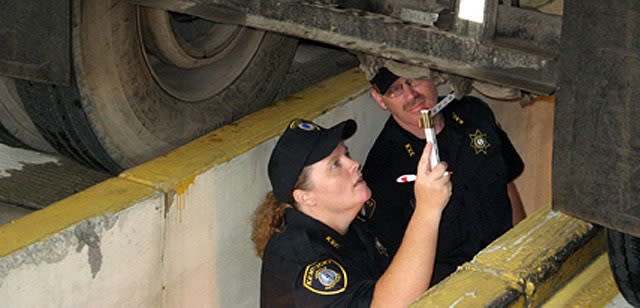
Photo via CVSA
2 min to read
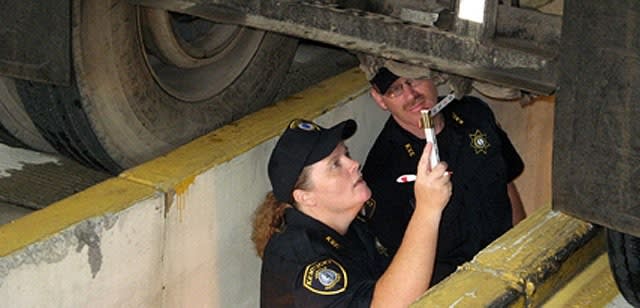
Photo via CVSA
The rate of out-of-service violations for both vehicles and drivers increased in this year’s Commercial Vehicle Safety Alliance International Roadcheck, according to recently released results.
During the 30th annual International Roadcheck, which took place June 6-8, 23% of vehicles and 4.2% of drivers that received Level I inspections were placed out of service.
This represents an upswing compared to last year’s Roadcheck, when only 21.5% of vehicles and 3.4% of drivers were placed out of service in Level I inspections.
(If an inspector identifies critical violations, he or she will render the driver or vehicle out of service, which means the driver cannot operate the vehicle until the critical vehicle mechanical conditions or defects, and/or driver qualifications, are corrected.)
In fairness, last year’s rates were the lowest that CVSA had seen since 1991 when it began tracking data on violations. However, this year's numbers were also significantly higher than in 2015, which were just a few ticks higher than in 2016.
In total, 62,013 Level I, II, and III inspections were conducted this year, slightly down from the 62,796 conducted in 2016. Level I inspections made up 40,944 of the total number of inspections. Because the number of inspections fluctuates year to year, comparing rates is a better metric for comparing years.
Brake system violations were once again the leading reason for vehicles being placed out of service at 26.9%, followed by cargo securement and tires/wheels at 15.7% and 15.1%, respectively.
Drivers were placed out of service most often for violations of hours of service, driving with the wrong class license, and false logbooks. There were 710 safety belt violations.
Each International Roadcheck has a specific focus, and this year’s emphasis was on cargo securement. Inspectors found 3,282 cargo securement violations. Improper load securement was the most common cargo securement violation, followed by failure to secure vehicle equipment, and leaking, spilling, blowing or falling cargo.
“This year, we’re celebrating 30 years of the International Roadcheck Program,” said Julius Debuschewitz, CVSA president, from Yukon Highways and Public Works. “When this program started in 1988, the goal of International Roadcheck was to conduct inspections to identify and remove unsafe commercial motor vehicles and/or drivers from our roadways. Thirty years and 1.5 million inspections later, the International Roadcheck enforcement initiative is still going strong, thanks to the more than 13,000 inspectors who work hard every day to reduce the number of crashes, injuries and fatalities on our roadways.”
More Drivers

Truck Drivers Need More Than Another Alert
Fleets have more visibility into truck health, safety events, and driver activity than ever. The next challenge is turning all that information into useful guidance for the person who has to decide what to do next.
Read More →
FMCSA Removes 110 Truck Driver Training Schools from Certified ELDT List
Federal regulators also are targeting more than 160 additional training providers and launching a nationwide audit of third-party CDL skills testers as part of a broader crackdown on trucking fraud.
Read More →
Hours of Service Pilot Programs: FMCSA Readies for 2027 Rollout
Two pilot programs could eventually reshape hours-of-service rules, giving truck drivers options to pause their 14-hour clock or use longer split sleeper rest periods.
Read More →
Medical Cards, English Proficiency Reshape Roadcheck Violations
Medical-card violations jumped to the top of the driver out-of-service list during CVSA’s 2026 International Roadcheck, while English-language proficiency violations appeared among the leading violations for the first time.
Read More →
Driver Trust Can Make or Break the Success of Fleet Safety Technology
New Teletrac Navman research suggests that onboarding, transparency about driver data, and positive feedback can play a significant role in how commercial drivers respond to safety and coaching technology.
Read More →
EEOC Sues KLLM Over Alleged Sex Discrimination in Driver Training
KLLM is facing a federal sex-discrimination lawsuit over policies the EEOC alleges put female truck driver trainees at a disadvantage.
Read More →
FMCSA Moves to Codify English Language Requirements for Commercial Drivers
By changing regulations on English-language proficiency requirements for commercial drivers, rather than relying on a guidance memo, the FMCSA said future administrations won't be able to walk back the Trump administration's stricter enforcement with just a memo.
Read More →
Drivers Put Western Star Trucks to the Test at Star Nation Experience
Watch to get an inside look at the Western Star trucks, technology, and community behind the Star Nation Experience 2026!
Read More →
Trump Administration Looks to Put More Veterans Behind the Wheel
The Freedom Haulers program pulls together existing and expanded programs at several federal agencies to recruit veterans to drive commercial heavy-duty trucks and cut the red tape for them to get a CDL, training, and employment.
Read More →
Putting Mack’s Command Steer to the Test
A test drive of Mack’s Command Steer active steering system evaluates how it can make truck driving easier and less tiring.
Read More →