




OOIDA Says Bridge Strike Law Unfair
The Owner-Operator Independent Drivers Association is speaking out against recent legislation proposed by New York Gov. David Paterson, aimed at cracking down on truck drivers who use a certain type of GPS to reduce the number of bridge strike
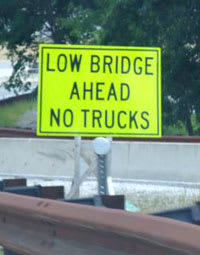
OOIDA questions whether GPS-using drivers ignore signs like these.
The Owner-Operator Independent Drivers Association is speaking out against recent legislation proposed by New York Gov. David Paterson, aimed at cracking down on truck drivers who use a certain type of GPS to reduce the number of bridge strikes
in the state. The OOIDA believes the law "unfairly punishes a greater majority of truckers, will do nothing to improve safety, and will ultimately hurt consumers," the association said.
According to an announcement by Paterson, the use of GPS systems by commercial truck drivers, which direct them to take state roads that are off limits or have low clearances, has caused a number of accidents. These accidents, called bridge strikes, involve trucks that run into overpasses, causing accidents and traffic delays.
The legislation, announced last Wednesday, would boost the penalties for truck drivers who illegally use parkways, and require trucks to use GPS devices with trucking-specific information to route them away from restricted roads. Under the rule, law enforcement officers would also have the authority to confiscate trucks that are stopped and ticketed at their discretion. In addition, the law would hold the trucking company or their insurance carrier responsible for the costs associated with the bridge strike.
"It's yet another case of New York using truckers as punching bags," said Mike Joyce, OOIDA legislative director. "The number of bridge strikes compared to the millions of truck miles traveled there doesn't add up to a need for all trucks to use any type of GPS just to avoid that type of incident."
"This heavy-handed scheme comes on the heels of recent tax, fee and proposed route restrictions for commercial vehicles. The governor is doing a great job of pushing New York to the top of the list of places where truckers least want to do business. Hopefully, that is not his goal - to drive the economic development out of New York."
OOIDA says Paterson's proposal fails to address why drivers chose to ignore clearly marked signs telling them which roads were restricted. Lou Esposito, a small-business truck driver from New York, says the bridges he has encountered there are not clearly marked.
"It's commonly known that they are marked wrong, and so there is confusion about the actual clearances," said Esposito. "However, I shouldn't have to go out and buy a device I do not need. I already know my way around, and if I have doubts about whether my truck will clear, I get out and look."
According to the association, a lack of driver training and allowing new drivers to rely too much on technology may be the real reason for bridge strikes. The group believes the state should review the safety of all bridges and their clearance heights, makes sure restricted routes are clearly marked, and educate drivers about the importance of reading road signs.
"Drivers are already being forced off a number of routes in New York which will mean more fuel will be used, which will ultimately mean more cost to consumers," Joyce said.
More Drivers

From One Generation to the Next: How Mentorship Builds Safer Truck Drivers
After three decades in trucking, Harold Perry shares what he's learned about driver safety, mentorship, and helping the next generation build confidence behind the wheel.
Read More →
Truck Drivers Need More Than Another Alert
Fleets have more visibility into truck health, safety events, and driver activity than ever. The next challenge is turning all that information into useful guidance for the person who has to decide what to do next.
Read More →
FMCSA Removes 110 Truck Driver Training Schools from Certified ELDT List
Federal regulators also are targeting more than 160 additional training providers and launching a nationwide audit of third-party CDL skills testers as part of a broader crackdown on trucking fraud.
Read More →
Hours of Service Pilot Programs: FMCSA Readies for 2027 Rollout
Two pilot programs could eventually reshape hours-of-service rules, giving truck drivers options to pause their 14-hour clock or use longer split sleeper rest periods.
Read More →
Medical Cards, English Proficiency Reshape Roadcheck Violations
Medical-card violations jumped to the top of the driver out-of-service list during CVSA’s 2026 International Roadcheck, while English-language proficiency violations appeared among the leading violations for the first time.
Read More →
Driver Trust Can Make or Break the Success of Fleet Safety Technology
New Teletrac Navman research suggests that onboarding, transparency about driver data, and positive feedback can play a significant role in how commercial drivers respond to safety and coaching technology.
Read More →
EEOC Sues KLLM Over Alleged Sex Discrimination in Driver Training
KLLM is facing a federal sex-discrimination lawsuit over policies the EEOC alleges put female truck driver trainees at a disadvantage.
Read More →
FMCSA Moves to Codify English Language Requirements for Commercial Drivers
By changing regulations on English-language proficiency requirements for commercial drivers, rather than relying on a guidance memo, the FMCSA said future administrations won't be able to walk back the Trump administration's stricter enforcement with just a memo.
Read More →
Drivers Put Western Star Trucks to the Test at Star Nation Experience
Watch to get an inside look at the Western Star trucks, technology, and community behind the Star Nation Experience 2026!
Read More →
Trump Administration Looks to Put More Veterans Behind the Wheel
The Freedom Haulers program pulls together existing and expanded programs at several federal agencies to recruit veterans to drive commercial heavy-duty trucks and cut the red tape for them to get a CDL, training, and employment.
Read More →