




NTSB: Trucker, Carrier, FMCSA at Fault in Fatal Truck Crash
The National Transportation Safety Board determined the probable cause of a fatal truck crash two year ago was a trucker's fatigue – but it said a carrier's failure to adhere to HOS rules and “inadequate safety oversight by the Federal Motor Carrier Safety Administration" contributed as well.

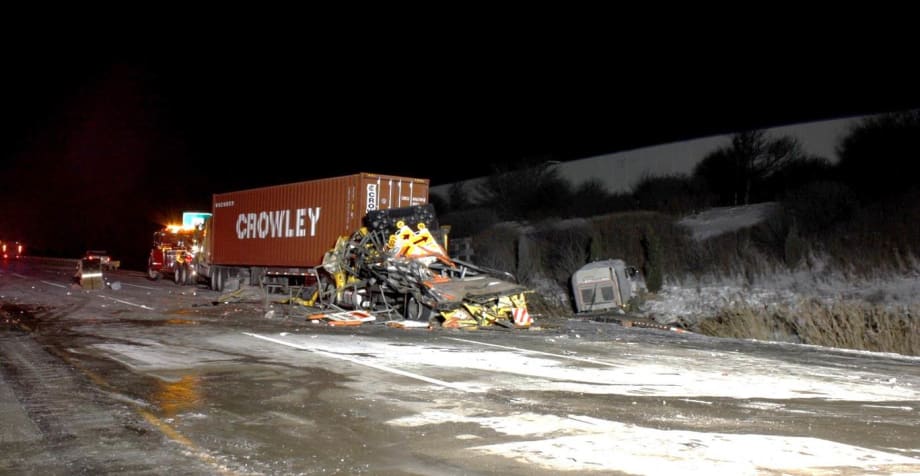
Aftrmath of Jan. 27, 2014, truck crash near Naperville, Ill. Image via NTSB
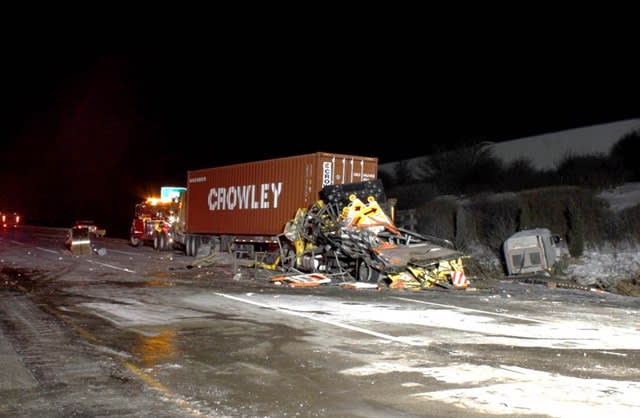
Aftrmath of Jan. 27, 2014, truck crash near Naperville, Ill. Image via NTSB
The National Transportation Safety Board has determined the probable cause of a fatal truck crash two year ago was the delayed response of a truck driver to vehicles stopped ahead of him “because he was fatigued due to inadequate sleep.”
The board found the driver had slept less than four and a half of the 37 hours preceding the crash and had falsified his logbook.
But that was not all. NTSB also said the failure of a “high-risk” motor carrier to adhere to federal hours-of-service regulations contributed to the crash — as did “inadequate safety oversight by the Federal Motor Carrier Safety Administration.”
In its Feb. 9 report, NTSB said that as a result of this crash investigation, it is making these new safety recommendations to FMCSA:
Develop and implement a notification program that automatically sends a letter to any motor carrier with Behavior Analysis and Safety Improvement Category (BASIC) scores defined as “high risk,” making it a “mandatory carrier.” This letter should state that the carrier is in high-risk status and should warn that the carrier has been placed on the mandatory compliance review list because of its increased crash risk. In addition, send the carrier’s insurance provider or surety a copy of the letter.
Form a working group consisting of safety partners, industry representatives and insurers to determine ways to share information that would prompt noncompliant and unsafe carriers to take appropriate remedial action.
Suspend the operating authority of any carrier that has five or more intervention alerts in its BASICs, demonstrating that it is not fit, willing, or able to comply with Federal Motor Carrier Safety Regulations. The carrier should be informed as to what actions it must take to demonstrate that it has corrected its safety issues and improved its safety procedures to reverse the suspension.
Review the process and procedures for imminent hazard orders to identify ways to make this process work more swiftly and effectively.
In addition, NTSB reiterated an earlier recommendation to FMCSA that the agency should "include safety measurement system rating scores in the methodology used to determine a carrier’s fitness to operate in the safety fitness rating rulemaking for the new Compliance, Safety, Accountability initiative."
“High-risk carriers are a threat to all who use our roadways,” said NTSB Chairman Christopher A. Hart. “Such carriers cannot be permitted to operate with impunity, as did the two carriers involved in this tragic and preventable accident. Today’s recommendations, if implemented, will expand the FMCSA’s toolkit for ensuring that high-risk carriers either conduct their businesses safely or cease operations.”
Asked for comment on the report’s criticism of federal safety oversight, FMCSA spokesman Duane DeBruyne told HDT that “the agency would fully cooperate and would continue to work diligently with the NTSB in addressing these latest safety recommendations.”
After the Jan. 27, 2014, crash on I-88 near Naperville, Ill., FMCSA investigators found that truck driver Renato V. Velasquez had violated HOS rules that prohibit CDL drivers from driving for more than 11 hours on each shift or remaining on-duty after 14 hours of work. The agency also said he had falsified his logbooks with the intent of concealing the number of hours he worked.
The FMCSA investigators concluded that for a period of 26 hours from Jan. 26-27, Velasquez operated a tractor-trailer owned by DND International Inc. for approximately 1,000 miles and rested between 3-1/2 to 5-1/2 hours – well short of the federally required rest period.
Before reaching his last scheduled stop, Velasquez crashed into two fully illuminated stationary vehicles: an Illinois State Police car with its emergency lights activated and an Illinois Tollway truck outfitted with an activated warning arrow. Those emergency vehicles were stopped in the highway’s right lane assisting a disabled tractor-trailer operated by Michael’s Cartage.
NTSB characterized both DND International and Michael’s Cartage as “high-risk motor carriers.”
The crash killed a tollway worker and seriously injured an Illinois State Police trooper and another person.
Per the NTSB report, the DND International truck, towing a flatbed trailer loaded with steel coils, first struck an Illinois State Police car and pushed it off the road. Flames engulfed the patrol car, seriously injuring the police officer.
The truck then crashed into a Highway Emergency Lane Patrol (HELP) truck, sandwiching it between the striking truck and the disabled tractor-trailer, which fatally injured the HELP truck driver. That impact pushed the disabled tractor-trailer into a heavy-duty tow truck that was stopped in front of the rig.
NTSB said its investigators “found that despite several clearly visible warning indicators on the roadway, the driver of the DND International truck did not slow down or steer to avoid the stopped vehicles and applied the brakes just one second before impact. NTSB investigators further determined that he had slept less than four and a half of the 37 hours preceding the crash.”
“Fatigued driving kills,” said NTSB’s Hart, “and motor carriers that do not ensure that their drivers follow regulations designed to prevent fatigued driving are unsafe and should not be able to continue operating.”
The board noted that both DND International and Michael’s Cartage had “longstanding records of poor safety” and had been categorized as high-risk carriers by the Federal Motor Carrier Safety Administration.
“Yet for years, due to lack of resources and unsuccessful regulatory action, the FMCSA was unable to get the carriers to improve their safety behaviors in a meaningful way or to stop them from operating.” NTSB stated.
More Drivers

EEOC Sues Texas Trucking Company Over Driver Age Limits
The agency says Trancasa USA rejected applicants over 65 and applied tougher driving-record standards to those over 60.
Read More →
Nussbaum, Roehl Announce Second Driver Pay Increase This Year
This year has seen a swath of major truck driver pay increases as freight capacity has tightened.
Read More →
From One Generation to the Next: How Mentorship Builds Safer Truck Drivers
After three decades in trucking, Harold Perry shares what he's learned about driver safety, mentorship, and helping the next generation build confidence behind the wheel.
Read More →
Truck Drivers Need More Than Another Alert
Fleets have more visibility into truck health, safety events, and driver activity than ever. The next challenge is turning all that information into useful guidance for the person who has to decide what to do next.
Read More →
FMCSA Removes 110 Truck Driver Training Schools from Certified ELDT List
Federal regulators also are targeting more than 160 additional training providers and launching a nationwide audit of third-party CDL skills testers as part of a broader crackdown on trucking fraud.
Read More →
Hours of Service Pilot Programs: FMCSA Readies for 2027 Rollout
Two pilot programs could eventually reshape hours-of-service rules, giving truck drivers options to pause their 14-hour clock or use longer split sleeper rest periods.
Read More →
Medical Cards, English Proficiency Reshape Roadcheck Violations
Medical-card violations jumped to the top of the driver out-of-service list during CVSA’s 2026 International Roadcheck, while English-language proficiency violations appeared among the leading violations for the first time.
Read More →
Driver Trust Can Make or Break the Success of Fleet Safety Technology
New Teletrac Navman research suggests that onboarding, transparency about driver data, and positive feedback can play a significant role in how commercial drivers respond to safety and coaching technology.
Read More →
EEOC Sues KLLM Over Alleged Sex Discrimination in Driver Training
KLLM is facing a federal sex-discrimination lawsuit over policies the EEOC alleges put female truck driver trainees at a disadvantage.
Read More →
FMCSA Moves to Codify English Language Requirements for Commercial Drivers
By changing regulations on English-language proficiency requirements for commercial drivers, rather than relying on a guidance memo, the FMCSA said future administrations won't be able to walk back the Trump administration's stricter enforcement with just a memo.
Read More →