




NRF Urges President Obama to Intervene in Port Negotiations
The National Retail Federation sent a letter to President Obama to express the retail industry's growing concern about the possibility of a contract agreement not being reached between the International Longshoremen's Association and the United States Maritime Alliance, Ltd.
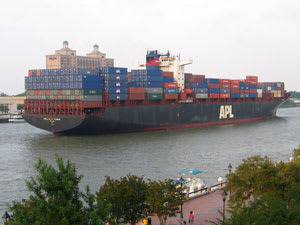
Container traffic at East and Gulf Coast ports like the Port of Savannah would be affected by a strike. (Photo by Evan Lockridge)
The National Retail Federation sent a letter to President Obama to express the retail industry's growing concern about the possibility of a contract agreement not being reached between the International Longshoremen's Association and the United States Maritime Alliance, Ltd.
The two sides have been in negotiations, with the assistance of federal mediators, for the past few months with little demonstrable progress. While another round of talks is scheduled for this week, the contract deadline of Dec. 29 is quickly approaching.
If the sides fail to extend the negotiations or reach an agreement, a port strike impacting 15 container ports along the East and Gulf Coast is highly probable. A strike at these ports has not occurred since 1977.
"A strike of any kind at ports along the East and Gulf Coast could prove devastating for the U.S. economy," NRF President and CEO Matthew Shay wrote to the president. "We call upon you to use all means necessary, including Taft-Hartley, to keep the two sides at the negotiating table and head off a coast-wide strike."
Any supply chain disruption at the ports would immediately impact every importer and exporter that utilizes the facilities along the East and Gulf Coasts from Boston to Houston. This could potentially disrupt or delay spring and summer retail merchandise.
If a strike or lockout occurs, 15 separate container ports including; Boston, New York/New Jersey, Delaware River, Baltimore, Hampton Roads, Wilmington, Charleston, Savannah, Jacksonville, Port Everglades, Miami, Tampa, Mobile, New Orleans, and Houston - would immediately cease operations.
"We cannot afford further supply chain disruptions as we enter 2013," Shay said. "The two sides must remain at the negotiating table until a deal is reached."
If a strike or lockout occurs, the president could utilize the Taft-Hartley Act to end the job action and force the two sides back to the negotiating table. The last time the Act, which seeks to protect the free flow of commerce, was invoked was by President George W. Bush during the 2002 West Coast ports lockout.
Economists estimate that the 2002 10-day lockout cost the U.S. economy $1 billion a day and took more than six months for the supply chain to recover.
"Allowing a strike to occur for even one day could have a negative impact on all of those downstream businesses and employees who rely on the ports," Shay said. "The U.S. economy cannot afford to wait for a strike to occur before we see administration action. We urge you to get engaged now with these parties to ensure a strike does not occur."
More Fleet Management

Geotab Links Fleet Card to Vehicle Data
The new card combines fuel discounts with telematics-based purchase controls. Geotab’s analysis also points to potential savings from choosing lower-priced fuel stops.
Read More →
How MFA Helps Protect Trucking Fleets
Multi-factor authentication adds protection when passwords are stolen. Here’s how it works and where fleets should start.
Read More →
How Better Freight Data Helps Trucking Teams Get Ahead of Disruption
Trucking and logistics teams have plenty of data. The problem is getting the right information in front of the right people soon enough to act. Better-connected data can help teams spot trouble earlier and make smarter decisions before small problems become big ones.
Read More →

Trimble: Taking Artificial Intelligence in Trucking Beyond Faster Tasks
At Insight 2026, Trimble executives argued that fleets may need to redesign workflows to get more from AI as it introduced new products and enhancements. AI’s value will depend on how fleets combine automation with their people's knowledge.
Read More →
Build a bulletproof fleet: Uniting ELDs and dash cams for total compliance
An ELD can prove compliance, but it cannot always prove what happened on the road. Discover how uniting accurate ELD data with AI-powered dash cam video can help your fleet strengthen compliance, defend against liability, protect drivers and reduce operational costs.
Read More →
Nominations Open for HDT Emerging Leaders
Heavy Duty Trucking is looking for accomplished trucking fleet professionals under 40 who are making an impact and helping lead the industry forward.
Read More →
Why Private Fleets Are Taking More Freight
Private fleets are putting their own trucks on demanding customers and high-cost lanes as companies seek greater control over service, costs, and capacity.
Read More →
Color Match Smarter: Tools That Restore & Perform
For fleet managers and collision repair professionals keeping heavy-duty trucks on the road, getting the color right the first time isn't just about appearance — it's about efficiency, turnaround time, and bottom-line results. Discover how today's digital color tools are transforming the repair process from guesswork to precision.
Read More →
FMCSA Pauses Biennial-Update Enforcement Amid Motus Transition
Carriers whose updates were due on or after June 1 have more time, while FMCSA works to stabilize its new registration system and warns of phishing sites impersonating its new carrier registration system, Motus.
Read More →
2026 Blueprint for Countering Smarter Supply Chain Theft
Cargo theft is no longer just the cost of doing business. It's a multi-billion-dollar criminal enterprise exploiting vulnerabilities across your fleet, drivers, and supply chain.
Read More →