




Noregon: Uptime, Not Growth, Will Define Trucking’s 2026 Path
A newly released industry white paper from Noregon Systems finds the trucking industry headed toward a structural reset across multiple operational fronts.


Squeezing more uptime from older equipment will be critical for fleets in the coming year, according to a new white paper released by Noregon Systems.
Photo: Noregon Systems
After enduring one of the longest and most painful freight recessions in recent memory, fleets, service providers, and suppliers are entering 2026 with a mix of cautious optimism and operational fatigue, a new white paper study from Noregon has found.
The good news is that freight volumes seem to be stabilizing, capacity is finally coming out of the market, and spot rates have shown early signs of life, Noregon reported.
But margins remain thin, capital is tight, and the industry’s center of gravity is shifting from growth to efficiency.
In Noregon’s view, the companies that navigate 2026 successfully won’t be the ones chasing expansion. They’ll be the ones squeezing more uptime, productivity, and insight out of increasingly complex and increasingly older equipment.
That’s based on the findings in a new white paper released by Noregon titled “Unpacking the Commercial Vehicle Diagnostics Industry 2026.”
A Fragile Economic Floor, not a Recovery
In the white paper, Noregon characterizes the current macroeconomic environment as fragile but stabilizing.
It noted that U.S. GDP growth remained positive in 2025, at 1.8%–2.4%, but trucking felt little relief.
Freight fundamentals through 2023 and 2024 reflected a classic oversupply scenario, with spot rates running 20%–30% below contract pricing and tender rejections stuck in recessionary territory.
By late 2025, however, the first real signs of balance began to appear.
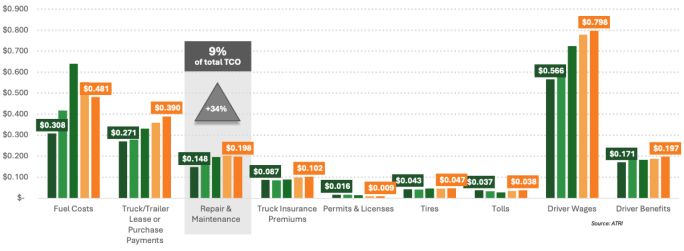
Chart: Noregon Systems
The outbound tender rejection index climbed toward 10% by mid-December—still modest by historical standards, but enough to signal that the freight recession may finally be approaching its trough.
That shift didn’t happen organically, though.
Capacity left the market in force. More than 200 fleets operating 250 trucks or more filed for bankruptcy in early 2025, driving a 35% year-over-year increase in carrier failures.
DOT enforcement targeting non-domiciled CDL drivers in the second half of the year accelerated that correction further, the study found, removing thousands of drivers from the labor pool.
As a result, there are fewer trucks chasing freight, modestly firmer rates, and guarded optimism heading into 2026.
Noregon noted that most macro forecasts peg U.S. GDP growth between 1.5% and 2.1% in 2026—enough to stabilize freight demand, but not enough to quickly absorb the excess capacity built during the pandemic-era boom.
Fleets and Shops See the Same Market -- Very Differently
One of the more telling findings in Noregon’s annual survey is the growing disconnect between fleet managers and shop managers, and how each group views current economic conditions.
Fleet managers, according to the report, are cautiously optimistic. They see capacity exiting the market and believe improved rate discipline will eventually restore profitability.
Shop managers, on the other hand, are notably less bullish.
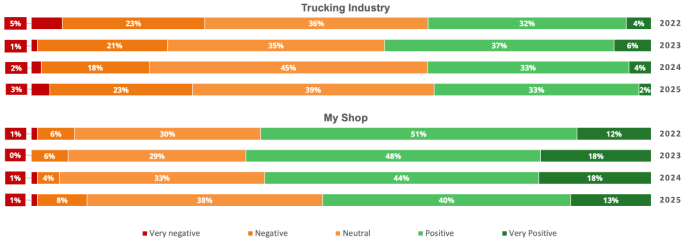
Chart: Noregon Systems
That divergence reflects a hard reality: Capacity correction cuts both ways.
As fleets fail or downsize, service demand drops with them. For shops, fewer trucks on the road can mean fewer repair orders -- at least in the short term.
Complicating matters further, Noregon found that truckload rates stayed near $2.30 per mile through much of 2024 and 2025. This figure barely clears the American Transportation Research Institute (ATRI) estimated marginal cost of $2.20 per mile for carriers.
According to Noregon, elevated insurance premiums, fuel costs, and financing expenses left many carriers operating at or below the break-even point. This is especially truck for fleets running older equipment, the study found.
Overall, Noregon found that repair and maintenance costs matter more than ever. And they’re rising fast, the white paper found.
Older Trucks, Higher Stakes
According to Noregon’s analysis, nearly 74% of U.S. trucks on the road today are eight years old or older.
That reality is colliding with two other trends: Rising vehicle complexity and a shrinking technician workforce.
Repair and maintenance accounted for roughly 9% of the total cost of operating a heavy-duty linehaul truck in 2025—a 34% increase compared to the 2020–2024 period.
For fleets forced to hold onto assets longer, every unplanned repair carries outsized financial consequences, the study found.
That reality helps explain why uptime has become the primary economic lever fleets can still control in the current economic conditions.
In 2026, Noregon argues, service providers capable of reducing dwell time, improving diagnostic accuracy, and keeping older trucks productive will play a central role in the industry’s recovery.
New Truck Sales Stay Subdued
On the equipment side of the equation, Noregon has revised its expectations of new Class 8 truck sales downward for the coming year.
A year ago, many industry experts predicted 2025 would see around 300,000 Class 8 truck sales.
Chart: Noregon Systems
Instead, tariffs, weak freight demand, and a cautious capital environment depressed the market significantly.
An estimated 258,000 Class 8 units were sold in 2025.
Looking ahead, Noregon forecasts 245,000 new Class 8 trucks sold in 2026, before rebounding to 281,000 units in 2027. Trailer sales are projected at 285,000 units in 2026.
Despite lower new-truck volumes, however, the active Class 8 population continues to grow, the white paper found.
Noregon estimates that there were 3.6 million active trucks on the road in 2025. The company expects that number to rise to 3.8 million units in 2026 and 4.1 million by 2027.
A Year Defined by Execution
All told, Noregon’s white paper paints a picture of an industry recalibrating, economically, operationally, and technologically.
With capital spending under pressure and fleet age climbing, uptime becomes the primary profit driver for carriers, according to the study. Accordingly, Noregon said, service efficiency becomes a strategic necessity for fleets. Data integration becomes mandatory for fleets to remain competitive.
For fleets, shops, and suppliers alike, Noregon said, 2026 won’t be about betting on growth. It will be about executing better under tight constraints and building systems that enable the industry to operate smarter, not just harder.
The full white paper report can be downloaded here: “Unpacking the Commercial Vehicle Diagnostics Industry 2026.”
More Fleet Management

Color Match Smarter: Tools That Restore & Perform
For fleet managers and collision repair professionals keeping heavy-duty trucks on the road, getting the color right the first time isn't just about appearance — it's about efficiency, turnaround time, and bottom-line results. Discover how today's digital color tools are transforming the repair process from guesswork to precision.
Read More →
FMCSA Pauses Biennial-Update Enforcement Amid Motus Transition
Carriers whose updates were due on or after June 1 have more time, while FMCSA works to stabilize its new registration system and warns of phishing sites impersonating its new carrier registration system, Motus.
Read More →
2026 Blueprint for Countering Smarter Supply Chain Theft
Cargo theft is no longer just the cost of doing business. It's a multi-billion-dollar criminal enterprise exploiting vulnerabilities across your fleet, drivers, and supply chain.
Read More →


How Telematics Improves Visibility, Control, and Performance in Refrigerated Fleets
Explore how telematics help refrigerated fleets improve visibility, uptime, efficiency, compliance, and cargo protection across connected cold chain operations.
Read More →
What the U.S.-Canada Trade War Means for Trucking
Escalating U.S.-Canada tariffs could disrupt cross-border freight, reduce truck volumes, raise costs, and create new uncertainty for carriers on both sides of the border.
Read More →
What Are Trucking’s Top Concerns for 2026?
The American Transportation Research Institute wants to know what's worrying trucking fleet managers, drivers, and other stakeholders in its annual Industry Issues survey.
Read More →
American Trucking Associations Looks for a New Leader
ATA President and CEO Chris Spear abruptly left his job at the association on August 21, at a pivotal time for the trucking industry.
Read More →
Public Wi-Fi Cybersecurity Risks: How Truck Drivers and Fleets Can Protect Their Data
Public Wi-Fi can expose truck drivers and fleets to credential theft, malware, and other cyber threats. Here’s how to reduce the risk on the road.
Read More →
For Nicky Cupp, Fleet Innovation Starts With Frustration
HDT Truck Fleet Innovator Nicky Cupp turns everyday pain points at Fraley & Schilling into opportunities for better technology and smarter processes.
Read More →
Adam Buttgenbach’s Approach to Electric Trucks: Start With Where They Fit
HDT Truck Fleet Innovator Adam Buttgenbach helped PepsiCo build one of North America’s largest EV fleets by focusing on where electric trucks make operational sense.
Read More →