




Nikola: Fuel-Cell Tre Production to Start in July
Nikola is shifting its priorities away from battery-electric to its hydrogen-fuel-cell electric truck, its new Hyla hydrogen refueling business, and autonomous technologies.

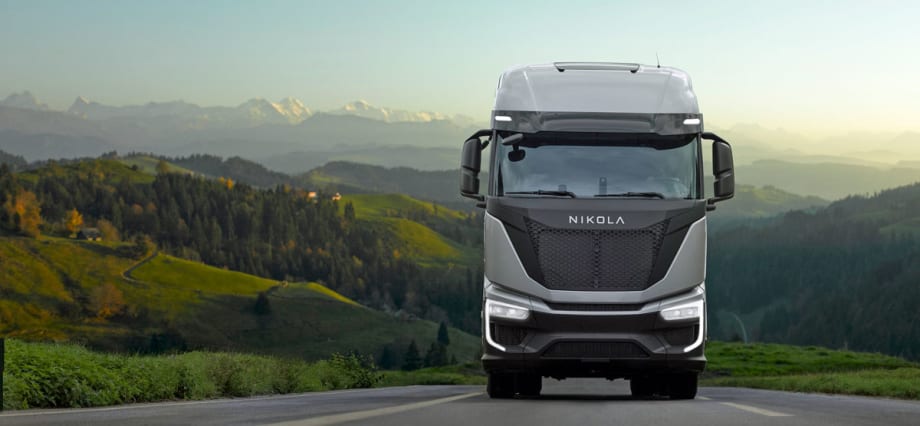
Nikola is putting more focus on its fuel-cell-electric Tre for North America.
Photo: Nikola
Nikola is prioritizing its focus on North America, its hydrogen-fuel-cell electric truck, its new Hyla hydrogen refueling business, and autonomous technologies.
In announcing its first quarter 2023 results, the company explained that manufacturing and energy are capital-intensive businesses, and it needs to remain focused where it has competitive advantages. So it is realigning its cost structure with this revised business focus, reducing spend and cash burn.
As part of that, Nikola said, it’s selling its stake in the European manufacturing joint venture to Iveco Group. And it's focusing on its new fuel-cell-electric vehicle for production, keeping the battery-electric model in its lineup as a build-to-order product.
Nikola reported GAAP net loss per share of $0.31 and non-GAAP net loss per share of $0.26 for the first quarter, although it said it saw a “substantial gross margin improvement from Q4 2022 to Q1 2023.”
“Nikola had a very solid quarter, building sales momentum with Class 8 battery electric truck deliveries to customers, and orders for 140 hydrogen fuel cell trucks from customers,” said Nikola CEO Michael Lohscheller. “We are on the right path with our re-energized management and commercial teams, improved sales strategy, new dealers, and energy partners,” he said.
Focusing on FCEV
Nikola said it will temporarily pause production at its Coolidge, Arizona, manufacturing facility as it modifies the assembly line to accommodate both hydrogen fuel cell and battery electric builds on the same line. It expects to resume production in July with the first saleable hydrogen fuel cell trucks.
“We are building sales momentum and backlog for the hydrogen fuel cell truck, and as of today orders for 140 hydrogen fuel cell trucks have been received from 12 end customers,” according to Nikola.
There are many reasons not to go forward with EVs in trucking. The glass is never more than half full.
We discuss openly our financial status and our plans and rarely lose customers because of lack of faith in Nikola. You are either comfortable with a startup or not. Most are. https://t.co/qoo8bSebXF— Jason Roycht (@JasonRoycht) May 11, 2023
Nikola has completed the first two of 10 gamma hydrogen fuel cell trucks. The remaining eight trucks are scheduled to be complete by the end of June. Gamma trucks will be used for customer pilots and to finalize vehicle validation. Pilot fleets include Biagi Bros, Walmart, Linde, and AJR Trucking, a leading carrier for the United States Postal Service.
The company also expects to begin battery module and pack manufacturing in Coolidge by the end of July, and Bosch Fuel Cell Power Module assembly by December 2023.
On the ground in Memphis at @ThompsonTrucks with our Tre FCEV. The first time for our FCEV in Grind City for some customer visits. pic.twitter.com/eiBFTBudW6
— Jason Roycht (@JasonRoycht) May 10, 2023
The battery-electric Tre will remain in the Nikola lineup as a build-to-order product. In the first quarter it noted that it produced 63 Tre battery-electric trucks, with 31 wholesale deliveries to dealers and 33 retail sales from dealers to end customers.
However, its inventory of battery-electric Tre trucks is sufficient to allow it to stop production to make the changes.
On May 2, Nikola announced a joint development agreement with Voltera Power, which includes Voltera supplying the capital for up to 50 Hyla hydrogen refueling stations over the next five years.
The company said it has “made significant progress” on its PHH and continues to work closely with Fortescue Future Industries on the co-development of large-scale U.S. green hydrogen production facilities across North America.
“We see tremendous opportunity for mobile hydrogen fueling and believe mobile fueling will play a critical role in the build out of the hydrogen refueling ecosystem, allowing us to be flexible and capital efficient as truck network density is scaled,” Nikola said, noting that it has commissioned four Hyla hydrogen mobile fuelers and is working with partners for additional mobile fuelers.
Nikola isn't the only company pushing forward on hydrogen fuel cell trucks for North America. Paccar recently announced it was moving ahead with commercializing Kenworth and Peterbilt FCEV trucks, and Hyundai Motor debuted the commercialized model of its Xcient fuel cell tractor.
Iveco Partnership
The Nikola-Iveco partnership started in 2019 to leverage the companies’ respective expertise to deploy zero-emission heavy-duty trucks in North America and Europe. The two companies worked jointly at a steady pace, despite Covid-19 and supply chain challenges, and launched battery-electric and fuel-cell-electric trucks for regional and long haul in both North America and Europe.
Going forward, Iveco Group will concentrate on Europe for the further development and commercialization of its own battery-electric and fuel cell electric trucks. Nikola will focus its operations in North America, with an integrated approach to its customers, offering BEV, FCEV and hydrogen infrastructure via its Hyla brand.
“Iveco will remain an important partner and key supplier for us and will cheer for our long-term success, and they are expected to remain a meaningful stockholder moving forward,” said the company.
More Fuel Smarts

How Volvo Updated Its D13 for EPA 2027 [Watch]
Volvo’s updated D13 promises lower emissions without sacrificing performance or fuel economy. Take a closer look at what changed inside the engine in this HDT Spotlight video.
Read More →
Diesel Price Spike Shortens Payback for Natural Gas Trucks, Report Says
Energy Vision estimates fleets could recover the higher purchase price of an RNG-fueled Class 8 tractor in 1.3 to 2.8 years under current fuel-price scenarios.
Read More →
Calstart Becomes Catalyst Mobility, Reflecting Broader Focus
Calstart is now Catalyst Mobility, reflecting the nonprofit’s growing national role in clean transportation, including zero-emission trucks, infrastructure and incentive programs.
Read More →

Record Diesel Prices Squeeze Trucking Fleets
Average U.S. diesel prices have climbed to nearly $6 a gallon, surpassing the 2022 record as tight refinery capacity and Middle East disruptions keep fuel costs elevated.
Read More →
How Fuel Delivery Shapes Engine Performance
Fuel delivery depends on more than what happens at the injector. For fleet, maintenance and technical professionals, looking at the full path from pump to injector can provide useful context for understanding engine performance.
Read More →
East Coast Port Launches $45M Electric Truck Push
The Port Authority of New York and New Jersey announced millions in incentives for zero-emission drayage trucks, yard tractors, and new charging hubs near the port.
Read More →
California Bill Could Shed Light on Electric Truck Prices
Why do battery-electric Class 8 trucks remain so expensive? A California bill headed to Gov. Gavin Newsom would give fleets and state agencies more visibility into what manufacturers charge.
Read More →
Detroit Opens Orders for EPA 2027 Engines
Detroit isn’t starting from scratch to meet EPA 2027 diesel emissions standards. Its Gen 6 DD13 and DD15 engines keep much of today’s platform while updating the fuel and aftertreatment systems.
Read More →
Zero-Emission Truck Corridor Planned for West Coast
California, Oregon, Washington, British Columbia and Baja California are coordinating plans for truck charging and hydrogen fueling from Canada to Mexico.
Read More →
A Closer Look at Kenworth’s Electric T880E Vocational Truck [Video]
Learn more about Kenworth's T880E battery-electric vocational truck at the Paccar Technical Center, including its range, applications, upfitting considerations, and PTO options, in this HDT Spotlight video.
Read More →