




New York Throws Out Proposed Truck Ban in Finger Lakes
Truck drivers will no longer have to worry about a potential ban on heavy trucks on certain routes in New York's Finger Lakes area, as the New York State Department of Transportation said it will no longer pursue the restrictio
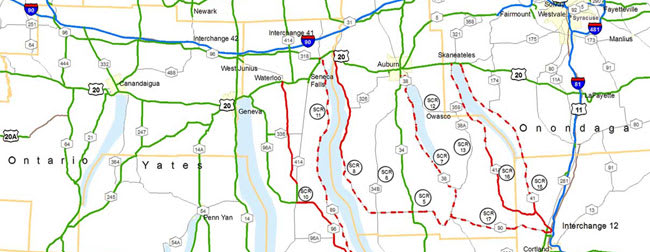
Detail of a map from the New York DOT explaining the proposed restricted routes.
Truck drivers will no longer have to worry about a potential ban on heavy trucks on certain routes in New York's Finger Lakes area, as the New York State Department of Transportation said it will no longer pursue the restriction
, according to Kendra Adams, executive director of the New York Motor Truck Association.
The ban, Adams said, was proposed by New York Gov. David Paterson and Sen. Charles Schumer (D-N.Y.), primarily in response to complaints of truck traffic from people in the community, according to a coalition formed to defeat this proposed regulation. The coalition is comprised of a number of business groups across New York state that opposed the proposal, including the Owner-Operator Independent Drivers Association, the American Trucking Associations, the Ontario Trucking Association, as well as the New York Motor Truck Association, to name a few.
According to Adams, a NYSDOT study found that the ban would not have worked because it would end up shifting truck traffic from certain communities into other areas. Ninety-four percent of the truck traffic in the area is local, and most trucks would shift to other local routes, instead of to the Interstate system, the ATA says.
According to the ATA, the coalition was lobbying against the restrictions, arguing that they would unnecessarily burden carriers and local businesses, with no apparent safety benefits.
"Our concern is simple: imposing any restrictions on routes trucks may travel is an extremely bad precedent that will increase the cost and time of trips, waste fuel and, most importantly, cause a ripple effect that will touch on every industry that is important to this state's economy, especially upstate," the coalition wrote in a July 2009 letter to Gov. Paterson. "On behalf of the 515,000 men and women who are employed by the trucking industry in New York State, and the twenty-six associations representing large and small businesses across this state, we urge you not to move forward with the proposed regulation to restrict truck traffic on certain roads in the Finger Lakes Region."
The next step, Adams says, is for the trucking industry to work directly with residents of the Finger Lakes area to find a solution to the truck traffic problem that works for everyone.
The seven routes that were part of the proposed ban include NY Route 41 between U.S. Route 11 and U.S Route 20; NY Route 41A between NY Route 41 and US Route 20; NY Route 90 between U.S. Route 11 and US Route 20; NY Route 38 between NY Route 90 and the southern Auburn City line; NY Route 79 between NY Route 90 and the southern Auburn City line; NY Route 89 between the western Ithaca City line and US Route 20; and NY Route 96 between the western Ithaca City line and NY Route 414 and between NY Route 414 and US Route 20.
For more information on the coalition against the proposed restrictions, visit www.nytrucks.org/trucksbringit.aspx.
More Drivers

Truck Drivers Need More Than Another Alert
Fleets have more visibility into truck health, safety events, and driver activity than ever. The next challenge is turning all that information into useful guidance for the person who has to decide what to do next.
Read More →
FMCSA Removes 110 Truck Driver Training Schools from Certified ELDT List
Federal regulators also are targeting more than 160 additional training providers and launching a nationwide audit of third-party CDL skills testers as part of a broader crackdown on trucking fraud.
Read More →
Hours of Service Pilot Programs: FMCSA Readies for 2027 Rollout
Two pilot programs could eventually reshape hours-of-service rules, giving truck drivers options to pause their 14-hour clock or use longer split sleeper rest periods.
Read More →
Medical Cards, English Proficiency Reshape Roadcheck Violations
Medical-card violations jumped to the top of the driver out-of-service list during CVSA’s 2026 International Roadcheck, while English-language proficiency violations appeared among the leading violations for the first time.
Read More →
Driver Trust Can Make or Break the Success of Fleet Safety Technology
New Teletrac Navman research suggests that onboarding, transparency about driver data, and positive feedback can play a significant role in how commercial drivers respond to safety and coaching technology.
Read More →
EEOC Sues KLLM Over Alleged Sex Discrimination in Driver Training
KLLM is facing a federal sex-discrimination lawsuit over policies the EEOC alleges put female truck driver trainees at a disadvantage.
Read More →
FMCSA Moves to Codify English Language Requirements for Commercial Drivers
By changing regulations on English-language proficiency requirements for commercial drivers, rather than relying on a guidance memo, the FMCSA said future administrations won't be able to walk back the Trump administration's stricter enforcement with just a memo.
Read More →
Drivers Put Western Star Trucks to the Test at Star Nation Experience
Watch to get an inside look at the Western Star trucks, technology, and community behind the Star Nation Experience 2026!
Read More →
Trump Administration Looks to Put More Veterans Behind the Wheel
The Freedom Haulers program pulls together existing and expanded programs at several federal agencies to recruit veterans to drive commercial heavy-duty trucks and cut the red tape for them to get a CDL, training, and employment.
Read More →
Putting Mack’s Command Steer to the Test
A test drive of Mack’s Command Steer active steering system evaluates how it can make truck driving easier and less tiring.
Read More →