




New Rules Adopted for Cargo Tanks
The Research and Special Programs Administration of the U.S. Department of Transportation has adopted a number of revisions to rules governing the construction and maintenance of cargo tanks
The Research and Special Programs Administration of the U.S. Department of Transportation has adopted a number of revisions to rules governing the construction and maintenance of cargo tanks.
The final rule is effective Oct. 1, 2003, although RSPA has allowed more time for compliance with some changes. Following is a summary of the changes. The complete revision, including discussions, can be found in the April 18, Federal Register at www.nara.gov/fedreg.
-- Clarifies that registration requirements apply to cargo tank facilities that test, inspect and repair cargo tanks, and to manufacturers, assemblers and Design Certifying Engineers (DCEs).
-- Revises the definition of "assembly" to include the installation of linings or coatings to the inside wall of a cargo tank wall and the installation of equipment or components during the manufacturing process that are necessary to conform to the specification requirements. The term "assembler" is not limited to a person who mounts cargo tanks on motor vehicle suspension parts, but also includes a person who installs equipment or components during the manufacturing process.
-- Revises the definition of "cargo tank" to include intermediate bulk containers in the list of specifications that are not considered cargo tanks. RSPA adds a new section reference to the definition of "maximum allowable working pressure" and relaxed some requirements for design certifying engineers and registered inspectors.
-- Modifies the Hazardous Materials Table by adding a new Special Provision 144 for diesel fuel; fuel, aviation, turbine engine; fuel oil (No. 1, 2, 4, 5, or 6); gas oil; gasohol gasoline mixed with ethyl alcohol, with not more than 20% alcohol; gasoline; hydrocarbons, liquid, n.o.s.; kerosene; petroleum crude oil; petroleum distillates, n.o.s. or petroleum products, n.o.s; and petroleum oil. The provision also clarifies that underground storage tanks (USTs) may be shipped as unregulated materials if they meet the definition of "empty" in Sec. 173.29, or if they are cleaned, purged or made inert in accordance with the American Petroleum Institute Standard 1604 for USTs.
-- Requires all manually activated, on-vehicle remote shutoff devices for closure of a cargo tank's internal shutoff valve to be marked "Emergency Shutoff," effective two years after the effective date of this final rule. The marking must be at least 0.75 inch high.
-- Clarifies that hazardous materials (HM) training requirements apply to persons involved with the transportation of a combustible liquid that is either in a bulk package or is also a hazardous substance, a hazardous waste, or a marine pollutant in any packaging.
-- Clarifies that only the initial carrier of a hazardous materials shipment is required to have a shipping paper that includes the shipper certification.
-- Revises requirement that all manhole closures must be closed and secured on cargo tanks containing hazardous materials or residues of hazardous materials, adding a reference that cargo tanks that have been cleaned and purged may be transported with open manhole closures.
-- Clarifies that accident damage protection devices must be certified by a DCE. -- Clarifies that the minimum metal thickness of 0.187 inches for steel and 0.270 inches for aluminum is for tanks with a design pressure of at least 100 psig. In all cases, the minimum thickness of the tank shell and head shall be determined using structural design requirements in Section VIII of the ASME Code or 25% of the tensile strength of the material used.
-- Deletes a requirement that mounting pads be the same material as the cargo tank and, instead, allows the pad material to be selected by the DEC.
-- Eliminates the exception for a small gap in the continuous weld around mounting pads while permitting continued use of weep holes or telltale holes as currently allowed.
-- Requires the use of malleable steel, stainless steel or ductile iron in the construction of inlet and outlet fittings on MC 331 cargo tanks. Sacrificial devices are excepted.
-- Requires essential information marked on MC 331 CTMV metal identification plates to be consistent with the requirements for DOT 400-series CTMVs. The information may be displayed on either a separate name and specification plate, or on a single plate that would serve as both the name and specification plate to allow for maximum flexibility.
In addition, the specification plate may be attached to the chassis rail so that cargo tank motor vehicles assembled without welding will not require welding the specification plate onto the cargo tank. If this option is chosen, however, the cargo tank serial number, assigned by the cargo tank manufacturer, must appear on the specification plate.
The same information that is required on 400 series tanks, in the same order, is required on MC 331 cargo tanks, in addition to information specific to MC 331 cargo tank motor vehicles. This requirement becomes effective one year from the date of publication of this final rule and is applicable to new construction only.
-- Authorizes DOT 400-series cargo tank rear-end protection provisions as an alternative to existing requirements for MC 338 cargo tank motor vehicles.
-- Requires internal self-closing stop valves to be equipped with a means of thermal activation or other remote closure method.
-- Requires essential information marked on MC 338 CTMV metal identification plates to be consistent with the requirements for DOT 400-series CTMVs so that this essential information is readily available to operators and enforcement officials. The information may be displayed on a separate name and specification plate, or on a single plate that would serve as both the name and specification plates.
In addition, the specification plate may be attached to the chassis rail so that cargo tank motor vehicles assembled without welding will not require welding the specification plate onto the cargo tank. If this option is chosen, however, the cargo tank serial number, assigned by the cargo tank manufacturer, must appear on the specification plate. The same information that is required on 400 series tanks, in the same order, will be required on MC 338 cargo tanks, plus information specific to MC 338 tanks. This requirement becomes effective one year from the date of publication of final rule and is applicable to new construction only.
-- Requires manhole markings to be placed on the outside of the manhole assembly where they can be seen without opening the manhole cover or fill opening.
-- Clarifies that pressure relief vents are not required to conform to the ASME Code. The requirement for a cargo tank to be "constructed in accordance with the ASME Code" or "constructed and certified in conformance with the ASME Code" applies to the construction of the cargo tank walls and closure devices. Certification to the ASME Code may be done without the installation of pressure relief devices. Sections 178.345-10, 178.346-3, 178.347-4, and 178.348-4 set forth requirements for pressure relief systems for DOT 400-series cargo tanks. These requirements are different from and supersede the ASME Code venting requirements.
-- Requires the words "See variable specification plate" be added to the name plate on cargo tanks built to more than one specification, consistent with industry practice. Eliminates the maximum loading and unloading pressure marking requirement from the specification plate.
-- Clarifies the parameters for testing cargo tanks that are used to transport petroleum distillate fuels and are equipped with vapor recovery equipment. These cargo tanks may be tested in accordance with EPA's annual certification test requirements. To satisfy the leakage test requirements, however, the Method 27 test must be performed using air and not liquid.
-- Revises the term "corroded or abraded" to mean any visible reduction in the material thickness of the cargo tank wall or valve due to
More Drivers
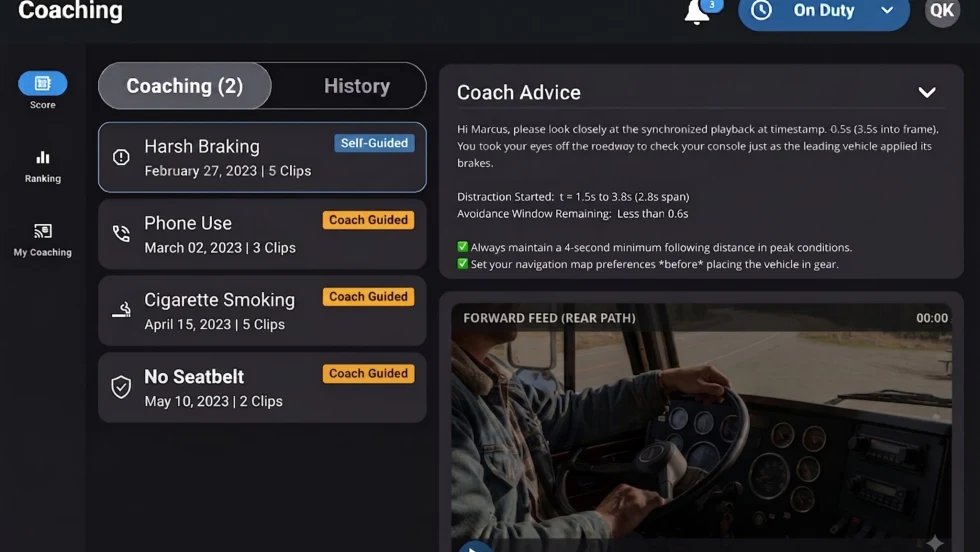
Platform Science Adds Dispatch and Safety Tools
Four additions to PS Fleet help fleets monitor loads, manage driver coaching, share truck locations and adjust video system settings.
Read More →
When Language Stops the Truck: The Return of ELP Out-of-Service Orders
English language proficiency rules for commercial drivers aren’t new, but renewed out-of-service enforcement has raised the stakes. Here’s what carriers need to know before a driver reaches a roadside inspection.
Read More →
Samsara Launches Custom AI Agent Builder
Agent Studio lets fleets create AI tools for hours-of-service monitoring, reporting and driver support, including agents that communicate by phone.
Read More →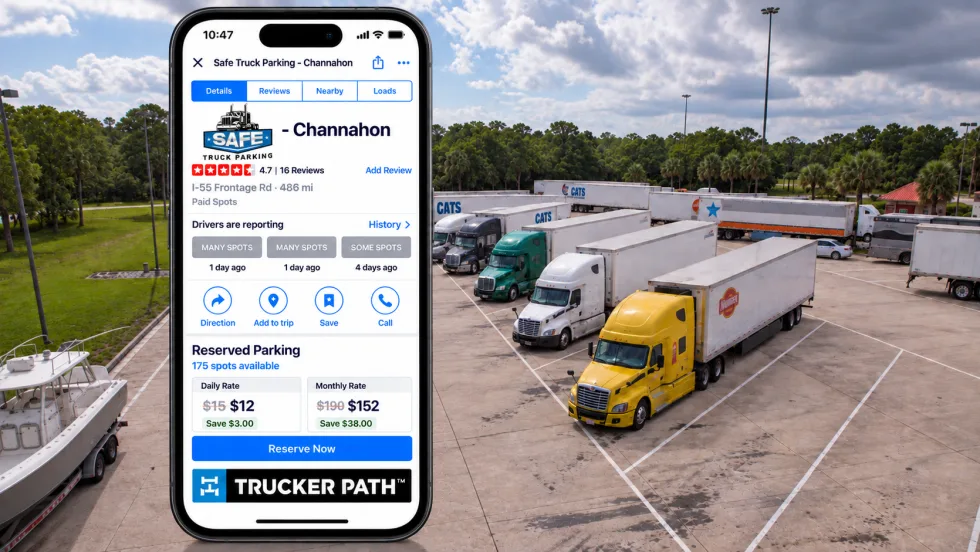
Trucker Path Expands Reserved Parking Network
Trucker Path has added close to 6,000 more truck parking spaces to its Trucker Path Reserved Parking Network with the addition of Safe Truck Parking.
Read More →
EEOC Sues Texas Trucking Company Over Driver Age Limits
The agency says Trancasa USA rejected applicants over 65 and applied tougher driving-record standards to those over 60.
Read More →
Nussbaum, Roehl Announce Second Driver Pay Increase This Year
This year has seen a swath of major truck driver pay increases as freight capacity has tightened.
Read More →
From One Generation to the Next: How Mentorship Builds Safer Truck Drivers
After three decades in trucking, Harold Perry shares what he's learned about driver safety, mentorship, and helping the next generation build confidence behind the wheel.
Read More →
Truck Drivers Need More Than Another Alert
Fleets have more visibility into truck health, safety events, and driver activity than ever. The next challenge is turning all that information into useful guidance for the person who has to decide what to do next.
Read More →
FMCSA Removes 110 Truck Driver Training Schools from Certified ELDT List
Federal regulators also are targeting more than 160 additional training providers and launching a nationwide audit of third-party CDL skills testers as part of a broader crackdown on trucking fraud.
Read More →
Hours of Service Pilot Programs: FMCSA Readies for 2027 Rollout
Two pilot programs could eventually reshape hours-of-service rules, giving truck drivers options to pause their 14-hour clock or use longer split sleeper rest periods.
Read More →