




New Orleans Port Offers Incentive to Get Rid of Older Trucks
The Port of New Orleans has launched its Clean Truck Replacement Incentive Program, providing incentives for local, short-haul truck owners to voluntarily replace 20 Class 8 drayage trucks from model years 1993-2006 with 2012 and newer models.
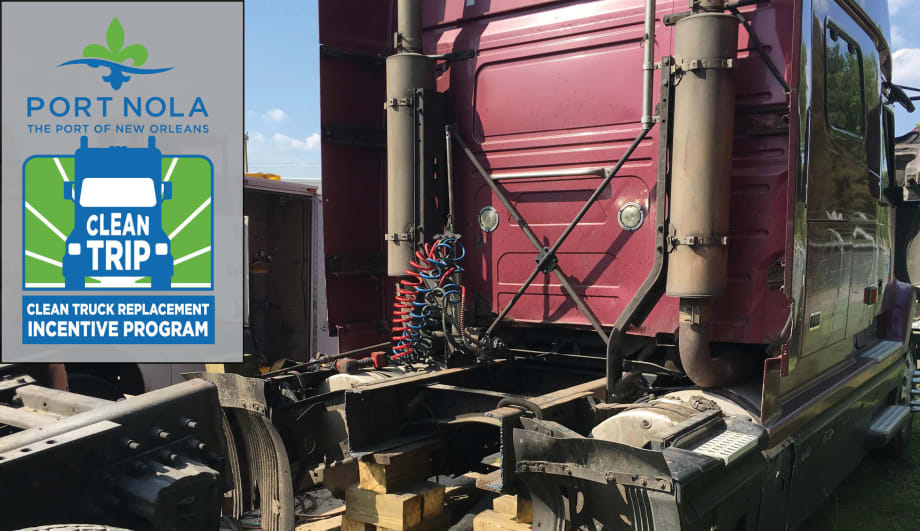
Image via Clean Trip
Image via Clean Trip
The Port of New Orleans has launched its Clean Truck Replacement Incentive Program, providing incentives for local, short-haul truck owners to voluntarily replace 20 Class 8 drayage trucks from model years 1993-2006 with 2012 and newer models.
The cost-share program will provide 50% of the vehicle sale cost of up to $35,000 and a maximum of two trucks per owner or fleet. The program is open to those who service cargo terminals and warehouses along the Mississippi River and the Industrial Canal.
Applications for the program are on Oct. 12, 2016. If more than 20 complete and eligible applications are received by the due date, the port will hold a public lottery at the Port Administration Building on Oct. 19.
“This program is a win-win,” said Gary LaGrange port president and CEO. “Local trucking companies can replace inefficient vehicles cost-effectively with commensurate emissions reductions and we have the opportunity to start a conversation about air quality.”
The Clean TRIP program is part of a $727,000 Clean Diesel competitive grant from the U.S. Environmental Protection Agency awarded to the Port of New Orleans. The grant supports the local port trucking community helping to reduce local air emissions and increase reliability and efficiency of on-road goods movement.
The total Clean TRIP project cost is $1.537 million, with $700,000 coming from mandatory cost-share with eligible truck owners and $110,636 coming from the Port for administrative costs.
More Fuel Smarts

Geotab Links Fleet Card to Vehicle Data
The new card combines fuel discounts with telematics-based purchase controls. Geotab’s analysis also points to potential savings from choosing lower-priced fuel stops.
Read More →
Fleet Economics Shape Electric Truck Outlook
ACT Research expects costs, charging infrastructure, and technology improvements to drive zero-emission commercial vehicle adoption as federal regulations and incentives retreat.
Read More →
Wex Adds Cardless Fuel Payments for Over-the-Road Customers
A new fuel card feature for Wex customers offers convenience and security.
Read More →

New California Law Could Shed Light on Electric Truck Prices
Why do battery-electric Class 8 trucks remain so expensive? A California bill signed by Gov. Gavin Newsom would give fleets and state agencies more visibility into what manufacturers charge.
Read More →
How Volvo Updated Its D13 for EPA 2027 [Watch]
Volvo’s updated D13 promises lower emissions without sacrificing performance or fuel economy. Take a closer look at what changed inside the engine in this HDT Spotlight video.
Read More →
Diesel Price Spike Shortens Payback for Natural Gas Trucks, Report Says
Energy Vision estimates fleets could recover the higher purchase price of an RNG-fueled Class 8 tractor in 1.3 to 2.8 years under current fuel-price scenarios.
Read More →
Calstart Becomes Catalyst Mobility, Reflecting Broader Focus
Calstart is now Catalyst Mobility, reflecting the nonprofit’s growing national role in clean transportation, including zero-emission trucks, infrastructure and incentive programs.
Read More →
Record Diesel Prices Squeeze Trucking Fleets
Average U.S. diesel prices have climbed to nearly $6 a gallon, surpassing the 2022 record as tight refinery capacity and Middle East disruptions keep fuel costs elevated.
Read More →
How Fuel Delivery Shapes Engine Performance
Fuel delivery depends on more than what happens at the injector. For fleet, maintenance and technical professionals, looking at the full path from pump to injector can provide useful context for understanding engine performance.
Read More →
East Coast Port Launches $45M Electric Truck Push
The Port Authority of New York and New Jersey announced millions in incentives for zero-emission drayage trucks, yard tractors, and new charging hubs near the port.
Read More →