




New Models Selling Well, Natural Gas ‘Happening,’ KW Reps Say
Revival in construction activity is driving healthy sales of vocational trucks, a recently launched highway tractor has become a “home run,” and interest in natural gas power should cause that segment to grow to 15-20% of heavy truck sales by 2020, Kenworth Truck Co. representatives said at a briefing for reporters Friday morning.

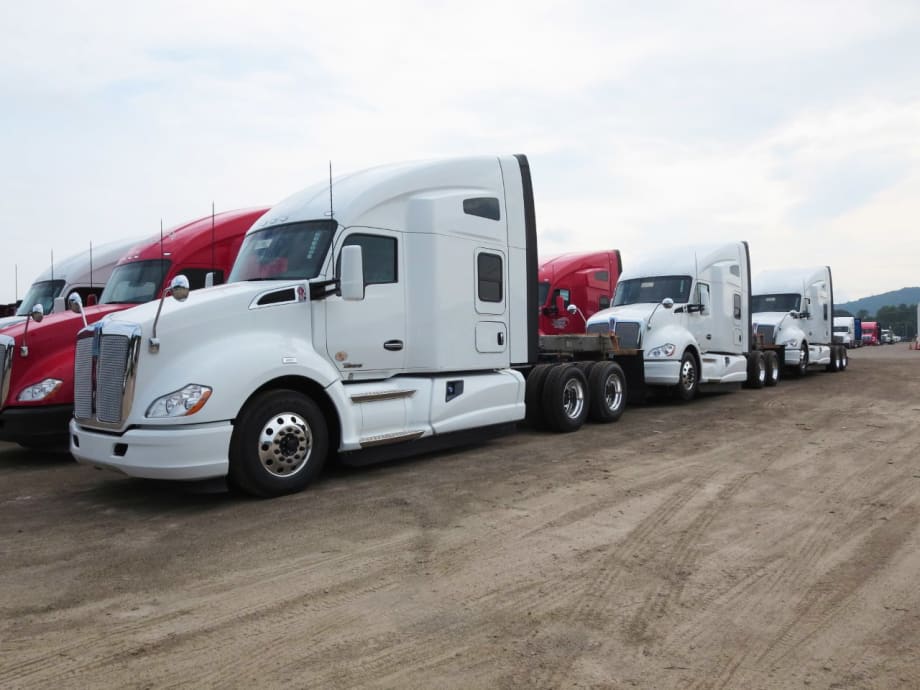
Roomy, comfortable T680 is a sales “home run” for Kenworth as it’s quickly edging out the older T660. Photo: Tom Berg
Roomy, comfortable T680 is a sales “home run” for Kenworth as it’s quickly edging out the older T660. Photo: Tom Berg
Revival in construction activity is driving healthy sales of vocational trucks, a recently launched highway tractor has become a “home run,” and interest in natural gas power should cause that segment to grow to 15-20% of heavy truck sales by 2020, Kenworth Truck representatives said at a briefing for reporters Friday morning.
Road building, in particular, is resulting in brisk sales of Kenworth’s T800 and T880 models, with the newer and more modern 880 now accounting for 40% of vocational-model production at the main plant in Chillicothe, Ohio, where reporters assembled for a ride-and-drive event. Also helping is home building, though it’s not regained the strength it had before the Great Recession.
Option content on the T880 now covers 85% of all vocational applications, said Alan Fennimore, manager for that segment within KW’s sales and marketing departments. More options coming include a front-engine power take-off and a wide-hood version with a larger radiator for low-speed heavy-haul operations.
The older “T8,” which entered Kenworth’s lineup 27 years ago and does a variety of vocational and on-highway jobs, will probably stay around for another five or six years simply because “some guys like the T800,” Fennimore said. Conversions are made “when others get in the T880 and look around and say, ‘Wow,’ and they just love it.” Changes are being made in the Chillicothe plant to build more T880s.
The T680 road tractor that was introduced about a year ago now accounts for half of all sales in that segment, said Brett Vanvoorhis, on-highway marketing manager. About 18,000 have been sold as buyers switch from the older T660 because of the 680’s greater room, comfort and technical advancements.
Like the T880, the T680 uses a cab that’s longer, wider and quieter than the cab on older models. It’s 2.1 meters (82.7 inches) wide, about 8 inches more than the narrow cab on the T660 and other older Kenworths.
Aside from extra interior room, the wider cab covers the entire front of a cabinet that houses tanks for compressed natural gas, said Andy Douglas, national sales manager for specialty vehicles. Behind a narrower cab, a CNG cabinet sticks out to where he and others call it a “flying mattress.” Now the aerodynamics of the T680’s nose and cab are extended past the CNG cabinet, adding a bit of fuel economy.
“I’m a true believer” in natural gas, Douglas declared. “It’s no longer a science experiment. It’s happening. The question is not if, but when” it will become popular. “Eighty years ago, diesel was the alternative fuel. It took 25 years for it to become common” as truckers converted from gasoline engines.
Early adopters of gas were operators of transit buses, then refuse trucks, which stay close to fueling points, he said. Also, “they had an engine, the 9-liter” ISL G from Cummins Westport. Now operators of concrete mixer trucks are beginning to buy, and on-road operators are being pushed into gas by shippers who want sustainability and a “green” image. Cummins Westport’s ISX12 G is the enabling engine for viable operation of 80,000-pound tractor-trailers.
“But I’m telling everybody who will listen to me at Cummins to build the 15-liter” gas engine that Cummins recently put on “pause” due to uncertainty for gas-truck prospects. The 15-liter is needed for use in over-100,000-pound combinations here and in Canada, he said, adding that the engine builder is now considering it again.
The cost advantage of gas motor fuel – about $1.50 to $2 per diesel gallon equivalent -- alone makes the case for natural gas, Douglas said, so fleets really don’t need government subsidies to make it financially attractive. The 15% to 20% market share for gas by the year 2020 is one he’s heard, so he’s not predicting it.
As for gas types, the lower cost of compressed natural gas and equipment to store and burn it is why CNG takes 90% of NG truck sales. And there are almost 700 commercial CNG stations in the U.S. compared to 56 for LNG. However, there are 90,000 diesel filling stations, “including one near you.”
“Kenworth is very committed to diesel,” he said. “By no means do we say that diesel is going away. We’ve invested a tremendous amount of money in diesel,” with the Paccar 12.9-liter MX-13 engine as a prime example.
More money is being invested in an additional product, a 10.8-liter MX-11 that’s due out next year, said Alan Fennimore, the vocational segment manager. It will be ideal for mixer trucks and bulk haulers who can convert the MX-11’s 300-pound weight savings over the MX-13 into payload.
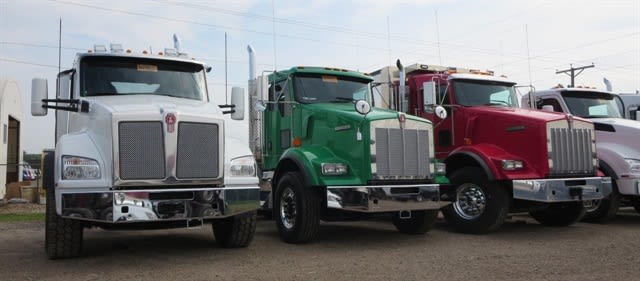
Vocational truck customers are converting to the more modern T880 (far left), though T800 (center and right) still has its followers. Photo: Tom Berg
More Fuel Smarts

How Volvo Updated Its D13 for EPA 2027 [Watch]
Volvo’s updated D13 promises lower emissions without sacrificing performance or fuel economy. Take a closer look at what changed inside the engine in this HDT Spotlight video.
Read More →
Diesel Price Spike Shortens Payback for Natural Gas Trucks, Report Says
Energy Vision estimates fleets could recover the higher purchase price of an RNG-fueled Class 8 tractor in 1.3 to 2.8 years under current fuel-price scenarios.
Read More →
Calstart Becomes Catalyst Mobility, Reflecting Broader Focus
Calstart is now Catalyst Mobility, reflecting the nonprofit’s growing national role in clean transportation, including zero-emission trucks, infrastructure and incentive programs.
Read More →

Record Diesel Prices Squeeze Trucking Fleets
Average U.S. diesel prices have climbed to nearly $6 a gallon, surpassing the 2022 record as tight refinery capacity and Middle East disruptions keep fuel costs elevated.
Read More →
How Fuel Delivery Shapes Engine Performance
Fuel delivery depends on more than what happens at the injector. For fleet, maintenance and technical professionals, looking at the full path from pump to injector can provide useful context for understanding engine performance.
Read More →
East Coast Port Launches $45M Electric Truck Push
The Port Authority of New York and New Jersey announced millions in incentives for zero-emission drayage trucks, yard tractors, and new charging hubs near the port.
Read More →
California Bill Could Shed Light on Electric Truck Prices
Why do battery-electric Class 8 trucks remain so expensive? A California bill headed to Gov. Gavin Newsom would give fleets and state agencies more visibility into what manufacturers charge.
Read More →
Detroit Opens Orders for EPA 2027 Engines
Detroit isn’t starting from scratch to meet EPA 2027 diesel emissions standards. Its Gen 6 DD13 and DD15 engines keep much of today’s platform while updating the fuel and aftertreatment systems.
Read More →
Zero-Emission Truck Corridor Planned for West Coast
California, Oregon, Washington, British Columbia and Baja California are coordinating plans for truck charging and hydrogen fueling from Canada to Mexico.
Read More →
A Closer Look at Kenworth’s Electric T880E Vocational Truck [Video]
Learn more about Kenworth's T880E battery-electric vocational truck at the Paccar Technical Center, including its range, applications, upfitting considerations, and PTO options, in this HDT Spotlight video.
Read More →