




New Jersey Intersection Again Named Worst Truck Congestion Bottleneck
The American Transportation Research Institute's 13th annual list highlighting the most congested bottlenecks for trucks in America identified the 100 worst offenders, with Georgia, Texas and Illinois having more than one on the top-10 list.

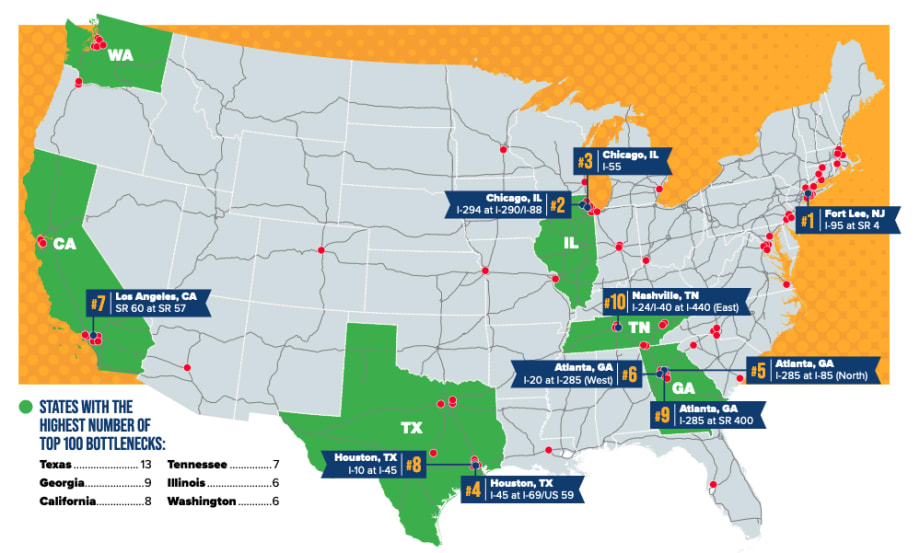
Texas, Georgia, California, Tennessee, Illinois and Washington had the highest number of top-100 bottlenecks in ATRI's study.
Source: ATRI
For the sixth year in a row, the intersection of I-95 and SR 4 in Fort Lee, New Jersey, has been named the worst freight bottleneck in the country by the American Transportation Research Institute.
ATRI’s 13th annual list highlighting the most congested bottlenecks for trucks in America identified the 100 worst offenders. The remaining Top 10 bottlenecks include:
Chicago: I-294 at I-290/I-88
Chicago: I-55
Houston: I-45 at I-69/US 59
Atlanta: I-285 at I-85 (North)
Atlanta: I-20 at I-285 (West)
Los Angeles: SR 60 at SR 57
Houston: I-10 at I-45
Atlanta: I-285 at SR 400
Nashville: I-24/I-40 at I-440 (East)
The 2024 Top Truck Bottleneck List measures the level of truck-involved congestion at more than 325 locations on the national highway system.
The analysis, based on an extensive database of freight truck GPS data, uses customized software applications and analysis methods, along with terabytes of data from trucking operations, to produce a congestion impact ranking for each location.
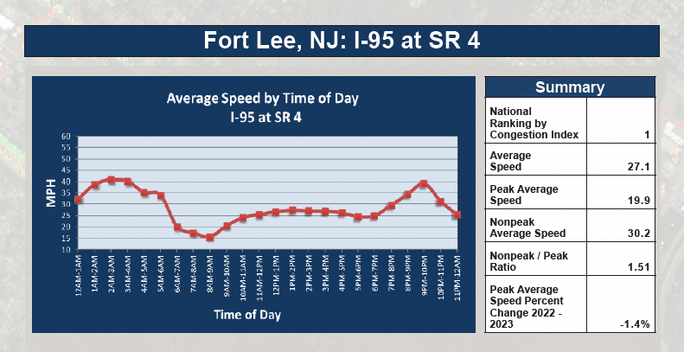
Statistics at the nation's worst trucking bottleneck showed the peak average speed dropped by 1.4% from 2022.
Source: ATRI
Congestion Getting Worse
ATRI’s analysis of data from 2023 found traffic conditions continue to deteriorate from recent years, in some instances due to work zones resulting from increased infrastructure investment.
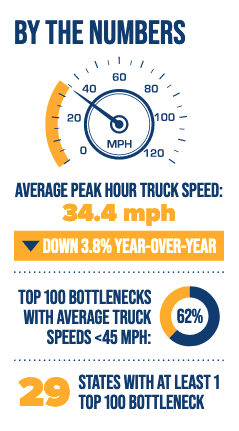
Average rush-hour truck speeds were 34.4 mph, down nearly 4% from the previous year. Among the top-10 locations, average rush hour truck speeds were 28.5 mph.
There were 29 states with at least one top-100 bottleneck. Among the top 100 bottlenecks, 62% had average truck speeds of less than 45 mph.
Last fall, ATRI reported that traffic congestion on U.S. highways added $94.6 billion in costs to the trucking industry in 2021, according to its Cost of Congestion study.
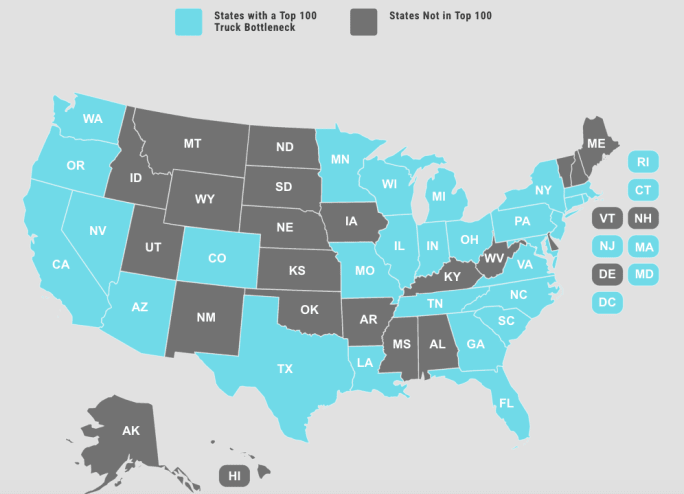
ATRI's Top Truck Bottleneck List measures the level of truck-involved congestion at more than 325 locations on the National Highway System.
Source: ATRI
Texas, Georgia Have Most Bottlenecks
Source: ATRI
Thirteen Texas locations made the top 100, including nine in the Houston metropolitan area (two of them in the top 10), leading ATRI to issue a news release that the Lone Star State once again leads the nation in truck bottlenecks.
“Texans are no strangers to traffic congestion,” said Texas Trucking Association President and CEO John D. Esparza. “Unfortunately, all that congestion means that our state’s economy takes a hit, as does our roadway safety and our environment.
“Trucks are the primary mover of goods in this state, and when trucks are stuck in congestion, all consumers pay the price. Using ATRI's annual analysis to see where these chokepoints are most impactful allows the state to target investment for the greatest return on the dollar.”
Nine Georgia locations made the top 100, including three in the top 10.
“With five Metro Atlanta locations in the top-20 ranking, our traffic challenges are not insignificant,” said Georgia Motor Trucking Association President and CEO Ed Crowell. He added that the Georgia DOT's Major Mobility Investment Program is targeting many of these chokepoints to ultimately improve freight movement
More Fleet Management

Color Match Smarter: Tools That Restore & Perform
For fleet managers and collision repair professionals keeping heavy-duty trucks on the road, getting the color right the first time isn't just about appearance — it's about efficiency, turnaround time, and bottom-line results. Discover how today's digital color tools are transforming the repair process from guesswork to precision.
Read More →
FMCSA Pauses Biennial-Update Enforcement Amid Motus Transition
Carriers whose updates were due on or after June 1 have more time, while FMCSA works to stabilize its new registration system and warns of phishing sites impersonating its new carrier registration system, Motus.
Read More →
2026 Blueprint for Countering Smarter Supply Chain Theft
Cargo theft is no longer just the cost of doing business. It's a multi-billion-dollar criminal enterprise exploiting vulnerabilities across your fleet, drivers, and supply chain.
Read More →


How Telematics Improves Visibility, Control, and Performance in Refrigerated Fleets
Explore how telematics help refrigerated fleets improve visibility, uptime, efficiency, compliance, and cargo protection across connected cold chain operations.
Read More →
What the U.S.-Canada Trade War Means for Trucking
Escalating U.S.-Canada tariffs could disrupt cross-border freight, reduce truck volumes, raise costs, and create new uncertainty for carriers on both sides of the border.
Read More →
What Are Trucking’s Top Concerns for 2026?
The American Transportation Research Institute wants to know what's worrying trucking fleet managers, drivers, and other stakeholders in its annual Industry Issues survey.
Read More →
American Trucking Associations Looks for a New Leader
ATA President and CEO Chris Spear abruptly left his job at the association on August 21, at a pivotal time for the trucking industry.
Read More →
Public Wi-Fi Cybersecurity Risks: How Truck Drivers and Fleets Can Protect Their Data
Public Wi-Fi can expose truck drivers and fleets to credential theft, malware, and other cyber threats. Here’s how to reduce the risk on the road.
Read More →
For Nicky Cupp, Fleet Innovation Starts With Frustration
HDT Truck Fleet Innovator Nicky Cupp turns everyday pain points at Fraley & Schilling into opportunities for better technology and smarter processes.
Read More →
Adam Buttgenbach’s Approach to Electric Trucks: Start With Where They Fit
HDT Truck Fleet Innovator Adam Buttgenbach helped PepsiCo build one of North America’s largest EV fleets by focusing on where electric trucks make operational sense.
Read More →