




New Canadian Rule Promotes Flexibility in Trailer and Tire Spec'ing
Canadian regulators have made changes to the country's Weights and Dimensions regulations promoting flexibility in tire spec'ing
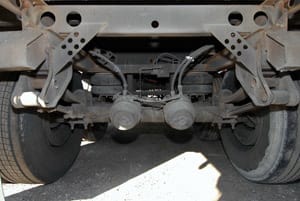
The Canadian government has reduced the minimum track width requirements for new trailers from 2.5 meters (98.4 inches) to 2.45 meters (96.5 inches). (Photo by Jim Park)
Canadian regulators have made changes to the country's Weights and Dimensions regulations promoting flexibility in tire spec'ing.
Previously, fleets choosing to use wide-base single tires were unable to revert to using dual tires on the same trailer, due to axle-length and track-width requirements. A recent change to the Memorandum of Understanding on Vehicle Weights and Dimensions reduces the minimum track width requirements for new trailers from 2.5 meters (98.4 inches) to 2.45 meters (96.5 inches).
The Canadian Trucking Alliance welcomed the announcement, saying it opens the door to nationwide adoption of greenhouse gas-reducing tire technology. "This move will improve fleet utilization, reduce capital costs, and simplify trailer spec'ing," CTA noted in a release.
Under the previous Memorandum of Understanding, trailer axles fitted with dual tires required a track width of no less than 2.5 meters. Axles on trailers of model year 2009 or earlier, equipped with single tires were required to have a minimum track width of no less than 2.3 meters (90.55 inches), whereas the track width for all axles on trailers from model year 2010 or later were required to be no less than 2.5 meters. Track width means the width of an axle across the outside faces of the tires measured at any point above the lowest point of the rim.
As a result, a trailer equipped with wide-base single tires would require a wider axle in order to meet the minimum track width requirements than a trailer equipped with dual tires. This made it impossible to switch from single to dual tires in order to maximize payload.
In Canada, there are currently significant weight differentials in the various jurisdictions in terms of permissible axle weights for wide-base single tires. Ontario and Quebec allow up to 9,000 kilograms (19,841 pounds) per axle in wide-base single tires, while most other provinces allow only 7,700 kilograms (16,975 pounds). This limits a fleet's choices when spec'ing trailer and tire configurations, and imposes financial burdens not experienced elsewhere in North America.
Under the new provisions, the minimum track width requirement for trailers built in or after 2010 that are equipped with single tires will be no less than 2.45 meters, while the track width for trailers equipped with dual tires will remain at 2.5 meters. In addition, the Memorandum of Understanding mandates some labeling requirements for trailers built in or after 2010 that are converted from dual to single tires (see below).
Bearing Loads
Users contemplating a switch between dual and single tires should be aware that adding a two-inch offset to the rim of the single tire could significantly alter bearing loads and the service life of both the bearings and the hub in some cases. Dan Tilton, chief engineer for heavy-truck applications for Timken, says his studies have concluded that if a user is operating with an existing wheel-end design and simply taking off a dual and replacing it with a wide-base tire, there could be a "fairly significant reduction in the expected life of the bearing components."
In a published backgrounder on wide-base single tires, the American Trucking Associations quotes Timken's Tilton as saying, "It changes the load position on the bearings. With the duals, the load position was designed to put it in a favorable position relative to the bearings, which are somewhat centered over the two bearing rows. Those designs have been around for quite some time, and the bearings were designed in the '50s and '60s. Users wanted the ability to go from dual to single and back to dual, but the wheel-end design has not been changed to accommodate the shifting of that load line."
Users are urged to check with their trailer suppliers to ensure proper bearing loads are maintained, or at least accounted for in switching from dual to single tires.
Previous Track Width Requirements
A. For trailer axles fitted with dual tires, track width must be no less than 2.5 meters.
B. For trailer axles fitted with single tires, (i) from model year 2009 and earlier, the track width must be no less than 2.3 meters, and (ii) from model year 2010 and later, the track width must be no less than 2.5 meters.
New Track Width Requirements
To accommodate situations where carriers would like to retain the option of being able to switch between dual tires and wide single tires on trailer axles, provinces and territories have agreed that the following provision will be made available:
A. The minimum track width requirement for trailers built in or after 2010 that are equipped with single tires will be no less than 2.45 meters.
B. The track width for trailers equipped with dual tires remains at 2.5 meters.
Labeling Requirements
Any trailer built in or after 2010 and converted from dual to single tires must bear a label adjacent to the original compliance label: identifying the company, or authorized dealer of a company, under the Motor Vehicle Safety Act (Canada) that converted the trailer; and indicating the revised tire and wheel size designation and revised gross vehicle and axle weight ratings.
Provincial and territorial regulations prohibit loading axles beyond the manufacturer's gross axle weight rating as indicated on the trailer's compliance label. In rating the axles, trailer manufacturers are required to take account of the axle capacity and all of its components. When revising axle weight ratings, qualified companies are expected to account for the wheel offsets and the impact this may have on axle and bearing capacity.
For more information, visit www.tc.gc.ca.
More Drivers

Platform Science Adds Dispatch and Safety Tools
Four additions to PS Fleet help fleets monitor loads, manage driver coaching, share truck locations and adjust video system settings.
Read More →
When Language Stops the Truck: The Return of ELP Out-of-Service Orders
English language proficiency rules for commercial drivers aren’t new, but renewed out-of-service enforcement has raised the stakes. Here’s what carriers need to know before a driver reaches a roadside inspection.
Read More →
Samsara Launches Custom AI Agent Builder
Agent Studio lets fleets create AI tools for hours-of-service monitoring, reporting and driver support, including agents that communicate by phone.
Read More →
Trucker Path Expands Reserved Parking Network
Trucker Path has added close to 6,000 more truck parking spaces to its Trucker Path Reserved Parking Network with the addition of Safe Truck Parking.
Read More →
EEOC Sues Texas Trucking Company Over Driver Age Limits
The agency says Trancasa USA rejected applicants over 65 and applied tougher driving-record standards to those over 60.
Read More →
Nussbaum, Roehl Announce Second Driver Pay Increase This Year
This year has seen a swath of major truck driver pay increases as freight capacity has tightened.
Read More →
From One Generation to the Next: How Mentorship Builds Safer Truck Drivers
After three decades in trucking, Harold Perry shares what he's learned about driver safety, mentorship, and helping the next generation build confidence behind the wheel.
Read More →
Truck Drivers Need More Than Another Alert
Fleets have more visibility into truck health, safety events, and driver activity than ever. The next challenge is turning all that information into useful guidance for the person who has to decide what to do next.
Read More →
FMCSA Removes 110 Truck Driver Training Schools from Certified ELDT List
Federal regulators also are targeting more than 160 additional training providers and launching a nationwide audit of third-party CDL skills testers as part of a broader crackdown on trucking fraud.
Read More →
Hours of Service Pilot Programs: FMCSA Readies for 2027 Rollout
Two pilot programs could eventually reshape hours-of-service rules, giving truck drivers options to pause their 14-hour clock or use longer split sleeper rest periods.
Read More →