




Million-Mile Engine Teardown Tests EcoPower Re-Refined Oil
Safety-Kleen Systems this week showcased a million-mile teardown of two Cummins ISX engines that have been running its Eco-Power re-refined engine oil since 2008. You're probably familiar with the name Safety-Kleen as a longtime maker of parts washers. You may even know that they provide used oil disposal. You may not know that it turns some of that used oil into re-refined engine oils
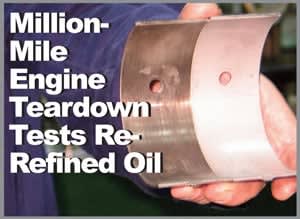
A bearing from one of the million-mile engines, left, compared to a brand-new bearing.
Safety-Kleen Systems this week showcased a million-mile teardown of two Cummins ISX engines that have been running its Eco-Power re-refined engine oil since 2008.
You're probably familiar with the name Safety-Kleen as a longtime maker of parts washers. You may even know that they provide used oil disposal. You may not know that it turns some of that used oil into re-refined engine oils.
EcoPower allows fleets to significantly reduce their carbon footprint, according to the company. Not only does the oil make use of a product that might otherwise be discarded, it also takes up to 85% less energy to produce than oil refined from crude, according to a company fact sheet.
Safety-Kleen says it is North America's largest used oil re-refiner, annually collecting approximately 200 million gallons of used oil and re-refining approximately 160 million gallons at its two re-refineries in East Chicago and Breslau, Ontario. The Ontario facility has been in operation since 1998. The company has been selling oil to the military and to large transit and municipal fleets for some 20 years.
EcoPower oil goes through an extensive process to remove water, contaminants, old additives, etc. Then an additive package is blended in to meet API standards as well as a number of engine and OE-specific tests.
In addition, as more consumers and fleets use synthetic oils, more and more of the used oil they pick up to recycle is synthetic. That means the re-refined EcoPower oil is actually a synthetic blend.
Recycled oil, in a general sense, does not have the best of reputations. In the past, such products were not made with high-tech processes, but with lower-tech filtering methods. Or, "They put it through three socks," as colorfully put by Curt Knapp, senior vice president and chief marketing offer.
In 2008 the company decided that with the growing emphasis on sustainability among major corporations, it was time to roll out the product to the corporate fleet world, Knapp said. Safety-Kleen decided that it order to convince fleets of the viability of re-refined oil, some hard evidence was needed.
So it put two trucks on the road using the oil and ran them to a million miles, then did a teardown to evaluate how well the oil protected the engines. The teardown event was held at the Outcast Kustoms facility in Mooresville, N.C., for invited media, customers and guests.
The test was run by Infineum, a joint venture of ExxonMobil and Shell, which provides the additives for Eco-Power's heavy-duty truck oils. The fleet was Cooke Trucking Co., Mt. Airy, N.C., which runs about 50 trucks, both less-than-truckload and linehaul. Because of its scrupulous maintenance program, Infineum uses this fleet for a number of tests.
Drivers, technicians, and even some of the Infineum people working on the test did not know what oil they were testing, according to Pat Fetterman, industry liaison advisor for Infineum. The oil was stored in plain beige drums. The EcoPower oil was a 15W-40 meeting API CJ-4 specifications.
The two test trucks run team between North Carolina and the West Coast, hauling primarily furniture west and bringing back fresh produce. The oil drain interval was targeted at 40,000 miles, with intermediate used-oil analysis, an extension of the standard 25,000 miles Cummins recommends for oils meeting its CES2008 standard. The filter was a Fleetguard model that includes both a full flow and a stacked bypass filter combined in one can, according to Fetterman.
The first 500,000 miles of the test also involved comparison testing against premium oils from two leading brands of engine oil. Based on used-oil analysis, the EcoPower oil actually outperformed the oils made from virgin base stocks in the areas of viscosity and TBN retention (TBN stands for total base number and a is a measure of the oil's ability to neutralize acids.)
A team from Cummins was involved in the teardown.
The results?
Fetterman explained that the parts on a Cummins ISX most likely to show wear are the No. 3 and No. 5 intake rocker cam interface on the cams; they're the most highly loaded and the last ones to get oil.
In this case, they are in such good shape that when the engine is rebuilt and sent on to its second owner, they will use the same cams.
Bearings are also a common spot for wear to show up. There was some copper exposed on the bearings, but Fetterman said the amount was "very acceptable, typical of what I would expect" on an engine with this many miles.
The sludge rating of 9.5 is "a very, very clean part," Fetterman said.
These were EPA-2007 engines, meaning they put a lot of soot into the oil.
Overall, Fetterman said, "These look like very good million-mile engines. They look like what I would expect to see with a premium oil at a million miles." At 40,000 miles, he says, the oil will be made up of 4% to 6% soot. That's about 5 to 6 pounds of soot, he said after a quick calculation. "That's the equivalent of half a 10-pound bag of charcoal, ground up and held suspended in the oil."
The company will be doing more scientific testing, including used-oil analysis and a Mack T12 cylinder lining wear test, among others; results will be available on the company website by early September.
Safety-Kleen recently began blending a variety of engine oils at its new East Chicago, Ind., blend facility, which was completed in late June. The facility, which began construction in 2010, will allow the company to blend more of its own finished oil products in-house.
"By controlling the process at our own facility, we ensure a consistently high level of quality control," says Dave Sprinkle, executive vice president for oil re-refining. The new facility will have an initial blending capacity of 20 million gallons annually, with the option to increase production by expanding work shifts in the future. Initial production of blended products began on July 2.
More info: http://www.ecopoweroil.com/fleets
More Drivers

Truck Drivers Need More Than Another Alert
Fleets have more visibility into truck health, safety events, and driver activity than ever. The next challenge is turning all that information into useful guidance for the person who has to decide what to do next.
Read More →
FMCSA Removes 110 Truck Driver Training Schools from Certified ELDT List
Federal regulators also are targeting more than 160 additional training providers and launching a nationwide audit of third-party CDL skills testers as part of a broader crackdown on trucking fraud.
Read More →
Hours of Service Pilot Programs: FMCSA Readies for 2027 Rollout
Two pilot programs could eventually reshape hours-of-service rules, giving truck drivers options to pause their 14-hour clock or use longer split sleeper rest periods.
Read More →
Medical Cards, English Proficiency Reshape Roadcheck Violations
Medical-card violations jumped to the top of the driver out-of-service list during CVSA’s 2026 International Roadcheck, while English-language proficiency violations appeared among the leading violations for the first time.
Read More →
Driver Trust Can Make or Break the Success of Fleet Safety Technology
New Teletrac Navman research suggests that onboarding, transparency about driver data, and positive feedback can play a significant role in how commercial drivers respond to safety and coaching technology.
Read More →
EEOC Sues KLLM Over Alleged Sex Discrimination in Driver Training
KLLM is facing a federal sex-discrimination lawsuit over policies the EEOC alleges put female truck driver trainees at a disadvantage.
Read More →
FMCSA Moves to Codify English Language Requirements for Commercial Drivers
By changing regulations on English-language proficiency requirements for commercial drivers, rather than relying on a guidance memo, the FMCSA said future administrations won't be able to walk back the Trump administration's stricter enforcement with just a memo.
Read More →
Drivers Put Western Star Trucks to the Test at Star Nation Experience
Watch to get an inside look at the Western Star trucks, technology, and community behind the Star Nation Experience 2026!
Read More →
Trump Administration Looks to Put More Veterans Behind the Wheel
The Freedom Haulers program pulls together existing and expanded programs at several federal agencies to recruit veterans to drive commercial heavy-duty trucks and cut the red tape for them to get a CDL, training, and employment.
Read More →
Putting Mack’s Command Steer to the Test
A test drive of Mack’s Command Steer active steering system evaluates how it can make truck driving easier and less tiring.
Read More →