




Michigan, Daimler Creating 'Truck Stop of the Future'
Daimler Trucks and the state of Michigan are teaming up to build “The Truck Stop of the Future” — a federally funded charging hub for commercial electric vehicles.

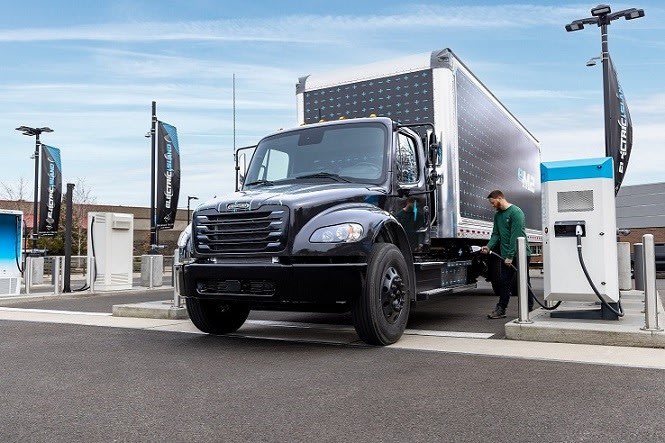
Daimler and the state of Michigan are partnering on a project to develop a new, BEV-focused truck stop business model.
Photo: Daimler Trucks North America
Daimler Trucks and the state of Michigan are teaming up to build “The Truck Stop of the Future” — a federally funded charging hub for commercial electric vehicles.
The state of Michigan announced a real-world prototype program known as the Mobility Charging Hub, which it said will help companies transition fleets to electric commercial vehicles. Michigan is billing the Mobility Charging Hub as “The Truck Stop of the Future.”
The concept blends a traditional truck stop business model with a dedicated EV charging hub. As EVs become more prevalent, truck stops will inevitably need to evolve their existing service models. This represents an opportunity to unlock new revenue in the trucking space, create new jobs, as well as redesign spaces into more sustainable assets, the state said.
A New Business Model for Truck Stops
Through this new program, Michigan will develop the partnerships, integrations and business models necessary for accelerating the transition to EVs at scale, while creating a playbook replicable across truck stop locations nationwide, accordding to the announcement.
The new project will also help test new technologies, digital services, and business models designed to accelerate deployment of commercial EVs at scale and modernize the truck stop experience.
The program will also serve the dual purpose of supporting passenger vehicle charging. Charging infrastructure remains a challenge for the broad deployment of EVs, but projects like this show that progress can be made toward a zero-emission future.
“Freight trucks drive commerce, deliver goods, and connect businesses throughout the nation, which is why it is critical to prepare this industry for the future,” said Lt. Governor Garlin Gilchrist II. “Our Mobility Charging Hub will help more companies electrify their fleets, cement Michigan’s leadership in the future of freight, and rebuild our transportation infrastructure to support the economy of tomorrow.
"Over the past five years, our administration has made progress investing in infrastructure and positioning Michigan as the best place to innovate the future, and we are taking that one step further with this ‘truck stop of the future.’ We will work with anyone to ensure more innovators and companies can make it in Michigan.”
$13 Million in Funding for EV Charging Hub
Michigan will have access to $13 million in funding to support the Mobility Charging Hub development. The money will be used to secure partnerships with companies aiming to test and implement solutions related to EV innovation, fleet management and overall ease of travel. Initial project partners are Daimler Truck North America and DTE Energy, which Michigan said are fundamental in making this project become a reality.
That $13 million includes $8.5 million in federal funding support. This money comes from a Rebuilding American Infrastructure with Sustainability and Equity (RAISE) grant award to Michigan’s Department of Labor and Economic Opportunity and Michigan’s Office of Future Mobility and Electrification. It will also be used to establish a grant program through the Mobility Charging Hub that will help fund future activations onsite.
Development of Mobility Charging Hub Will Happen in Phases
The Mobility Charging Hub will include several multi-phased initiatives.
In the first phase, the core infrastructure to support EV charging at the site will be established as a foundation. DTE will operate the core infrastructure of the Mobility Charging Hub, including EV charging solutions, solar canopies, and battery energy storage systems, and will look to partner with third-party operators for value-added services.
After successful demonstrated usage and commercial viability in the first phase, Michigan’s Office of Future Mobility and Electrification and its partners will work to enable the Mobility Charging Hub as a platform for testing innovation.
Located on the I-96 Freight Corridor
The project will be located at Daimler Truck North America's 130-acre Detroit manufacturing plant, located in Redford near I-96, home to the company's diesel and electric Detroit Powertrains and employing more than 3,000.
The site is already equipped with the necessary power, and this location sees more than 10,000 medium and heavy-duty commercial trucks travel daily across the state, or across the state’s borders into Canada. Michigan accounts for 30% of all truck and rail freight between the United States and Canada.
In addition, DTNA’s existing workforce training programs for EVs can be expanded in the future to provide training programs related to agnostic EV charging infrastructure with the establishment of the Mobility Charging Hub.

The new charging facility will be located near Daimler's Redford, Michigan, facility adjacent to I-96.
Photo: Daimler Trucks North America
“At DTNA, we are driven by our vision of leading sustainable transformation at the speed of right,” said Rakesh Aneja, head of eMobility, DTNA.
“After introducing Electric Island, a first-of-its-kind heavy-duty electric truck charging site in Portland, Oregon, and investing in Greenlane this year, a joint venture for public charging infrastructure, we are excited to partner with the State of Michigan and DTE in this innovative Mobility Charging Hub," he said.
Tony Tomczak, vice president of electric sales and marketing at DTE, explained that this project is DTE's first venture into owning and operating EV chargers. "We're a proud leader in building publicly accessible EV charging for medium- and heavy-duty vehicles, giving our fleet customers another reason to electrify.”
Michigan said the new project supports the state’s broader mobility goals to provide safer, greener and more accessible transportation infrastructure and services established in the MI Future Mobility Plan. Specifically, Michigan aims to accelerate fleet transition to EVs by bolstering available resources and providing incentives to fund the transitions.
More Fuel Smarts

How Volvo Updated Its D13 for EPA 2027 [Watch]
Volvo’s updated D13 promises lower emissions without sacrificing performance or fuel economy. Take a closer look at what changed inside the engine in this HDT Spotlight video.
Read More →
Diesel Price Spike Shortens Payback for Natural Gas Trucks, Report Says
Energy Vision estimates fleets could recover the higher purchase price of an RNG-fueled Class 8 tractor in 1.3 to 2.8 years under current fuel-price scenarios.
Read More →
Calstart Becomes Catalyst Mobility, Reflecting Broader Focus
Calstart is now Catalyst Mobility, reflecting the nonprofit’s growing national role in clean transportation, including zero-emission trucks, infrastructure and incentive programs.
Read More →

Record Diesel Prices Squeeze Trucking Fleets
Average U.S. diesel prices have climbed to nearly $6 a gallon, surpassing the 2022 record as tight refinery capacity and Middle East disruptions keep fuel costs elevated.
Read More →
How Fuel Delivery Shapes Engine Performance
Fuel delivery depends on more than what happens at the injector. For fleet, maintenance and technical professionals, looking at the full path from pump to injector can provide useful context for understanding engine performance.
Read More →
East Coast Port Launches $45M Electric Truck Push
The Port Authority of New York and New Jersey announced millions in incentives for zero-emission drayage trucks, yard tractors, and new charging hubs near the port.
Read More →
California Bill Could Shed Light on Electric Truck Prices
Why do battery-electric Class 8 trucks remain so expensive? A California bill headed to Gov. Gavin Newsom would give fleets and state agencies more visibility into what manufacturers charge.
Read More →
Detroit Opens Orders for EPA 2027 Engines
Detroit isn’t starting from scratch to meet EPA 2027 diesel emissions standards. Its Gen 6 DD13 and DD15 engines keep much of today’s platform while updating the fuel and aftertreatment systems.
Read More →
Zero-Emission Truck Corridor Planned for West Coast
California, Oregon, Washington, British Columbia and Baja California are coordinating plans for truck charging and hydrogen fueling from Canada to Mexico.
Read More →
A Closer Look at Kenworth’s Electric T880E Vocational Truck [Video]
Learn more about Kenworth's T880E battery-electric vocational truck at the Paccar Technical Center, including its range, applications, upfitting considerations, and PTO options, in this HDT Spotlight video.
Read More →