





Dig Deeper: Has the Freight Cycle Peaked?
May Truck Orders Remain Constrained by Supply Chain
"The prevailing theme in trucks is largely unchanged: Long backlogs and supply-chain constrained production continue to keep new orders trending within a narrow range.”
June 3, 2022
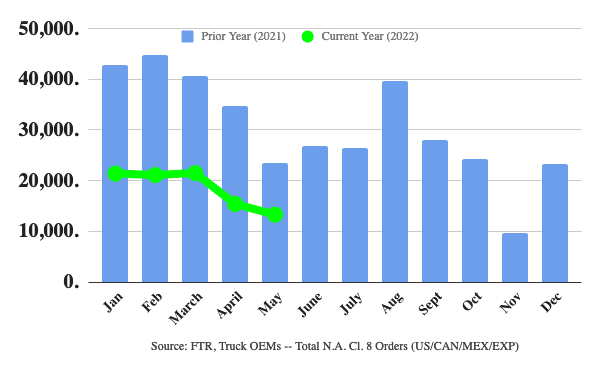
Class 8 truck orders remain down from last year as truck makers struggle with supply-chain issues.
Source: FTR
3 min to read
North American Class 8 truck orders for May were between 13,300 units and 14,000, according to FTR and ACT Research preliminary estimates.
FTR notes its 13,300 estimate is the lowest total since November 2021. May order activity was down 13% month over month and down 43% from a year earlier. Class 8 orders have totaled 270,000 units over the last 12 months.
FTR explains that truck makers are quickly running out of build slots for 2022, and with production still constrained by the supply chain, especially semiconductors, they cannot increase build rates this year. OEMs are not booking many orders for 2023 yet because the cost of commodities and other components are inflated and variable, making accurate quoting difficult.
“The supply chain was making slight improvements in the last few months, but some of that progress stalled due to disruptions in China and Russia,” said Don Ake, FTR vice president of commercial vehicles. “The OEMs are not confident they can increase production in the second half of the year; therefore, they are not able to take more orders.”
Nevertheless, he said, demand for new trucks remains healthy. Freight is growing and fleets need more trucks to keep up with customer demands and to trade in older vehicles. The supply of new trucks has been running way behind demand for over a year now, and many fleets need to catch up to their replacement cycles.
“This is like ticket sales for a popular concert,” Ake explains. “At the beginning, sales are high because there are plenty of seats available. But at the end, fewer tickets are sold because there are fewer seats to sell. There just aren’t many build slots still open in 2022. Orders could even slide under 10,000 in the summer months before the cycle begins for next year.”
‘Mild Improvement’
ACT Research estimates showed Class 8 net orders in May were 14,000 units, while Class 5-7 net orders moderated to 17,000 units.
“We are coming to that time of year when orders tend to be seasonally weak, as OEMs typically have yet to open their forward-year build schedules, as is currently the case for 2023,” said Eric Crawford, ACT vice president and senior analyst. “Thus, May’s sequential decline in Class 8 orders from April actually reflects some mild improvement on a seasonally adjusted basis.
“So despite broader macro uncertainty about Russia/Ukraine, interest rates, and potential recession, the prevailing theme in trucks is largely unchanged,” Crawford said. “Long backlogs and supply-chain constrained production continue to keep new orders trending within a narrow range.”
Regarding the heavy-duty segment, Crawford noted, “With Class 8 backlogs stretching through 2022 and still no clear visibility on the easing of the all-things shortage, May’s net orders reflect a mild upside surprise, albeit one still in line with the ongoing conservative approach by OEMs looking to limit the risk of overbooking and underbuilding that plagued the industry in 2021.” About medium-duty, he said, “May’s order moderation for Classes 5-7 follows this segment’s near all-time backlog levels in April.”
Light at the End of the Tunnel?
Daimler Truck officials told Bloomberg that they see signs of the chip shortage easing. Daimler Truck’s Karin Radstrom said the world’s largest truck maker has so far evaded disruption from coronavirus lockdowns in China.
“It’s better, it’s not perfect, but it’s better than last year,” Radstrom said in an interview with Bloomberg. “I try to not celebrate too early; we’re still monitoring the situation closely.”
More Equipment

How Volvo Updated Its D13 for EPA 2027 [Watch]
Volvo’s updated D13 promises lower emissions without sacrificing performance or fuel economy. Take a closer look at what changed inside the engine in this HDT Spotlight video.
Read More →
Michelin Tire Improves Efficiency and Durability for Regional Fleets
The Michelin X Multi Energy D2 is a regional haul drive tire engineered to help fleets improve fuel efficiency, durability and traction in demanding stop-and-go operations.
Read More →
ZF Expands Commercial Vehicle Push in North America
ZF is expanding its North American commercial-vehicle presence with new transmission applications, electrification, trailer technology and autonomous-driving systems.
Read More →
Tesla Wants a Self-Driving Semi. Are Cameras Enough?
Could Tesla’s camera-only autonomous driving technology work on an 80,000-pound Semi? In this commentary, HDT's Deborah Lockridge takes a look at Tesla, Cybercab, and how autonomous trucks see the road.
Read More →
Kodiak: Driverless Long-Haul Truck Launch on Track for 2026
Kodiak AI says its driverless long-haul safety case is 93% complete and it remains on track to begin commercial operations by year-end 2026.
Read More →
What DOT’s Automated Vehicle Strategy Means for Trucking
The U.S. Department of Transportation issued a new automated-vehicle strategy that outlines plans for driverless-truck regulations, cross-state freight corridors, and federal safety standards.
Read More →
East Coast Port Launches $45M Electric Truck Push
The Port Authority of New York and New Jersey announced millions in incentives for zero-emission drayage trucks, yard tractors, and new charging hubs near the port.
Read More →
PlusAI Going Public to Fund Autonomous Truck Launch
A SPAC deal could provide PlusAI with up to $300 million as it works toward a 2027 commercial launch of factory-built autonomous trucks.
Read More →
NHTSA Moves to Rewrite Truck Fuel-Economy Rules
The National Highway Traffic Safety Administration says it lacks authority to regulate medium- and heavy-duty truck engines separately from complete vehicles, but the existing standards have not yet been eliminated.
Read More →
Detroit Opens Orders for EPA 2027 Engines
Detroit isn’t starting from scratch to meet EPA 2027 diesel emissions standards. Its Gen 6 DD13 and DD15 engines keep much of today’s platform while updating the fuel and aftertreatment systems.
Read More →