




Maverick Focuses on Training to Slow Driver Turnover
Amid growing concern about a shortage of drivers, Maverick Transportation is laying the foundation for a long-term solution by improving driver training. At an ALK Transportation Technology Summit in Princeton, N.J., last week, there was much talk about a coming convergence of circumstances that will tip the balance of driver supply and demand.

Amid growing concern about a shortage of drivers, Maverick Transportation is laying the foundation for a long-term solution by improving driver training.
At an ALK Transportation Technology Summit in Princeton, N.J., last week, there was much talk about a coming convergence of circumstances that will tip the balance of driver supply and demand.
“Any disruption is going to put us in a state of flux,” said Tommy Barnes, president of Con-way Multimodal.
In a similar vein, Derek Leathers, president and COO of Werner Enterprises, warned that soon there will be a pinch on driver supply as demand for freight services pick up.
For Curt Valkovic, director of driver training at Maverick, evidence of the pending shortage shows up in the demographics of the people who apply for training.
“It’s getting harder to find experienced drivers,” he said. “Eighty-five to 90% of applicants come in with less than six months experience in trucking.”
That’s a training issue, but it’s also closely connected to morale. And morale is key to keeping drivers behind the wheel once they are trained.
Drivers move on for the obvious reasons that the lifestyle is tough and they are not paid well enough, but there’s another, more important motivator.
The biggest problem is that drivers feel they have not been treated fairly, said Cindy Nelson, vice president of marketing and business development for EBE Technologies. EBE helped Maverick build the framework for its new training system.
Valkovic and his team were going after two things when they designed their system. One was to automate the voluminous tracking requirements for a training curriculum that serves as 1,200-truck fleet with several diverse business units. The other was to imbed the moral value of accountability in the process.
“What I love seeing more than anything is a driver who comes in without a clue and as they go through this program you see them developing pride in themselves,” Valkovic said.
“They’re so excited that they chose a company that holds them accountable.”
Valkovic took the opportunity to mention that he’s a fan of the Federal Motor Carrier Safety Administration’s CSA program, mainly for its emphasis on accountability.
Maverick built accountability into the system by requiring trainees to confirm that they understand each stage of the curriculum and the performance that is expected of them.
“We do have people who leave because they don’t want to be held to that standard, but it’s so awesome to see a guy or a lady stay and elevate themselves.”
These are the drivers who stick around, Valkovic said.
Details of the Program
Valkovic said he and his team spent 18 months writing the logic that EBE plugged into its software framework.
They already had the training curriculum but the program was built on paper. More than 1,400 pieces of data per driver had led to file rooms filled with paper.
They needed to automate in order to go paperless, and to manage the differing levels of experience among trainees and the company’s dissimilar business operations, as well as ensure quality, data tracking and Maverick’s commitment to a green work environment.
“It’s a very structured environment,” Valkovic said.
The skills portion of the curriculum, for example, includes map reading, trip planning, logging, breakdown procedures, time management, use of the Qualcomm onboard communications system, cargo securement, simulator training and value-based driving.
That last point goes to what Valkovic described as “a moral obligation.”
“Drivers have to be compassionate and caring people,” he said. “We have a moral obligation to do the right thing for these people who choose this industry.”
Maverick started phasing in the program last year and already Valkovic has seen an improvement in retention. Turnover has dropped from 75% to 63%. He’s saving five to six hours a week in documentation, as he’s gain flexibility in the training program.
And would-be drivers are starting to look at Maverick for the quality of the program. A recent survey of 300 trainees showed that 62% were attracted by the educational opportunity, Valkovic said.
He added that the training program is helping Maverick in its transition to performance-based pay for drivers.
In that program, the company pays a flat rate per mile and offers the opportunity to earn up to an additional 6 cents per mile based on performance in key areas such as miles per gallon, out-of-route and safe driving.
“Information on performance-based pay is part of the training curriculum,” he said. “Trainees start seeing it from day one.”
One of the things Valkovic likes most about the program is that he controls it and can make changes without having to go through EBE.
While the details of the Maverick program are proprietary, the framework can be adapted by other carriers and Nelson said EBE is working with a half-dozen fleets to do that.
More Fleet Management
For Nicky Cupp, Fleet Innovation Starts With Frustration
HDT Truck Fleet Innovator Nicky Cupp turns everyday pain points at Fraley & Schilling into opportunities for better technology and smarter processes.
Read More →
Adam Buttgenbach’s Approach to Electric Trucks: Start With Where They Fit
HDT Truck Fleet Innovator Adam Buttgenbach helped PepsiCo build one of North America’s largest EV fleets by focusing on where electric trucks make operational sense.
Read More →
Deen Albert: Let Automation Do the Math, People Make the Decisions
HDT Truck Fleet Innovator Deen Albert makes sure people are still at the heart of operations at Grand Island Express, even while adopting artificial intelligence tools. AI-assisted dispatch helped boost revenue 25% with the same number of trucks.
Read More →
Trimble’s New AI Agent Takes Aim at Fleet Back-Office Busywork
Arc Agent works across Trimble TMS products to automate repetitive tasks such as freight orders, maintenance, invoices, fuel costs and more.
Read More →
How HDT’s 2026 Truck Fleet Innovators Are Rethinking Fleet Operations
Meet five trucking leaders who are challenging assumptions, solving operational problems, and putting innovative ideas to work.
Read More →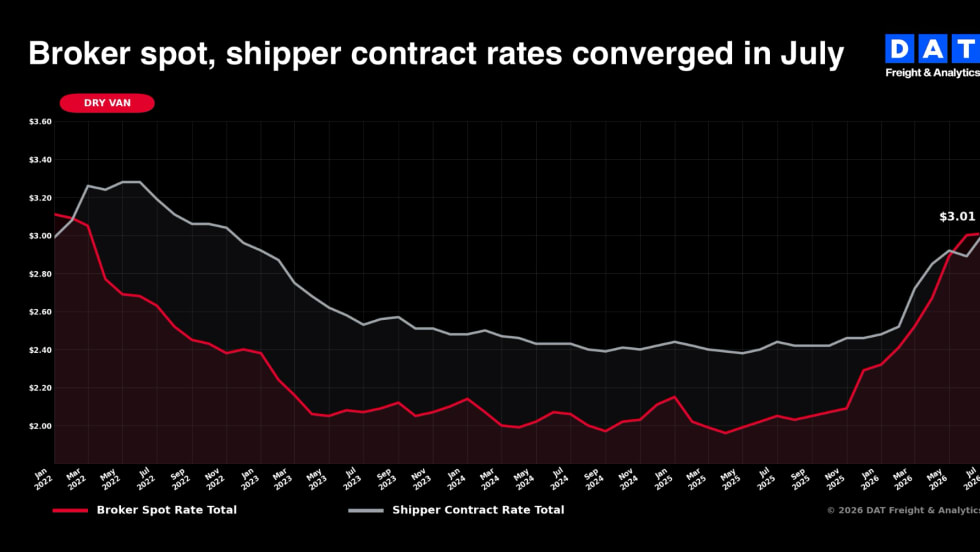
Tight Trucking Capacity Pushes Rates Higher Even as Freight Volumes Fall
“Spot rates moving ahead of contract rates have historically signaled a tightening market, but we haven’t seen a capacity-driven market quite like this one,” said DAT's Dean Croke.
Read More →
Import Cargo’s Early Peak Season is Winding Down
There was an early start to peak season this year at the nation's gateway ports, as retailers brought in merchandise ahead of tariff changes in late July and responded to other supply chain uncertainties,
Read More →
Fewer Cargo Thefts, Bigger Losses: Criminals Target Higher-Value Loads
CargoNet says organized theft rings are stealing fewer shipments but choosing more valuable freight, including metals and technology, resulting in record losses.
Read More →
How Innovative Trucking Leaders Turn Change Into an Advantage
As the pace of change accelerates in trucking, the fleets that adapt best have more than the latest technology. They have cultures that embrace improvement.
Read More →
Freight Broker Bonds Just Got Harder to Get. Here's What That Means for Your Fleet.
When it gets harder for a freight broker to prove they are financially sound, the ones who cannot clear that bar get pushed out of the market. And those are exactly the brokers who used to leave motor carriers holding the bag.
Read More →