




Werner’s Derek Leathers on the Industry Outlook
Slowly but steadily, freight demand is growing, said Derek Leathers, president and COO of truckload carrier Werner Enterprises, speaking at the ALK Transportation Technology Summit Wednesday.

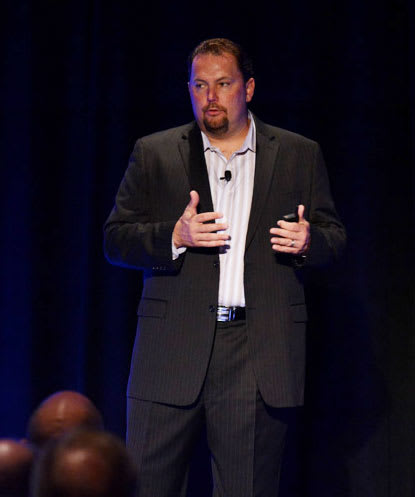
Werner Enterprises' Derek Leathers speaks at the annual ALK Summit.

Werner Enterprises' Derek Leathers speaks at the annual ALK Summit.
Slowly but steadily, freight demand is growing, says Derek Leathers, president and COO of truckload carrier Werner Enterprises. More demand is good, he says, but the risk is that it brings the truckload industry closer to an imbalance that could disrupt distribution.
Leathers, speaking at the ALK Transportation Technology Summit in Princeton, N.J., Wednesday, said that the supply-demand equilibrium has been tightening in recent months but not enough to expose how close the balance is.
We’re at the point where small variances in the supply chain can make a big difference, Leathers said.
For instance, the demand for beverages and snacks for Memorial Day could bounce up against demand for yard tools that has been delayed by cool April weather, he said. That may explain why Werner is seeing strong increases in its measurements of pending near-term demand.
It’s a situation that’s been created by a long-term downward trend in truckload capacity. Industry capacity is down 9.6% since the first period of 2008, and 17.6% since the fourth period of 2006, he said.
Truckload companies are not positioned to dramatically expand their fleets any time soon. Even replacing aging trucks is a problem, Leathers said.
The fleet now averages 6.6 years in age, compared to a normal age of 5.5. Leathers said the cost of rejuvenation would be $54 billion over two years.
“Where will the money come from?” Leathers asked. Interest rates are low but banks are not willing to lend.
The solution will involve making the most of in-house productivity with new technology tools to manage freight, and using other modes to move freight where it makes sense, he said.
Technology is not a solution by itself, he added.
“You need the proper blend between technology and human interaction,” he said. “If you have a broken process or broken strategy, all the technology in the world ain’t gonna fix that, it’s just going to make it very efficiently wrong.”
The fleets that survive will be the ones that can offset rate increases with innovation, he said.
“The secret sauce is to find a way to move less loads. You need to have the optimization and collaboration that is required to thread the needle to get the rate you need while respecting the customer’s need to lower costs.”
Intermodal opportunities will be another key to success, he said.
“We are in midst of a renaissance in intermodal.”
The opportunity is limited by the nature of rail versus freight: 77% of all freight moves by truck in ways that are not competitive with rails, and 15% of rail freight is not competitive with trucks.
But 5% of trucking could go by rail, and 3% of rail freight could go on the highway.
“Our job as logistics providers is to look every day for increased opportunities to save our customers money and one of the lowest hanging fruits is in that small sliver to maximize the conversion opportunity.”
That means putting the best intermodal freight on rail.
“We must continuously look for the best combined efforts of all modes. It’s where technology can make a difference,” he said.
“Absent that, we will have a freight capacity tightness that will be a net negative for the economy.”
Leathers also said that “nearshoring” to Mexico is growing rapidly, referring to manufacturing work that is being relocated from Asia to Mexico.
Manufacturers are not shutting down their Asian plants but are moving their incremental growth back to Mexico, in part to balance fuel costs.
Leathers is not optimistic about the possibility of improving trucking productivity by increasing sizes and weights.
He would like to see a change that allows 88,000-pound, 5-axle trucks, rather than current legislation that would allow states to permit 97,000-pound, 6-axle units.
The 88,000-pound trucks can stop as well as the current 80,000-pound standard, and the industry would not have to buy new trailers and axles.
He also would like for states to be able to establish regional corridors where certain types of operations could run heavier vehicles.
“(But) there’s very little chance of success,” he said. “I just don’t think it’s going to happen.”
Leathers is not pleased with the way federal safety regulations are being implemented.
“Hours of service, CSA…regardless of how clearly you demonstrate how the regulation has missed the mark, it takes too long to fix.”
One problem with the HOS rule is that mandatory electronic logging is not yet in place, so there’s no way to ensure that the rules are being obeyed.
“We missed the mark on this one,” he said. “We need to focus on electronic logs to ensure that we are compliant.”
CSA brought the driver to the table, a good thing, but it is flawed by a lack of correlation between scores and safety performance. Under CSA, 329,000 carriers have been inspected but only 89,134 have enough inspections to generate a Safety Management System score, he said.
More Fleet Management

For Nicky Cupp, Fleet Innovation Starts With Frustration
HDT Truck Fleet Innovator Nicky Cupp turns everyday pain points at Fraley & Schilling into opportunities for better technology and smarter processes.
Read More →
Adam Buttgenbach’s Approach to Electric Trucks: Start With Where They Fit
HDT Truck Fleet Innovator Adam Buttgenbach helped PepsiCo build one of North America’s largest EV fleets by focusing on where electric trucks make operational sense.
Read More →
Deen Albert: Let Automation Do the Math, People Make the Decisions
HDT Truck Fleet Innovator Deen Albert makes sure people are still at the heart of operations at Grand Island Express, even while adopting artificial intelligence tools. AI-assisted dispatch helped boost revenue 25% with the same number of trucks.
Read More →
Trimble’s New AI Agent Takes Aim at Fleet Back-Office Busywork
Arc Agent works across Trimble TMS products to automate repetitive tasks such as freight orders, maintenance, invoices, fuel costs and more.
Read More →
How HDT’s 2026 Truck Fleet Innovators Are Rethinking Fleet Operations
Meet five trucking leaders who are challenging assumptions, solving operational problems, and putting innovative ideas to work.
Read More →
Tight Trucking Capacity Pushes Rates Higher Even as Freight Volumes Fall
“Spot rates moving ahead of contract rates have historically signaled a tightening market, but we haven’t seen a capacity-driven market quite like this one,” said DAT's Dean Croke.
Read More →
Import Cargo’s Early Peak Season is Winding Down
There was an early start to peak season this year at the nation's gateway ports, as retailers brought in merchandise ahead of tariff changes in late July and responded to other supply chain uncertainties,
Read More →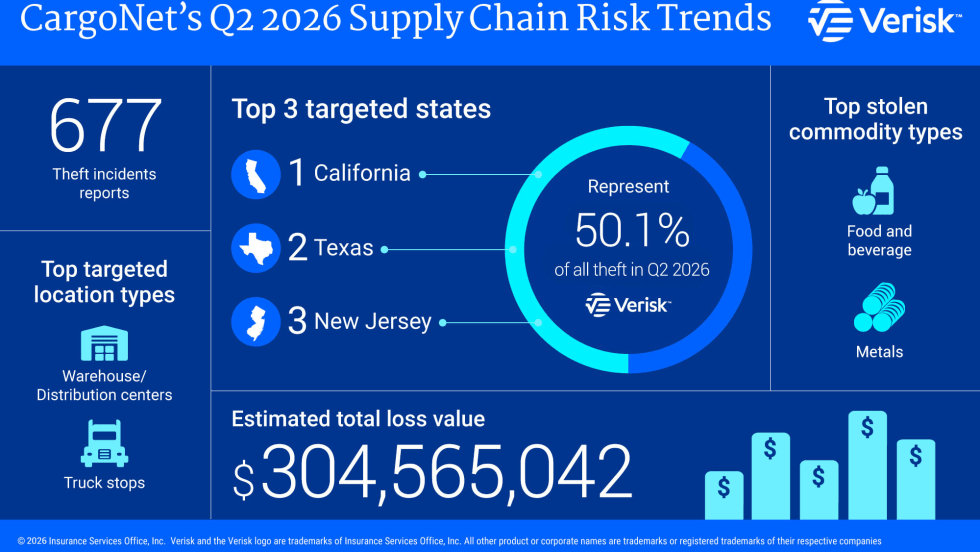
Fewer Cargo Thefts, Bigger Losses: Criminals Target Higher-Value Loads
CargoNet says organized theft rings are stealing fewer shipments but choosing more valuable freight, including metals and technology, resulting in record losses.
Read More →
How Innovative Trucking Leaders Turn Change Into an Advantage
As the pace of change accelerates in trucking, the fleets that adapt best have more than the latest technology. They have cultures that embrace improvement.
Read More →
Freight Broker Bonds Just Got Harder to Get. Here's What That Means for Your Fleet.
When it gets harder for a freight broker to prove they are financially sound, the ones who cannot clear that bar get pushed out of the market. And those are exactly the brokers who used to leave motor carriers holding the bag.
Read More →