




Marine Highways Not Seen As Big Competitor to Trucking
"You're not going to move flat screen TVs by water," said Lana Batts, a managing partner at Transport Capital Partners, in response to the Department of Transportation's recent announcement aimed at moving more cargo on the
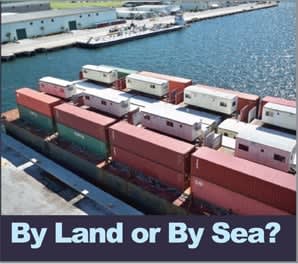
(Photo courtesy of SeaBridge Freight)
"You're not going to move flat screen TVs by water," said Lana Batts, a managing partner at Transport Capital Partners, in response to the Department of Transportation's recent announcement aimed at moving more cargo on the water than on the U.S. highways.
Wednesday, U.S. Transportation Secretary Ray LaHood announced the "America's Marine Highway" program, which will help identify rivers and coastal routes that could carry cargo efficiently
, bypassing congested roads around busy ports and reducing greenhouse gases.
Industry analysts and stakeholders said the new initiative has its pros and cons, but maritime transportation can only work under certain circumstances. It typically suits heavy, dense commodities such as coal, sand, gravel and grain, according to Batts as well as Clayton Boyce, spokesman for the American Trucking Associations. These types of commodities don't require just-in-time delivery.
"It doesn't really matter when it gets there," Batts said.
"If it needs to get there in a day or two days, you're going to put it on a truck," said Boyce.
But Hank Hoffman, president and CEO of SeaBridge Freight, says marine can be very competitive with truck on transit time. This year, SeaBridge, an intermodal company based in Florida, plans to add a second tug and barge, which will provide a five-day cycle and give the company the ability to move to a different class of cargo.
Larry Gross, senior consultant and intermodal expert for FTR Associates, said moving some cargo from truck to marine highway is an option -- in very limited circumstances.
"You're going to have very specific types of freight that will be amenable to that, and there is a possibility I think for a small portion of freight to be diverted from the highway to the water," he says. But he emphasizes that it's a very small portion indeed.
Intermodal Insights
Gross points out that rail intermodal, although its market share of the long-haul truckload market has been growing and hit 13.3 percent at the end of last year, is still only about 4 percent of total dry van movements and no more than 1.5 percent of total truck movements. Marine highways will be even less significant.
"If [rail] intermodal is a small component, then [marine highways] will be an infinitesimally small component in terms of its ability to actually absorb significant amounts of truck freight," he said.
Stifel Nicolaus trucking analysts attended the North American Marine Highways & Logistics Conference in Linthicum Heights, Md., this week. Among their key takeaways, they say, "For most modally competitive origin-destination pairs, short sea shipping is currently not an economically attractive mode. At current fuel prices, trucking is typically a more attractive option for shippers when considering cost and service levels."
According to Boyce, there aren't a lot of products that can be moved completely by rail or maritime, so there's usually going to be a truck on either end of the delivery. Therefore, he says, moving freight onto the water will concentrate truck traffic near the railroad/intermodal ramp or the ports. You're more likely to get complaints in those areas, whereas, traffic would be more dispersed in a total truck move, without hitting any choke points, Boyce says.
Hoffman, who has spent the bulk of his career in the trucking industry, says maritime transport provides trucking fleets with a low-cost way to hand off cargo and help them better utilize their own capacity. In reference to the new program, he believes it will help ports be good sponsors in helping to promote the Marine Highway Program.
Batts defines intermodal as "transport by truck and some other means." The truck is going to be part of the equation, unless "you can figure out how to get the barge to pull up to the dock at Wal-Mart."
The Jones Act
Another vital part of the equation, Batts says, is the Jones Act, which defines all maritime law in the U.S. This piece of legislation requires that all goods transported by water in the U.S. must be carried by U.S.-made ships and crewed by U.S. citizens. As a result, shipyards operate on a cost-plus basis, making coastal shipping a very expensive way to go, Batts said.
According to Batts, the legislation prevents shipyards from buying ships at a fraction of the price from other countries, making the industry less competitive.
"Until [the DOT is] willing to address the labor protection situation, it's never going to amount to anything," she said.
Trucking's Concern
Should the trucking industry be concerned? "Absolutely not," said Batts.
According to the ATA, the government cannot decide how to move goods; the shipper decides. "It doesn't work that way," Boyce said. "The market determines the best way to ship the goods."
Stifel Nicolaus analysts said they view short sea shipping "as an alternative that may become more attractive during periods of tight truckload capacity and/or high fuel prices, but is not likely to have an immediate impact on truckload carriers."
The concern, however, would come if the federal government throws money into this project because of "unrealistic expectations of that change and effects of the change," Boyce says.
Indeed, Stifel Nicolaus analysts observed at the marine highways conference this week, that "Carriers providing short sea shipping services, as well as some 'inside the beltway,' believe that government subsidies for short sea shipping are in the public's best interest."
The ATA fears the DOT will take money out of the Highway Trust Fund and put it into maritime or railroad investments. The Highway Trust Fund "should be used for its intended purpose," ATA's Boyd said, which is to improve the nation's highways. Federal funding, he says, is not a bad idea, but "that money should come from the right place."
More Drivers

Truck Drivers Need More Than Another Alert
Fleets have more visibility into truck health, safety events, and driver activity than ever. The next challenge is turning all that information into useful guidance for the person who has to decide what to do next.
Read More →
FMCSA Removes 110 Truck Driver Training Schools from Certified ELDT List
Federal regulators also are targeting more than 160 additional training providers and launching a nationwide audit of third-party CDL skills testers as part of a broader crackdown on trucking fraud.
Read More →
Hours of Service Pilot Programs: FMCSA Readies for 2027 Rollout
Two pilot programs could eventually reshape hours-of-service rules, giving truck drivers options to pause their 14-hour clock or use longer split sleeper rest periods.
Read More →
Medical Cards, English Proficiency Reshape Roadcheck Violations
Medical-card violations jumped to the top of the driver out-of-service list during CVSA’s 2026 International Roadcheck, while English-language proficiency violations appeared among the leading violations for the first time.
Read More →
Driver Trust Can Make or Break the Success of Fleet Safety Technology
New Teletrac Navman research suggests that onboarding, transparency about driver data, and positive feedback can play a significant role in how commercial drivers respond to safety and coaching technology.
Read More →
EEOC Sues KLLM Over Alleged Sex Discrimination in Driver Training
KLLM is facing a federal sex-discrimination lawsuit over policies the EEOC alleges put female truck driver trainees at a disadvantage.
Read More →
FMCSA Moves to Codify English Language Requirements for Commercial Drivers
By changing regulations on English-language proficiency requirements for commercial drivers, rather than relying on a guidance memo, the FMCSA said future administrations won't be able to walk back the Trump administration's stricter enforcement with just a memo.
Read More →
Drivers Put Western Star Trucks to the Test at Star Nation Experience
Watch to get an inside look at the Western Star trucks, technology, and community behind the Star Nation Experience 2026!
Read More →
Trump Administration Looks to Put More Veterans Behind the Wheel
The Freedom Haulers program pulls together existing and expanded programs at several federal agencies to recruit veterans to drive commercial heavy-duty trucks and cut the red tape for them to get a CDL, training, and employment.
Read More →
Putting Mack’s Command Steer to the Test
A test drive of Mack’s Command Steer active steering system evaluates how it can make truck driving easier and less tiring.
Read More →