





Related: California Bill Means 'End for Independent Trucking' in State
Lawsuit Challenges California Law Requiring Construction Truck Drivers to be Employees
The Western States Trucking Association filed a lawsuit in federal court challenging a construction-trucking-specific provision of California’s already controversial Assembly Bill 5, which severely restricts the use of independent contractors in the state.
December 20, 2019
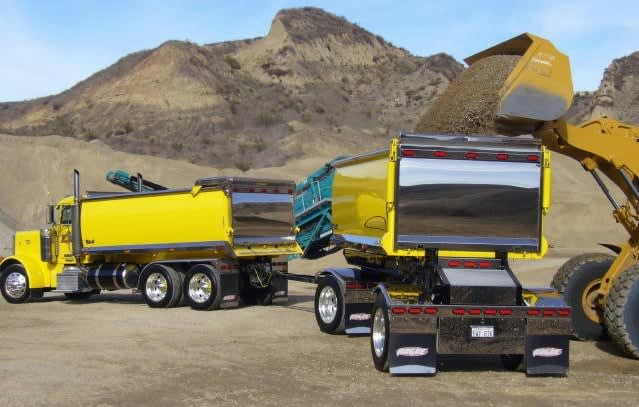
The independent contractor model has been a significant component of the construction trucking industry for decades, notes WSTA.
Photo courtesy Western States Trucking Association
3 min to read
The Western States Trucking Association filed a lawsuit in federal court challenging a construction-trucking-specific provision of California’s already controversial Assembly Bill 5, which severely restricts the use of independent contractors in the state.
AB 5, signed by Gov. Newsom in September and effective Jan. 1, 2020, dramatically affects all workers that have independent contractor status, “upending the market for owner-operator trucking companies by imposing massive liability upon those that contract with them,” according to a WSTA press release. But the group says it’s even worse news for the construction sector.
For most workers, AB 5 codified the California Supreme Court’s stringent ABC test from its 2018 Dynamex decision. It requires companies wishing to use independent contractors to meet all three requirements. At issue is the “B” prong of the test: That the worker performs work that is outside the usual course of the hiring entity’s business.
WSTA said that for motor carriers that provide “construction trucking services,” AB 5 included no test whatsoever. “Rather, it mandates that workers are employees rather than independent contractors. This mandate is clearly preempted by federal law, which prohibits states from enacting or enforcing any law or regulation related to the price, route, or service of a motor carrier,” the association explains in a press release.
WSTA was the first to file a lawsuit on behalf of the trucking industry when it challenged the original Dynamex decision back in 2018. When it became clear to WSTA during negotiations with the Legislature and stakeholders that AB 5 would be passed at the Capitol in a way that would render WSTA’s original Dynamex lawsuit moot and thus likely unsuccessful, it voluntarily dismissed its case on Sept. 4, 2019.
“However, with the subsequent inclusion of the offensive construction trucking provision in AB 5, WSTA determined that it was now appropriate and necessary to refile a lawsuit specifically targeting AB 5’s construction trucking provision in order to best protect its construction trucking members,” the release explained.
WSTA is not the only trucking group that has challenged the law in court. The California Trucking Association and two California-based owner-operators filed a challenge to the law in November.
CTA's suit argues that the classification test codified by AB 5 is preempted by the supremacy and commerce clauses in the U.S. Constitution and is in direct conflict with the Federal Motor Carrier Safety Act and the Federal Aviation Administration Authorization Act of 1994. (Part of the FAAAA bans states from enacting laws that affected a motor carrier's prices, routes and services.)
WSTA said it applauds the efforts of the California Trucking Association and others who are also challenging AB 5 in court.
“In its lawsuit, CTA has taken a broad approach and is challenging the ABC test itself as it applies to all motor carriers. Alternatively, WSTA’s lawsuit is narrowly focused on AB 5’s construction trucking provision in Labor Code section 2750.3, subdivision (f)(8), which does not utilize the ABC test. Given the unpredictability of the judicial system, it is possible that a judge could rule narrowly in the CTA case in a manner that does not provide adequate relief for construction trucking companies. As such, WSTA has filed this complementary case to ensure that its members are protected in each scenario.”
You can read WSTA's legal challenge on the association's website.
More Drivers

Truck Drivers Need More Than Another Alert
Fleets have more visibility into truck health, safety events, and driver activity than ever. The next challenge is turning all that information into useful guidance for the person who has to decide what to do next.
Read More →
FMCSA Removes 110 Truck Driver Training Schools from Certified ELDT List
Federal regulators also are targeting more than 160 additional training providers and launching a nationwide audit of third-party CDL skills testers as part of a broader crackdown on trucking fraud.
Read More →
Hours of Service Pilot Programs: FMCSA Readies for 2027 Rollout
Two pilot programs could eventually reshape hours-of-service rules, giving truck drivers options to pause their 14-hour clock or use longer split sleeper rest periods.
Read More →
Medical Cards, English Proficiency Reshape Roadcheck Violations
Medical-card violations jumped to the top of the driver out-of-service list during CVSA’s 2026 International Roadcheck, while English-language proficiency violations appeared among the leading violations for the first time.
Read More →
Driver Trust Can Make or Break the Success of Fleet Safety Technology
New Teletrac Navman research suggests that onboarding, transparency about driver data, and positive feedback can play a significant role in how commercial drivers respond to safety and coaching technology.
Read More →
EEOC Sues KLLM Over Alleged Sex Discrimination in Driver Training
KLLM is facing a federal sex-discrimination lawsuit over policies the EEOC alleges put female truck driver trainees at a disadvantage.
Read More →
FMCSA Moves to Codify English Language Requirements for Commercial Drivers
By changing regulations on English-language proficiency requirements for commercial drivers, rather than relying on a guidance memo, the FMCSA said future administrations won't be able to walk back the Trump administration's stricter enforcement with just a memo.
Read More →
Drivers Put Western Star Trucks to the Test at Star Nation Experience
Watch to get an inside look at the Western Star trucks, technology, and community behind the Star Nation Experience 2026!
Read More →
Trump Administration Looks to Put More Veterans Behind the Wheel
The Freedom Haulers program pulls together existing and expanded programs at several federal agencies to recruit veterans to drive commercial heavy-duty trucks and cut the red tape for them to get a CDL, training, and employment.
Read More →
Putting Mack’s Command Steer to the Test
A test drive of Mack’s Command Steer active steering system evaluates how it can make truck driving easier and less tiring.
Read More →