





Related: California Bill Means 'End for Independent Trucking' in State
California Governor Signs Law That Threatens Independent Contractor Status
California Gov. Gavin Newsom on Sept. 18 signed Assembly Bill 5 into law, a measure that trucking interests in the state say will wipe out the ability to use owner-operators.
September 18, 2019
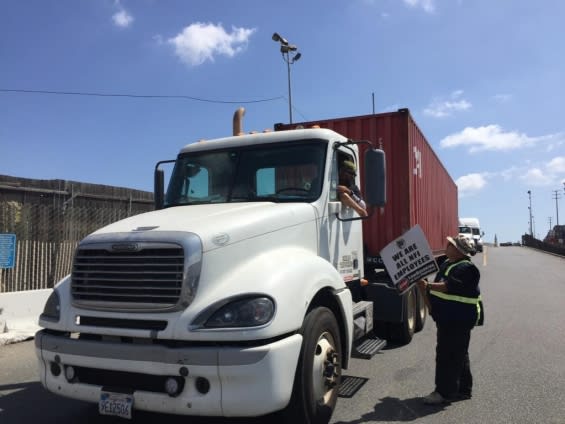
Teamsters from local unions within Joint Councils 7 and 42 took part in multiple lobbying days in Sacramento in support of AB5, meeting with legislators.
Photo: Teamsters
4 min to read
California Gov. Gavin Newsom on Sept. 18 signed Assembly Bill 5 into law, a measure that trucking interests in the state say will wipe out the ability to use owner-operators.
In a signing statement, Newsom called the bill “landmark legislation for workers and our economy.” It will reduce worker misclassification, he said, of workers being classified as independent contractors rather than employees, and tied the issue to “the hollowing out of our middle class.”
He said the next step is “creating pathways for more workers to form a union… while preserving flexibility and innovation.” He pledged to “convene leaders from the Legislature, the labor movement and the business community to support innovation and a more inclusive economy.”
Much of the attention around the bill, which goes into effect in January, has centered around “gig” workers, notably drivers for Uber and Lyft, who operate as independent contractors. The author of the bill, Assemblywoman Lorena Gonzalez (D-San Diego), called them out in her statement on the signing of the bill, but also truck drivers:
“By applying a strict test to determine who is an independent contractor and making employment status a default under the law, working Californians who have been kept off payroll as employees will gain access to basic labor rights for the first time, including rights to minimum wage, overtime, unemployment insurance, workers’ compensation, paid sick days, paid family leave, workplace protections against harassment and retaliation, and the right to form or join a union. Some of the many workers who will benefit include janitorial workers, construction workers, port truck drivers, home health aides, hotel and hospitality workers, delivery and ride-hail drivers.”
Truckers on both sides of the issue lobbied legislators on the bill. Teamsters from local unions within Joint Councils 7 and 42 took part in multiple lobbying days in Sacramento in support of AB5, meeting with legislators. Independent truckers told legislators about how they were building their own successful businesses and didn't want to be employees.
The California Trucking Association and the Western States Trucking Association have spoken out against the bill, saying it will end the use of independent contractor truckers in the states. CTA tried to work with legislators to address the issue of worker misclassification while still allowing “true” independent contractors to work in the industry.
Los Angeles-based Sandra Alzate, a WSTA board member, told Reuters that she hires independent owner-operators when her customers have more work than her four-truck company can handle on its own.
“I’m going to lose clients because I can’t provide the trucks they need for their jobs,” she said, adding she had already planned to invest $400,000 on two truck upgrades and cannot afford to hire additional drivers or buy additional rigs.
However, the Owner-Operator Independent Drivers Association takes a more wait-and-see attitude regarding how the new law will affect trucking. OOIDA told its California members, "We see it as self-inflicted by motor carriers after decades of treating drivers like indentured servants, perpetuating an environment with awful working conditions, and a failure to pay drivers anything close to a living wage. We know there is a concern that it might be difficult for many owner-operators and motor carriers to comply with the part 'B' requirement. At this time, we think that's a premature assumption.
"However, should this new law negatively impact legitimate independent owner-operators, we will challenge it in every way possible," OOIDA said. "Our hope is that it will force motor carriers in California to rethink the way they treat drivers and either hire them as employees or restructure traditional lease agreements to give owner-operators real independence. It's also possible we'll see wages increase as a result."
There is litigation challenging the applicability of this law to trucking, which was filed after the California Supreme Court ruled in the Dynamex case that the ABC test must be used when evaluating wage and hour classification in class action cases. The problem with the ABC test is the “B” prong, which states that to be a contractor, the worker must perform “work that is outside the usual course of the hiring entity’s business.”
The California Trucking Association's lawsuit argues that the Dynamex ruling should not be enforced because it is preempted under the supremacy clause of the U.S. Constitution. This sets the decision in direct conflict with a federal law Congress passed in 1994, part of the Federal Aviation Administration Authorization Act, to prevent states from enacting laws that affected a motor carrier's prices, routes and services. The Dynamex decision also imposes an impermissible burden on interstate commerce under the U.S. Constitution’s commerce clause, CTA contends.
Meanwhile, Uber and Lyft have said they are making no plans to turn their contractors into employees, claiming the law doesn’t apply to them. The drivers aren’t part of the “usual course” of their business, they contend, because they are simply tech platforms for digital marketplaces and aren’t actually in the business of providing transportation.
But they’re hedging their bets, too. Recently, Uber, Lyft, and DoorDash announced they’re pouring $90 million into a 2020 California ballot initiative that would directly appeal to voters to undo the legislation.
Full text of the bill: http://leginfo.legislature.ca.gov
More Drivers

Truck Drivers Need More Than Another Alert
Fleets have more visibility into truck health, safety events, and driver activity than ever. The next challenge is turning all that information into useful guidance for the person who has to decide what to do next.
Read More →
FMCSA Removes 110 Truck Driver Training Schools from Certified ELDT List
Federal regulators also are targeting more than 160 additional training providers and launching a nationwide audit of third-party CDL skills testers as part of a broader crackdown on trucking fraud.
Read More →
Hours of Service Pilot Programs: FMCSA Readies for 2027 Rollout
Two pilot programs could eventually reshape hours-of-service rules, giving truck drivers options to pause their 14-hour clock or use longer split sleeper rest periods.
Read More →
Medical Cards, English Proficiency Reshape Roadcheck Violations
Medical-card violations jumped to the top of the driver out-of-service list during CVSA’s 2026 International Roadcheck, while English-language proficiency violations appeared among the leading violations for the first time.
Read More →
Driver Trust Can Make or Break the Success of Fleet Safety Technology
New Teletrac Navman research suggests that onboarding, transparency about driver data, and positive feedback can play a significant role in how commercial drivers respond to safety and coaching technology.
Read More →
EEOC Sues KLLM Over Alleged Sex Discrimination in Driver Training
KLLM is facing a federal sex-discrimination lawsuit over policies the EEOC alleges put female truck driver trainees at a disadvantage.
Read More →
FMCSA Moves to Codify English Language Requirements for Commercial Drivers
By changing regulations on English-language proficiency requirements for commercial drivers, rather than relying on a guidance memo, the FMCSA said future administrations won't be able to walk back the Trump administration's stricter enforcement with just a memo.
Read More →
Drivers Put Western Star Trucks to the Test at Star Nation Experience
Watch to get an inside look at the Western Star trucks, technology, and community behind the Star Nation Experience 2026!
Read More →
Trump Administration Looks to Put More Veterans Behind the Wheel
The Freedom Haulers program pulls together existing and expanded programs at several federal agencies to recruit veterans to drive commercial heavy-duty trucks and cut the red tape for them to get a CDL, training, and employment.
Read More →
Putting Mack’s Command Steer to the Test
A test drive of Mack’s Command Steer active steering system evaluates how it can make truck driving easier and less tiring.
Read More →