





Related – Drivers: Hire Fewer, Keep More
Labor Department Analysis Questions Driver Shortage
The American Trucking Associations has long said there’s a severe driver shortage, driven by factors such as demographic changes and an overall tight work force. The Owner-Operator Independent Drivers Association contends there’s really not a shortage – just a shortage of pay and an abundance of poor treatment. Now an article published by the U.S. Department of Labor has provided new fuel for debate.
March 20, 2019

Credit:
File image
5 min to read
The American Trucking Associations has long said there’s a severe driver shortage, driven by factors such as demographic changes and an overall tight work force. The Owner-Operator Independent Drivers Association contends there’s really not a shortage – just a shortage of pay and an abundance of poor treatment. Now an article published by the U.S. Department of Labor has provided new fuel for debate.
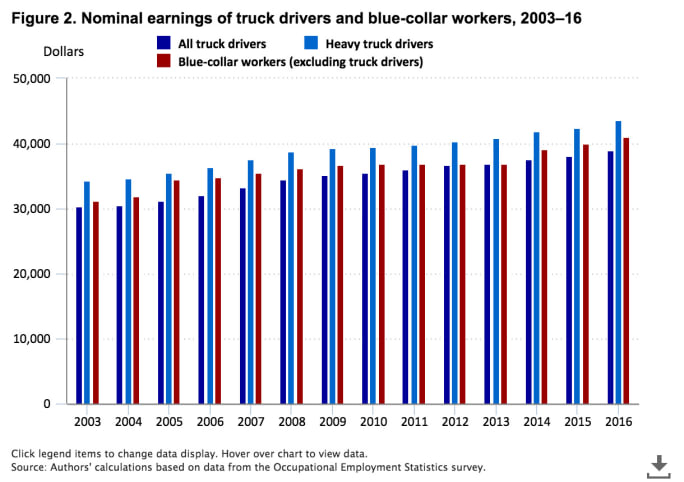
In an article titled, “Is the U.S. labor market for truck drivers broken?” published in the deparment's Monthly Labor Review, Stephen Burks, a professor in the Department of Economics at the University of Minnesota Morris, and Kristen Monaco with the U.S. Bureau of Labor Statistics, dig into various labor statistics and conclude that, “As a whole, the market for truck drivers appears to work as well as any other blue-collar labor market, and while it tends to be ‘tight,’ it imposes no constraints on entry into (or exit from) the occupation. There is thus no reason to think that, given sufficient time, driver supply should fail to respond to price signals in the standard way.”
In other words, from a big-picture economic standpoint, they say if driver wages go up enough, there should be no driver shortage.
They do, however, note that the problem is concentrated in the long-haul truckload segment of the industry. “The persistent issues localized in the TL segment are not visible in the aggregate data and require a distinct analysis,” not able to be analyzed by the data used for this particular article.
(Note: The Department of Labor says the opinions in articles in its Monthly Labor Review do not represent official positions of the Bureau of Labor Statistics or the Department of Labor.)
OOIDA: Shortage is a Myth
OOIDA jumped on the research as justification for its stance on the driver shortage.
“We have often said that the notion of a driver shortage is a myth,” said Todd Spencer, OOIDA president, in a statement. “Our greatest concern about the perpetuation of the myth is that the misinformation is used to push agendas that are harmful to the industry and highway safety,” he said, referring to efforts to allow younger drivers to operate in interstate commerce.
OOIDA’s research foundation recently published two documents debunking the myth of a driver shortage. A fact sheetexplains how the industry isn’t afflicted with a shortage of drivers, but is actually plagued with overcapacity and driver retention. A second, accompanying document talks about how wages have decreased for truck drivers at large carriers and many have moved toward smaller fleets.
“Most carriers with high turnover do so by design,” said Spencer. “They could deal with driver turnover by offering better wages and benefits and improved working conditions. But putting younger drivers behind the wheel of a truck isn’t the solution, because it does nothing to address the underlying issues that push drivers out of the industry. It merely exacerbates the churn.”
ATA: Researchers Misunderstand Trucking Industry
Bob Costello, chief economist for ATA, however, told HDT the article “demonstrated some basic misunderstandings about the trucking industry generally and how we at ATA and in the industry discuss the driver shortage.”
“First, the trucking industry is large and diverse – with many types of carriers, services, jobs and career paths for drivers. ATA has long recognized this when we discuss the driver shortage – repeatedly emphasizing that the shortage is generally contained to one segment of our industry: the over-the-road or long-haul for-hire truckload segment. The authors go out of their way to say their data could not tell the difference between drivers in this segment and other drivers – this error is compounded by the fact that some of the data utilized in the analysis is nearly two decades old.
“Second, this work ignores ATA’s long-standing contention that at the heart of the shortage is the need for qualified drivers. Unlike other ‘blue collar’ jobs the authors compare truck drivers to, motor carriers cannot simply hire anyone to do the job. There are many barriers to entry for new drivers: age requirements, CDL testing standards, strict drug and alcohol testing regimes and, perhaps most importantly for many fleets, safe and clean driving records.
“Carriers repeatedly say it isn’t that they don’t have enough applicants for their open positions – they do. What they do not have is enough applicants who meet the demanding qualifications to be hired. In some cases, carriers must reject 90% of applicants out of hand because they fail to meet at least one of the prerequisites to drive in interstate commerce.”
Costello also notes that the authors’ own concession that wages are going up significantly, as motor carriers are unable to hire quality drivers, undercuts their conclusions. “This alone suggests there is a systemic issue with getting enough labor in the for-hire truckload driver market.”
Driver Shortage versus Profit Margins
Avery Vise, vice president of research for trucking analysts FTR, agreed with the analysis.
"The issue is that the 'price signals' (aka pay) tend to be slow in responding to the need for more drivers and typically are not set to guarantee that every seat is filled," he told HDT. "Carriers certainly don't want to get too aggressive and find themselves needing to pull back on pay rates. Moreover, trucking dynamics tend to ensure a certain chronic level of shortage because compensation is so directly tied to productivity, as opposed to most occupations where workers are paid salaries or hourly rates. If we get to a point where active capacity exceeds freight demand, then driver compensation would decline because drivers would get fewer miles.
"Put simply," Vise said, "the industry could eliminate a driver shortage by paying more, but it would do so by giving up margin – or worse – except perhaps during times like late 2017 through most of 2018. We do have periods like 2017 and 2018 where carriers find themselves scrambling for more drivers, but that's always going to happen."
Editor's Note, 3/25/2019: This article has been edited to clarify the relationship of the analysts to the Department of Labor. The Labor Department says the opinions in articles in its Monthly Labor Review do not represent official positions of the Bureau of Labor Statistics or the Department of Labor. The articles are intended to provide a deeper dive into labor‐related topics, and any opinions are strictly those of the authors.
More Drivers

FDA Eases Path for Oral-Fluid Testing
Federal actions could advance oral-fluid drug testing for truck drivers, but lab certification delays and marijuana rescheduling questions remain.
Read More →
Why Hiring Truck Drivers Is Getting Harder
Higher recruiting costs, a shrinking driver pool, and renewed pay competition are raising the stakes for fleets heading into 2027.
Read More →
Roehl Offers Truck Drivers $10,000 Retention Incentive
Payments begin after the first load and continue in mileage-based installments for eligible experienced drivers joining the fleet.
Read More →
Platform Science Adds Dispatch and Safety Tools
Four additions to PS Fleet help fleets monitor loads, manage driver coaching, share truck locations and adjust video system settings.
Read More →
When Language Stops the Truck: The Return of ELP Out-of-Service Orders
English language proficiency rules for commercial drivers aren’t new, but renewed out-of-service enforcement has raised the stakes. Here’s what carriers need to know before a driver reaches a roadside inspection.
Read More →
Samsara Launches Custom AI Agent Builder
Agent Studio lets fleets create AI tools for hours-of-service monitoring, reporting and driver support, including agents that communicate by phone.
Read More →
Trucker Path Expands Reserved Parking Network
Trucker Path has added close to 6,000 more truck parking spaces to its Trucker Path Reserved Parking Network with the addition of Safe Truck Parking.
Read More →
EEOC Sues Texas Trucking Company Over Driver Age Limits
The agency says Trancasa USA rejected applicants over 65 and applied tougher driving-record standards to those over 60.
Read More →
Nussbaum, Roehl Announce Second Driver Pay Increase This Year
This year has seen a swath of major truck driver pay increases as freight capacity has tightened.
Read More →
From One Generation to the Next: How Mentorship Builds Safer Truck Drivers
After three decades in trucking, Harold Perry shares what he's learned about driver safety, mentorship, and helping the next generation build confidence behind the wheel.
Read More →