




Kodiak Robotics Demonstrates Tire Blowout on Self-Driving Truck
Steer tire blowouts instantly cause trucks to behave erratically and unpredictably. Kodiak said its self-driving trucks can instantly react to the change in vehicle dynamics.

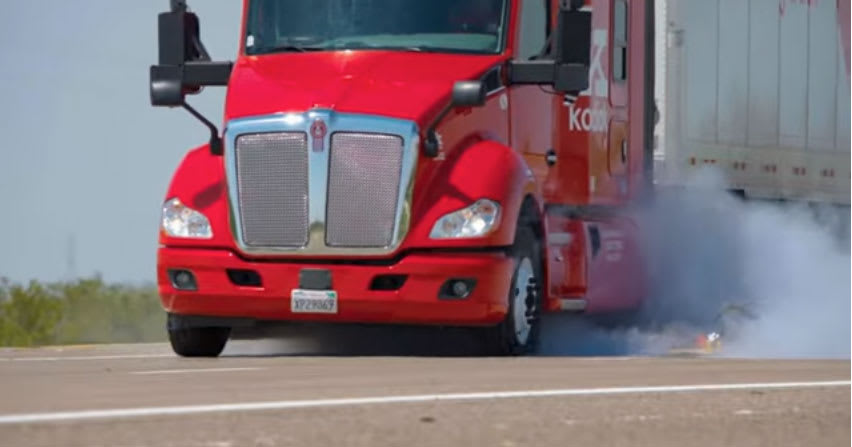
Kodiak said its technology can maintain such precise control in case of a blowout that the vehicle doesn’t even leave the lane.
Screen capture of Kodiak video
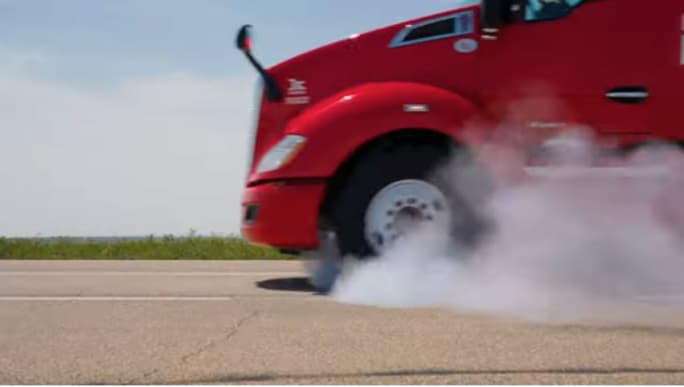
Kodiak used a test rig to puncture the left-front steer tire.
Screen capture of Kodiak video
In its latest demonstration of how its autonomous truck can handle unexpected occurences on the highway, Kodiak Robotics released a video showing how its autonomous technology, the Kodiak Driver, can maintain control of the truck when it suffers a catastrophic steer-axle tire blowout.
The video shows a Kodiak self-driving truck rolling over a test rig that punctures the front driver-side tire of a Kodiak Class 8 tractor while the autonomous technology is engaged. Even after the tire is destroyed, the Kodiak Driver stays in control and brings the truck to a safe and complete stop while maintaining its lane, with the driver’s hands off the wheel.
Kodiak told HDT that the truck was traveling approximately 35 mph when it struck the spike. When asked about how it would perform at highway speeds, Dan Goff, Kodiak's head of external affairs, responded that Kodiak has tested the tire blowout in simulation at 65 mph. "The simulation shows that the truck would still remain in-lane if the truck was traveling at that speed."
Steer tire blowouts instantly cause trucks to behave erratically and unpredictably, potentially resulting in a loss of control, jackknifing, or other dangerous situations. The Federal Motor Carrier Safety Administration estimate in a 2015 report that tire problems were responsible for approximately 15% of truck-related crashes.
Kodiak said its self-driving trucks can instantly react to the change in vehicle dynamics. In the case of the blown tire, the truck compensates for the failed tire by applying an entirely different steering angle. This exercise has been repeated multiple times and Kodiak truck’s consistent ability to maintain its lane positioning illustrates the adaptability and control of the Kodiak Driver, said the company in a news release.
“People ask us all the time ‘what happens if you blow a tire,’ and we wanted to showcase how the Kodiak Driver can maintain control more precisely than a traditional truck, even with a completely destroyed tire,” said Don Burnette, founder and CEO, Kodiak Robotics. “We can’t control the hazards trucks will face on the open road, but we can control how the trucks behave when a critical situation occurs.”
This blown tire demonstration relies on Kodiak’s fallback technology that guides Kodiak’s self-driving trucks to a safe stop in the event of a critical system failure. Upon experiencing the blowout, the autonomous system can immediately detect the tire fault, identify and adapt to the new vehicle dynamics, initiate the fallback protocol, trigger the hazard lights to turn on, and bring the truck to a stop within the lane. The speed of detection and level of control is critical for ensuring the safety of all motorists.
In order to clearly demonstrate the Kodiak Driver’s ability to maintain precise control in such a volatile situation, Kodiak chose to execute an in-lane fallback at a proving grounds in Texas. If a tire were to blow in a real-world setting, Kodiak explained, the truck would automatically execute its fallback plan, typically pulling it to a safe stop on the side of the road.
Updated 11/22/2022 to add information about the speed the truck was traveling at the time of the blowout.
More Equipment

How Volvo Updated Its D13 for EPA 2027 [Watch]
Volvo’s updated D13 promises lower emissions without sacrificing performance or fuel economy. Take a closer look at what changed inside the engine in this HDT Spotlight video.
Read More →
Michelin Tire Improves Efficiency and Durability for Regional Fleets
The Michelin X Multi Energy D2 is a regional haul drive tire engineered to help fleets improve fuel efficiency, durability and traction in demanding stop-and-go operations.
Read More →
ZF Expands Commercial Vehicle Push in North America
ZF is expanding its North American commercial-vehicle presence with new transmission applications, electrification, trailer technology and autonomous-driving systems.
Read More →
Tesla Wants a Self-Driving Semi. Are Cameras Enough?
Could Tesla’s camera-only autonomous driving technology work on an 80,000-pound Semi? In this commentary, HDT's Deborah Lockridge takes a look at Tesla, Cybercab, and how autonomous trucks see the road.
Read More →
Kodiak: Driverless Long-Haul Truck Launch on Track for 2026
Kodiak AI says its driverless long-haul safety case is 93% complete and it remains on track to begin commercial operations by year-end 2026.
Read More →
What DOT’s Automated Vehicle Strategy Means for Trucking
The U.S. Department of Transportation issued a new automated-vehicle strategy that outlines plans for driverless-truck regulations, cross-state freight corridors, and federal safety standards.
Read More →
East Coast Port Launches $45M Electric Truck Push
The Port Authority of New York and New Jersey announced millions in incentives for zero-emission drayage trucks, yard tractors, and new charging hubs near the port.
Read More →
PlusAI Going Public to Fund Autonomous Truck Launch
A SPAC deal could provide PlusAI with up to $300 million as it works toward a 2027 commercial launch of factory-built autonomous trucks.
Read More →
NHTSA Moves to Rewrite Truck Fuel-Economy Rules
The National Highway Traffic Safety Administration says it lacks authority to regulate medium- and heavy-duty truck engines separately from complete vehicles, but the existing standards have not yet been eliminated.
Read More →
Detroit Opens Orders for EPA 2027 Engines
Detroit isn’t starting from scratch to meet EPA 2027 diesel emissions standards. Its Gen 6 DD13 and DD15 engines keep much of today’s platform while updating the fuel and aftertreatment systems.
Read More →