





A Contrary Viewpoint: Is Hydrogen for Heavy Trucks a Fantasy?
Kenworth, Peterbilt Commercializing Fuel-Cell Electric Trucks
Paccar and Toyota are expanding their joint efforts to develop and produce zero-emissions, hydrogen fuel cell Kenworth and Peterbilt trucks powered by Toyota’s next-generation hydrogen fuel cell modules.
May 2, 2023
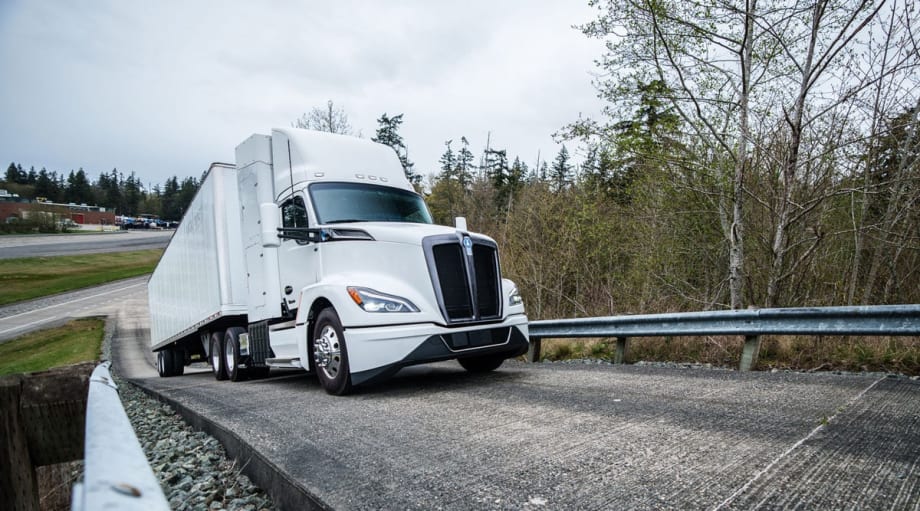
Kenworth is now accepting deposits for its first zero emissions Class 8 hydrogen fuel cell truck.
Photo: Kenworth
3 min to read
Paccar and Toyota are expanding their joint efforts to develop and produce zero-emissions, hydrogen fuel cell Kenworth and Peterbilt trucks powered by Toyota’s next-generation hydrogen fuel cell modules.
The expanded agreement supports ongoing development and commercialized zero-emission versions of the Kenworth T680 and Peterbilt 579 models featuring Toyota’s hydrogen fuel cell powertrain kit.
Paccar and Toyota have collaborated on FCEV truck development for the past several years, including a successful pilot program that deployed 10 Kenworth T680 FCEV trucks at the Port of Los Angeles. The pilot provided Kenworth and Toyota with real-world feedback that further enhanced the performance and range of the vehicle.
Designed for use in heavy-duty commercial vehicles, Toyota's heavy-duty fuel cell electric powertrain kit was recently awarded the Zero Emission Powertrain certification by the California Air Resources Board (CARB). Toyota will begin assembly of the modules in the United States in late 2023, with trucks becoming available in 2024 and 2025.
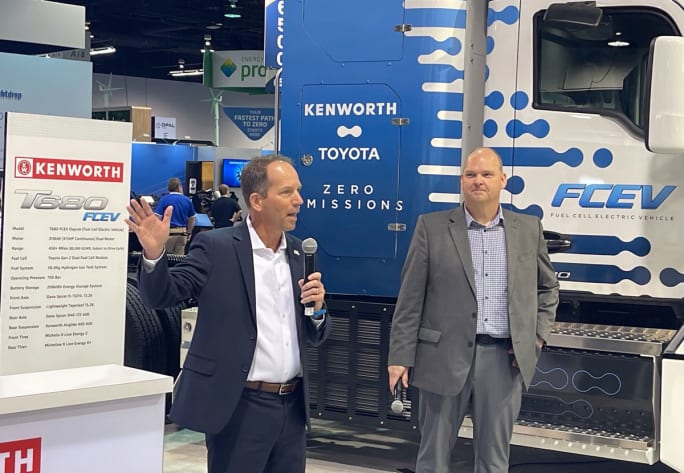
Joe Adams, Kenworth chief engineer (left) and Chris Rovik, executive program manager, advanced mobility, Toyota, discuss the companies’ heavy truck fuel-cell development partnership.
Photo: Jack Roberts
Kenworth T680 Hydrogen Fuel Cell Commercialization Plans
Kenworth is now accepting deposits for its first zero-emissions Class 8 hydrogen fuel cell truck. At the Advanced Clean Transportation Expo in Anaheim, California, May 2, the company announced it will begin production of its T680 hydrogen fuel cell electric vehicle powered by Toyota fuel cell technology.
Initial customer deliveries are planned for 2024 with serial production planned in 2025. Kenworth dealers in the United States and Canada are now accepting deposits for the first of these T680 FCEV builds.
Kenworth and Toyota collaborated closely on developing the T680 FCEV. Kenworth integrated Toyota’s latest advancements in hydrogen fuel cell technology into its flagship T680 on-highway truck. The T680 FCEV has a range of up to 450 miles, depending upon driving conditions.
“The T680 FCEV was engineered to offer one of the longest driving ranges of any zero emissions trucks on the market,” said Kevin Baney, Kenworth general manager and Paccar vice president. “With quick refueling, this broadens our zero-emission product offering to include round-the-clock operations in regional haul and demonstrates FCEV potential for long haul.”
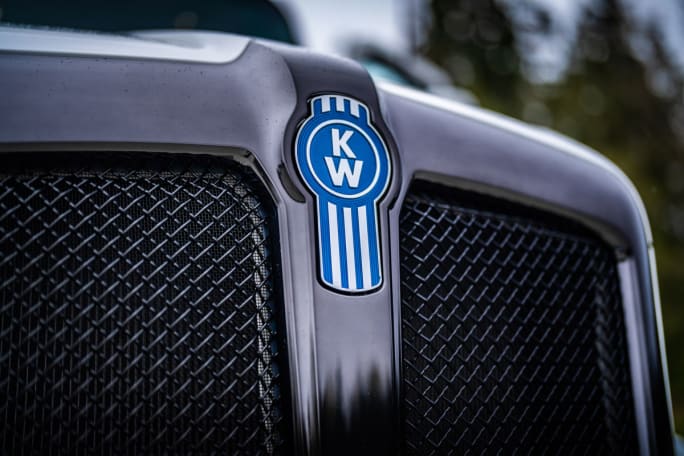
Kenworth's iconic badge turns blue for hydrogen fuel on the new FCEV trucks.
Photo: Kenworth
The truck is equipped with Toyota’s 310kW Dual Motor Assembly, capable of providing 415 horsepower continuously at a maximum payload of 82,000 lbs (GCWR), and the Toyota Gen 2 Dual Fuel Cell Module.
To learn more about the Kenworth T680 FCEV, visit www.Kenworth.com/trucks/t680-fcev/.
Peterbilt Announces Commercialization Plans For Hydrogen Fuel Cell Technology
Peterbilt also announced the addition of hydrogen fuel cell technology for its heavy-duty truck line-up at ACT Expo, saying the FCEV zero-emissions vehicles will be available in 2025.
“Peterbilt is quickly leveraging the lessons learned by Paccar on earlier hydrogen fuel cell projects to broaden our zero emissions powertrain solutions available to our customers,” said Jason Skoog, Paccar vice president and Peterbilt general manager. “Hydrogen fuel cell technology is a key component of a portfolio of Peterbilt zero-emissions vehicles that also includes our advanced battery-electric models. Our partnership with Toyota will deliver the most advanced fuel cell powertrain in the industry.”
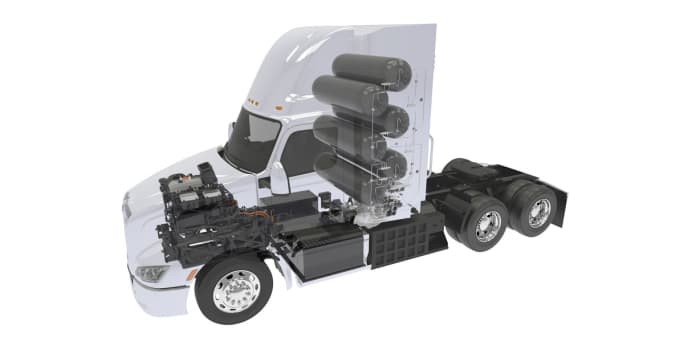
Peterbilt is leveraging the lessons learned by Paccar on earlier hydrogen fuel cell projects to broaden its zero-emissions powertrain solutions.
Photo: Peterbilt
Scott Newhouse, Peterbilt chief engineer, explained that hydrogen fuel cells are a great solution for longer-range applications.
“The fuel cell is designed to power the vehicle and recharge the batteries in the propulsion system, providing more range without additional battery weight. We are designing these advanced vehicles for optimal performance in longer-haul applications.”
More Fuel Smarts

Wex Adds Cardless Fuel Payments for Over-the-Road Customers
A new fuel card feature for Wex customers offers convenience and security.
Read More →
New California Law Could Shed Light on Electric Truck Prices
Why do battery-electric Class 8 trucks remain so expensive? A California bill signed by Gov. Gavin Newsom would give fleets and state agencies more visibility into what manufacturers charge.
Read More →
How Volvo Updated Its D13 for EPA 2027 [Watch]
Volvo’s updated D13 promises lower emissions without sacrificing performance or fuel economy. Take a closer look at what changed inside the engine in this HDT Spotlight video.
Read More →

Diesel Price Spike Shortens Payback for Natural Gas Trucks, Report Says
Energy Vision estimates fleets could recover the higher purchase price of an RNG-fueled Class 8 tractor in 1.3 to 2.8 years under current fuel-price scenarios.
Read More →
Calstart Becomes Catalyst Mobility, Reflecting Broader Focus
Calstart is now Catalyst Mobility, reflecting the nonprofit’s growing national role in clean transportation, including zero-emission trucks, infrastructure and incentive programs.
Read More →
Record Diesel Prices Squeeze Trucking Fleets
Average U.S. diesel prices have climbed to nearly $6 a gallon, surpassing the 2022 record as tight refinery capacity and Middle East disruptions keep fuel costs elevated.
Read More →
Sponsored•September 9, 2026
How Fuel Delivery Shapes Engine Performance
Fuel delivery depends on more than what happens at the injector. For fleet, maintenance and technical professionals, looking at the full path from pump to injector can provide useful context for understanding engine performance.
Read More →
East Coast Port Launches $45M Electric Truck Push
The Port Authority of New York and New Jersey announced millions in incentives for zero-emission drayage trucks, yard tractors, and new charging hubs near the port.
Read More →
Detroit Opens Orders for EPA 2027 Engines
Detroit isn’t starting from scratch to meet EPA 2027 diesel emissions standards. Its Gen 6 DD13 and DD15 engines keep much of today’s platform while updating the fuel and aftertreatment systems.
Read More →
Zero-Emission Truck Corridor Planned for West Coast
California, Oregon, Washington, British Columbia and Baja California are coordinating plans for truck charging and hydrogen fueling from Canada to Mexico.
Read More →