




Is That Contract Driver Really an Employee? Port Drayage Companies Face Legal Challenge as They Invest in Clean Trucks
As the American Trucking Associations continues its legal struggle to stop the Port of Los Angeles from implementing a concession program that would ban owner-operators from the port, the drayage companies that contract with those drivers will likely be facing new claims that the drivers are just misclassified employees
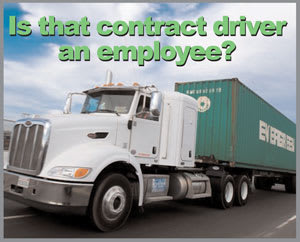
As the American Trucking Associations continues its legal struggle to stop the Port of Los Angeles from implementing a concession program that would ban owner-operators from the port, the drayage companies that contract with those drivers will likely be facing new claims that the drivers are just misclassified employees.
Total Transportation Services Inc., which runs more than 150 drivers at the Port of Los Angeles and Port of Long Beach, was recently sent a determination letter from the IRS ruling that one former driver - classified as an owner-operator - was actually an employee. But the IRS determination doesn't end with just that one driver.
"This ruling pertains to all workers performing services under the same or similar circumstances," the IRS letter says. But it also says that "the determination is based on the application of law to the information presented to us during the course of our investigation… we are not in a position to personally judge the validity of the information submitted."
In fact, all the IRS information on the specific case was obtained from the driver. Although the IRS said in its letter that it contacted the company, it got no response, so it based its determination on the information it had available. "Any other conditions that were not known or furnished may change this determination," the letter advised.
Company Says IRS Didn't Get Its Side
TTSI President Vic LaRosa said the company has no record of any such communication from the IRS, and the IRS has not been able to document that such a message was sent. It's hard to believe that a message from the IRS would not get noticed, he said.
If the IRS determination were to stand, it would be devastating for the company, which would have to come up with withholding and other appropriate employee taxes and payments for its drivers.
LaRosa said the company is responding to the IRS and that his attorneys don't feel it's a "big deal." But he also feels that the industry may be in for an onslaught of such challenges in the near future. Part of it has to do with the two ports' clean truck programs, which mandated that newer, cleaner trucks be used to service the ports.
Because the mostly immigrant population of contract drivers could not afford to buy such trucks, many harbor drayage companies bought the newer trucks and leased them to the drivers. That may have cleaned up the air, but it also may have made the drayage companies more vulnerable to charges that the drivers are not independent businessmen, but are, in fact, employees.
In its determination, the IRS claimed that the firm provided all equipment such as truck, chassis, container, and insurance, while the driver provided his own personal items and diesel fuel. And the cost of diesel was factored into the worker's rate, the IRS said.
"The worker was not engaged in an independent enterprise requiring capital outlay or the assumption of a business risk," the IRS letter said. Therefore he could not realize a profit or incur a loss as a result of his services for the firm. Lack of investment in facilities or equipment indicates dependence on the person or persons for whom the services are performed for such facilities or equipment and, accordingly the existence of an employer-employee relationship."
In the Eye of the Beholder?
Whether or not a driver or any other worker is legally an independent contractor or an employee is determined by a number of very subjective tests - none of which are conclusive in and of itself. The weight given to each of those tests is largely in the eye of the beholder - whether it is a judge or an administrative official - which makes determination of a worker's status a somewhat unpredictable and frustrating process for both those challenging a classification and those defending it.
LaRosa says his company and others in the drayage industry acted proactively in making huge investments in later-model trucks in order to satisfy the need to reduce air emissions in the harbor area.
"There's no way the owner-operators could be able to finance those trucks themselves," he said. "It seems a little unfair that now they are going to turn around and use this against us."
The driver in question worked for the company less than 30 days, LaRosa said. Although the company dispatched him to pick up and deliver certain loads, the driver was free to choose his own hours, work on whatever days he wished, and could even use the truck to contract with other companies, LaRosa said.
He also notes the Section 530 Safe Harbor provision of the 1978 Revenue Act, which provides an exception for companies that use independent contractors "if that classification is supported by a long-standing and recognized practice in a significant segment of the taxpayer's industry."
But it can be argued that the longstanding and recognized practice of using contract drivers in the drayage industry may have already been compromised as companies began owning the vehicles instead of the drivers owning their own rigs. How big a difference that change in circumstance will make in determining the status of the driver is a question that the attorneys - on both sides of the issue - will probably end up thrashing out in court.
George Cunningham is editor of The Cunningham Report, a weekly e-mail newsletter reporting on the West Coast ports. Previously he worked as a reporter and as an editor at several publications, including the Press-Telegram in Long Beach, where he covered the Los Angeles-Long Beach ports as a business writer.
More Fleet Management

Geotab Links Fleet Card to Vehicle Data
The new card combines fuel discounts with telematics-based purchase controls. Geotab’s analysis also points to potential savings from choosing lower-priced fuel stops.
Read More →
How MFA Helps Protect Trucking Fleets
Multi-factor authentication adds protection when passwords are stolen. Here’s how it works and where fleets should start.
Read More →
How Better Freight Data Helps Trucking Teams Get Ahead of Disruption
Trucking and logistics teams have plenty of data. The problem is getting the right information in front of the right people soon enough to act. Better-connected data can help teams spot trouble earlier and make smarter decisions before small problems become big ones.
Read More →

Trimble: Taking Artificial Intelligence in Trucking Beyond Faster Tasks
At Insight 2026, Trimble executives argued that fleets may need to redesign workflows to get more from AI as it introduced new products and enhancements. AI’s value will depend on how fleets combine automation with their people's knowledge.
Read More →
Build a bulletproof fleet: Uniting ELDs and dash cams for total compliance
An ELD can prove compliance, but it cannot always prove what happened on the road. Discover how uniting accurate ELD data with AI-powered dash cam video can help your fleet strengthen compliance, defend against liability, protect drivers and reduce operational costs.
Read More →
Nominations Open for HDT Emerging Leaders
Heavy Duty Trucking is looking for accomplished trucking fleet professionals under 40 who are making an impact and helping lead the industry forward.
Read More →
Why Private Fleets Are Taking More Freight
Private fleets are putting their own trucks on demanding customers and high-cost lanes as companies seek greater control over service, costs, and capacity.
Read More →
Color Match Smarter: Tools That Restore & Perform
For fleet managers and collision repair professionals keeping heavy-duty trucks on the road, getting the color right the first time isn't just about appearance — it's about efficiency, turnaround time, and bottom-line results. Discover how today's digital color tools are transforming the repair process from guesswork to precision.
Read More →
FMCSA Pauses Biennial-Update Enforcement Amid Motus Transition
Carriers whose updates were due on or after June 1 have more time, while FMCSA works to stabilize its new registration system and warns of phishing sites impersonating its new carrier registration system, Motus.
Read More →
2026 Blueprint for Countering Smarter Supply Chain Theft
Cargo theft is no longer just the cost of doing business. It's a multi-billion-dollar criminal enterprise exploiting vulnerabilities across your fleet, drivers, and supply chain.
Read More →