




Insurance Institute Wants Underride Guard Improvements
The Insurance Institute for Highway Safety is petitioning the federal government to require stronger underride guards on the back of tractor-trailers, following a series of tests the group says demonstrate that underride guards on tractor-trailers can fail in relatively low-speed crashes
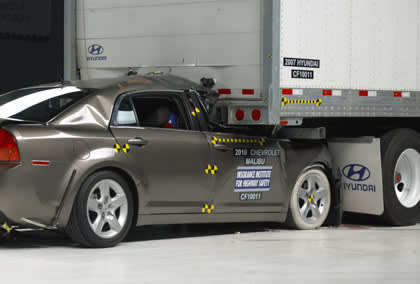
The Insurance Institute for Highway Safety is petitioning the federal government to require stronger underride guards on the back of tractor-trailers, following a series of tests the group says demonstrate that underride guards on tractor-trailers can fail in relatively low-speed crashes.
These rear guards are the main countermeasure for reducing underride deaths and injuries when a passenger vehicle crashes into the back of a tractor-trailer. In 2009, IIHS says, 70 percent of the 3,163 people who died in all large truck crashes were occupants of cars or other passenger vehicles. Underride makes death or serious injury more likely since the upper part of the passenger vehicle's occupant compartment typically crushes as the truck body intrudes into the vehicle safety cage.
"Cars' front-end structures are designed to manage a tremendous amount of crash energy in a way that minimizes injuries for their occupants," says Adrian Lund, Institute president. "Hitting the back of a large truck is a game changer. You might be riding in a vehicle that earns top marks in frontal crash tests, but if the truck's underride guard fails - or isn't there at all - your chances of walking away from even a relatively low-speed crash aren't good."
The Institute analyzed case files from the Large Truck Crash Causation Study, a federal database of roughly 1,000 real-world crashes in 2001-03, to identify crash patterns leading to rear underride of heavy trucks and semi-trailers with and without guards. Underride was a common outcome of the 115 crashes involving a passenger vehicle striking the back of a heavy truck or semi-trailer. Only 22 percent of the crashes didn't involve underride or had only negligible underride, a finding in line with prior studies. In 23 of the 28 cases in which someone in the passenger vehicle died, there was severe or catastrophic underride damage, meaning the entire front end or more of the vehicle slid beneath the truck.
The National Highway Traffic Safety Administration has estimated that about 423 people in passenger vehicles die each year when their vehicles strike the backs of large trucks, the institute says. More than 5,000 passenger vehicle occupants are injured.
The study raised questions about how and why guards failed and at what speeds, so the institute conducted crash tests evaluating three semi-trailer rear guards complying with U.S. rules. Two of the trailers also are certified to Canadian requirements, which are more stringent than the United States when it comes to strength and energy absorption. The tests involved crashing a 2010 Chevrolet Malibu into the rear of parked trailers.
"The aim was to see if some underride guards perform better than others and to identify what crash speeds and configurations produce different types of failure," Lund says.
Decapitation is a serious threat in underrides. In three of the crash tests, the heads of the dummies in the car made contact with either the intruding trailer or the car's hood after it tore free and pushed into the occupant compartment. One such test involved a Hyundai trailer whose underride guard bent forward, sheared its attachment bolts, and broke after the Malibu hit it in the center rear at 35 mph. This was the weakest guard tested, says the institute.
In contrast, a Wabash trailer outfitted with a guard certified to Canadian specifications successfully prevented underride of the Malibu's passenger compartment in a center-rear test at 35 mph. Its guard was the strongest of the three evaluated.
"Strong attachments kept the Wabash guard in place so it could engage the Malibu, allowing the car's structure to absorb and manage the crash energy," Lund says. "In the real world, this would be a survivable crash."
The Institute also ran tests with overlaps of 50 percent and 30 percent to find out what happens when a car hits the trailer with only part of its front instead of head-on.
In a 35-mph test with a 50-percent overlap, the guard on a Vanguard trailer, certified to US and Canadian standards, allowed severe underride, says the institute. In contrast, the Wabash trailer's guard successfully prevented underride in the same test. The outcome for the Wabash was different when the overlap was reduced to 30 percent. The struck end of the guard bent forward, and there was severe underride.
This test shows that even the strongest guard left as much as half of the rear of the trailer vulnerable to severe underride, IIHS concludes. The guard only worked as intended when the striking car engaged the center.
Offset tests stress guards' unsupported outboard ends. The vertical frame supports that attach guards to their trailer chassis are closer to guards' centers than ends. Preventing underride in narrow overlap crashes like these might mean devising a new way of attaching guards to trailers to utilize the side rails, IIHS says, in addition to requiring manufacturers to conduct compliance tests with guards on trailers.
"Under current certification standards, the trailer, underride guard, bolts, and welding don't have to be tested as a whole system," Lund says. "That's a big part of the problem. Some manufacturers do test guards on the trailer. We think all guards should be evaluated this way. At the least, all rear guards should be as strong as the best one we tested."
You can read the IIHS petition to NHTSA here.
Truckinginfo.com editors are contacting the trailer makers whose products were tested and will provide their comments in a follow-up story.
More Safety & Compliance

FMCSA Pauses Biennial-Update Enforcement Amid Motus Transition
Carriers whose updates were due on or after June 1 have more time, while FMCSA works to stabilize its new registration system and warns of phishing sites impersonating its new carrier registration system, Motus.
Read More →
ZF Expands Commercial Vehicle Push in North America
ZF is expanding its North American commercial-vehicle presence with new transmission applications, electrification, trailer technology and autonomous-driving systems.
Read More →
Truck Drivers Need More Than Another Alert
Fleets have more visibility into truck health, safety events, and driver activity than ever. The next challenge is turning all that information into useful guidance for the person who has to decide what to do next.
Read More →
Tesla Wants a Self-Driving Semi. Are Cameras Enough?
Could Tesla’s camera-only autonomous driving technology work on an 80,000-pound Semi? In this commentary, HDT's Deborah Lockridge takes a look at Tesla, Cybercab, and how autonomous trucks see the road.
Read More →
What DOT’s Automated Vehicle Strategy Means for Trucking
The U.S. Department of Transportation issued a new automated-vehicle strategy that outlines plans for driverless-truck regulations, cross-state freight corridors, and federal safety standards.
Read More →
NYC Expands Speed, Pedestrian Safety Tech Across Fleet
New York City is expanding intelligent speed assistance and pedestrian-alert systems across its municipal fleet, moving the technologies from pilot programs into vehicle procurement and retrofit requirements.
Read More →
FMCSA Removes 110 Truck Driver Training Schools from Certified ELDT List
Federal regulators also are targeting more than 160 additional training providers and launching a nationwide audit of third-party CDL skills testers as part of a broader crackdown on trucking fraud.
Read More →
Beyond DOT Compliance: What Makes a Trucking Fleet Truly Safe?
A trucking fleet can follow every rule and still make unsafe decisions. The real test comes when safety conflicts with freight, productivity, or cost.
Read More →
Hours of Service Pilot Programs: FMCSA Readies for 2027 Rollout
Two pilot programs could eventually reshape hours-of-service rules, giving truck drivers options to pause their 14-hour clock or use longer split sleeper rest periods.
Read More →
New Guide Offers Pet Safety Tips for Truck Drivers
Hundreds of thousands of pets travel in truck cabs. A new safety guide from Volvo Trucks and the Center for Pet Safety offers practical advice for truck drivers who bring dogs and cats along for the ride.
Read More →