




Infrastructure Funding: Attention Now on the Senate
After the House of Representatives passed its $1.5 trillion infrastructure package last week, attention now turns to the Senate, which last year passed its own version of surface transportation reauthorization.

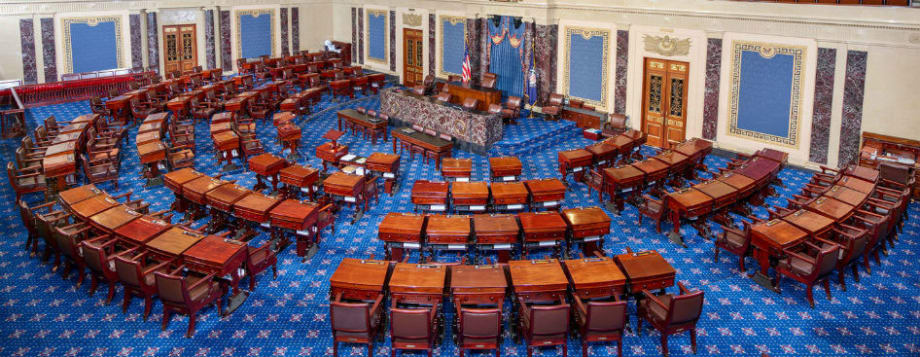
Now that the House has passed a massive infrastructure measure criticized as partisan, attention turns to the Senate.
Photo: U.S. Senate/Public Domain
After the U.S. House of Representatives passed its $1.5 trillion infrastructure package last week, attention now turns to the Senate, which last year passed its own version of surface transportation reauthorization.
A major part of the House bill, the $494 billion INVEST in America Act surface transportation reauthorization bill, included controversial trucking-specific provisions such as increased insurance minimums and delaying the new hours-of-service rules, and a focus on “green” transportation unlikely to find favor in the Republican-controlled Senate.
Missouri Republican Sam Graves, ranking member on the Transportation and Infrastructure Committee, has said the House bill’s focus on massive overhauls of non-transportation regulations lessens the bill’s chances of getting anywhere in the Republican-led Senate.
As Politico reported, “though the bill in its current form is not likely to go anywhere as long as Republicans hold the Senate, the core of the bill — the transportation-specific functions — are virtually guaranteed to survive, although the two chambers may not agree on what the final form will be until next year at the earliest.”
Senate Majority Leader Mitch McConnell called the House measure "nonsense," "absurd," "pure fantasy" and vowing that it will die in the Senate. And the White House has indicated it would veto the bill.
The Infrastructure Funding Question
There have been debates for years about how to fix our highway-funding process. The Highway Trust Fund is dwindling. The fuel tax has not been raised since the Clinton administration, while at the same time, vehicles are more fuel-efficient. And the COVID-19 pandemic shutdown earlier this year caused traffic levels to plummet, making the situation even worse.
During a Senate Committee on Environment and Public Works hearing on July 1, EPW chair John Barrasso (R-WY) said in opening remarks that surface transportation reauthorization legislation must be passed soon to stave off major fiscal problems down the road.
“Last month, we held a hearing on how rebuilding our highways and bridges will create jobs, will reduce the cost of goods and services, and will drive our nation’s economic recovery,” Barrasso said. “Three months from today, the surface transportation authorization will expire. This cannot be allowed to happen – especially during this pandemic-caused economic downturn.
“To make matters worse, the Highway Trust Fund is rapidly approaching insolvency. Prior to the pandemic, the Congressional Budget Office projected the Highway Trust Fund would run out of money in mid-2021. Now, with Americans driving less, the Highway Trust Fund will reach insolvency far sooner than first predicted.
“The time for Congress to pass meaningful, bipartisan infrastructure legislation is now.”
He criticized the partisan nature of the House bill and said Congress should move forward with the bipartisan Senate bill, America’s Transportation Infrastructure Act, which “will provide record levels of investment; $287 billion dollars will be available over five years to fix our roads and bridges, to create jobs, and to boost our economy.”
In his remarks in that hearing, Ranking Member Tom Carper (D-DE), also called for bipartisan work on developing a funding plan. “It’s time for the Senate Banking and Commerce Committees to develop their own bipartisan titles so that a truly robust surface transportation reauthorization bill can come to the Senate floor in the months ahead.
“Whether you’re driving an 18-wheeler truck hundreds of miles a day on interstates across the Heartland, or hitting potholes on your way to work or the grocery store, just about every driver in America will agree that our surface transportation infrastructure needs work,” Carper said, noting that approximately 20% of our federal-aid highways are in poor condition, as are some 46,000 bridges.”
But Carper also called for attention to the environment in these measures.
“For decades, we have invested in surface transportation infrastructure as a country without making meaningful progress toward improving safety, reducing harmful emissions and enhancing resilience. And now, we face a growing climate crisis that will only make those challenges even more daunting.”
More Fleet Management

Color Match Smarter: Tools That Restore & Perform
For fleet managers and collision repair professionals keeping heavy-duty trucks on the road, getting the color right the first time isn't just about appearance — it's about efficiency, turnaround time, and bottom-line results. Discover how today's digital color tools are transforming the repair process from guesswork to precision.
Read More →
FMCSA Pauses Biennial-Update Enforcement Amid Motus Transition
Carriers whose updates were due on or after June 1 have more time, while FMCSA works to stabilize its new registration system and warns of phishing sites impersonating its new carrier registration system, Motus.
Read More →
2026 Blueprint for Countering Smarter Supply Chain Theft
Cargo theft is no longer just the cost of doing business. It's a multi-billion-dollar criminal enterprise exploiting vulnerabilities across your fleet, drivers, and supply chain.
Read More →


How Telematics Improves Visibility, Control, and Performance in Refrigerated Fleets
Explore how telematics help refrigerated fleets improve visibility, uptime, efficiency, compliance, and cargo protection across connected cold chain operations.
Read More →
What the U.S.-Canada Trade War Means for Trucking
Escalating U.S.-Canada tariffs could disrupt cross-border freight, reduce truck volumes, raise costs, and create new uncertainty for carriers on both sides of the border.
Read More →
What Are Trucking’s Top Concerns for 2026?
The American Transportation Research Institute wants to know what's worrying trucking fleet managers, drivers, and other stakeholders in its annual Industry Issues survey.
Read More →
American Trucking Associations Looks for a New Leader
ATA President and CEO Chris Spear abruptly left his job at the association on August 21, at a pivotal time for the trucking industry.
Read More →
Public Wi-Fi Cybersecurity Risks: How Truck Drivers and Fleets Can Protect Their Data
Public Wi-Fi can expose truck drivers and fleets to credential theft, malware, and other cyber threats. Here’s how to reduce the risk on the road.
Read More →
For Nicky Cupp, Fleet Innovation Starts With Frustration
HDT Truck Fleet Innovator Nicky Cupp turns everyday pain points at Fraley & Schilling into opportunities for better technology and smarter processes.
Read More →
Adam Buttgenbach’s Approach to Electric Trucks: Start With Where They Fit
HDT Truck Fleet Innovator Adam Buttgenbach helped PepsiCo build one of North America’s largest EV fleets by focusing on where electric trucks make operational sense.
Read More →