




Independent Trucker Group Asks President to Suspend Plans for Mexican Trucks
The Owner-Operator Independent Drivers Association has asked President Obama to suspend any immediate plans to establish another cross-border trucking program
The Owner-Operator Independent Drivers Association has asked President Obama to suspend any immediate plans to establish another cross-border trucking program.
The association, which represents more than 160,000 small business truckers, sent a letter contending that the onus is on the Mexican government to raise its regulatory standards to that of the United States and Canada before its motor carriers are allowed full access to U.S. highways.
After President Obama signed an appropriations bill that cuts off funding for a controversial cross-border trucking program with Meixco, the Obama administration said it wants to come up with an alternative approach to cross-border trucking. The Mexican government responded to the legislation cutting off the border pilot program with retaliatory tariffs.
In his letter to the president, Jim Johnston, OOIDA president, said the North American Free Trade Agreement does not require the United States to make exemptions for safety and security. He notes that under the NAFTA treaty, each party to the agreement has the right to "adopt, maintain or apply any standards-related measure, including any such measure relating to safety, the protection of human, animal or plant life or health, the environment or consumers, and any measure to ensure its enforcement or implementation" provided that such measures must be applied in a non-discriminatory manner.
"Thus, one country may not treat service providers from another country any less favorably than it would 'in like circumstances' treat its own or another country's service providers."
Trucking companies in the United States are required to comply with consistently increasing safety, security and environmental regulations, which significantly increase their costs of operations, OOIDA notes.
"Mexico-domiciled trucking companies and drivers simply do not contend with a similar regulatory regime in their home country, nor must they contend with the corresponding regulatory compliance costs that encumber their U.S. counterparts," said Johnston in the letter.
"I only ask that your administration follow the laws that Congress has put in place to ensure that Mexico-domiciled trucking companies and truck drivers comply with the same level of safety, security and environmental standards that already apply to U.S.-based companies and drivers. That compliance is necessary to make certain the safety and security of U.S. citizens as well as to ensure operational cost fairness for American trucking companies and truck drivers."
Under the North American Free Trade Agreement, the crossing was supposed to have been opened to border-state traffic in 1995 and to long-distance traffic in 2000. The opening was stalled until 2007, in part by difficult negotiations with Mexico, but mainly by the legislative and legal tactics of U.S. labor, owner-operator and citizen advocacy groups who fear loss of U.S. jobs to Mexican drivers and argue that Mexican trucks will not be safe.
For more info:
Appropriations Bill Will Cut Cross-Border Program," 3/11/09
"Obama Administration to Revisit Cross-Border Trucking," 3/13/09.
"Mexico Retaliates For Cutting Off Cross-Border Program", 3/17/09
More Equipment
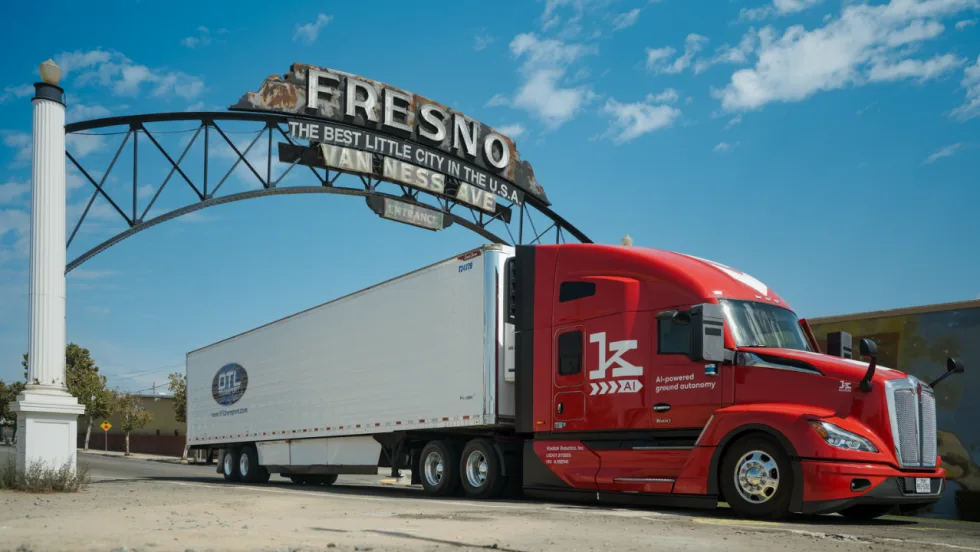
Kodiak Hauls Produce in California Autonomous Truck Pilot
Kodiak AI and DTL Transport have begun hauling produce between Fresno and Los Angeles under California’s new rules for testing heavy-duty autonomous trucks. A safety driver remains behind the wheel.
Read More →
Used-Truck Remarketing Math Is Changing
Used-truck value is no longer just a concern at trade-in. Decisions made throughout a truck’s first life can influence what it’s worth years later.
Read More →
How Volvo Updated Its D13 for EPA 2027 [Watch]
Volvo’s updated D13 promises lower emissions without sacrificing performance or fuel economy. Take a closer look at what changed inside the engine in this HDT Spotlight video.
Read More →
Michelin Tire Improves Efficiency and Durability for Regional Fleets
The Michelin X Multi Energy D2 is a regional haul drive tire engineered to help fleets improve fuel efficiency, durability and traction in demanding stop-and-go operations.
Read More →
ZF Expands Commercial Vehicle Push in North America
ZF is expanding its North American commercial-vehicle presence with new transmission applications, electrification, trailer technology and autonomous-driving systems.
Read More →
Tesla Wants a Self-Driving Semi. Are Cameras Enough?
Could Tesla’s camera-only autonomous driving technology work on an 80,000-pound Semi? In this commentary, HDT's Deborah Lockridge takes a look at Tesla, Cybercab, and how autonomous trucks see the road.
Read More →
Kodiak: Driverless Long-Haul Truck Launch on Track for 2026
Kodiak AI says its driverless long-haul safety case is 93% complete and it remains on track to begin commercial operations by year-end 2026.
Read More →
What DOT’s Automated Vehicle Strategy Means for Trucking
The U.S. Department of Transportation issued a new automated-vehicle strategy that outlines plans for driverless-truck regulations, cross-state freight corridors, and federal safety standards.
Read More →
East Coast Port Launches $45M Electric Truck Push
The Port Authority of New York and New Jersey announced millions in incentives for zero-emission drayage trucks, yard tractors, and new charging hubs near the port.
Read More →
PlusAI Going Public to Fund Autonomous Truck Launch
A SPAC deal could provide PlusAI with up to $300 million as it works toward a 2027 commercial launch of factory-built autonomous trucks.
Read More →