





Related— Trucking: The Indispensable Link in the Supply Chain
How to Build Tomorrow’s Supply Chain Today
A new Deloitte Insights market report contends that “considering the innovation gaining momentum in transportation and logistics, consumer expectations will only continue to rise.”
December 12, 2019
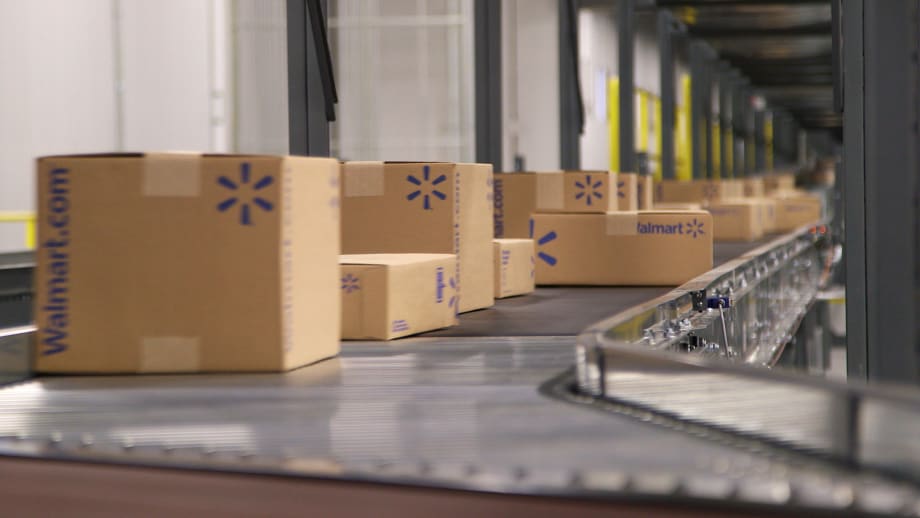
Some supply-chain processes, such as truck-loading at warehouses, “can be reimagined in their entirety” on the road to developing the “touchless supply chain.”
Photo: Walmart
5 min to read
The trouble with delivering the goods is that people expect you to, well, deliver the goods. Little wonder then that a new Deloitte Insights market report contends that “considering the innovation gaining momentum in transportation and logistics, consumer expectations will only continue to rise.”
The detailed report, posted online on Dec. 11, posits that reckoning with the rapid growth of eCommerce along with shifting trade patterns, and continued infrastructure constraints will force logistics providers and freight haulers to build “a next generation supply chain” to meet head on the rising expectations consumers have for goods delivery.
“While still in early stages, the foundations of a next-generation global movement-of-goods network are actively forming,” the report states. “We are already seeing progress across the three pillars that will underpin the future network: connected community, the ability to collaborate and connect with partners to see across the network; holistic decision-making, the ability to harness and harmonize traditional and new data to continuously learn and predict; and intelligent automation, the ability to utilize the right human or machine for the task at hand and automate digital processes.”
Deloitte predicts that over time, global consumers demanding greater delivery volume, speed, flexibility, transparency, and convenience will force change. With that in mind, supply chain players “should define their future ambitions and where to play in the future movement of goods ecosystem. Guided by a strategic vision, organizations can begin examining how the foundational pillars, connected community, holistic decision-making and intelligent automation, can help them win in chosen segments and markets — and the foundational and emerging capabilities required to enable those pillars."
Here’s a look at those three pillars Deloitte sees as the foundation of a new global supply chain for consumer goods:
1. Connected Community
The idea driving the development of Integrated data platforms or digital freight networks is to enhance visibility across the supply chain.
“For regional parcel carriers and logistics providers, the improved, real-time visibility into available cargo and tech-enabled coordination could be what’s needed to materially improve utilization,” the report suggest. “The ability to leverage the assets of other carriers through shared models could help expand coverage and monetize or acquire additional capacity, enabling fleets that flex with demand or create new revenue streams. A single 26-foot truck traveling 100 miles per day can generate up to $3,300 per month.”
And for retailers, the added freight services and crowdsourced assets “offer new opportunities to meet growing last-mile and peak season demand. As comfort with sharing models and crowdsourcing rises, retailers will have fresh options for moving goods between stores or ‘middle mile.’”
As a here-and-now example of how a connected community could grow into a vertically integrated, closed-loop network, Deloitte looks to Amazon, citing its “end-to-end infrastructure that allows them to meet and exceed the very expectations they’ve had a hand in shaping.”
To wit, the report points out: “The movement of goods from China to the United States on Amazon-owned vessels in 2018 marked the completion of the world’s first end-to-end, shipping network— the last missing leg joining a chain of cargo planes, fulfillment and distribution centers, long and short-haul trucks, a rapidly expanding last-mile network through branded delivery service partners, and of course, Amazon.com.”
2. Holistic Decision-Making
The idea here is to speed up how quickly action insightful data is acted upon. While many global players are already data-driven, now they must focus on “compressing the time between data collection and meaningful action. Global supply chains can be planned with immense precision, but dealing with unpredictable environments and rising consumer demands requires the agility to react to changing network conditions with dynamic decisions and, perhaps in the not-too-distant future, to tailor microsupply chains for each product and customer.”
The report holds that “early adopters are not only finding success from a mix of new data sources from connected assets, cargo, and warehouses—in some cases, they are harmonizing these new data streams with transportation management, inventory management, and other supply chain functions. These capabilities serve as early signals that traditional, linear supply chains are just beginning to collapse into more dynamic digital supply networks, where once-isolated data sources— such as operations data, connected assets and cargo, and historic data— begin centering around a digital core that provides real-time decision support.”
As companies become more engaged in digital transformation and begin to realize its benefits, they will keep investing in it. “This snowball effect of investment and success is exemplified by the long-term rollout of UPS’ dynamic routing system Orion,” the report relates.
“Orion’s first generation was far from real-time, but its yield of $100 million in annual savings spurred investment for second-generation upgrades, bringing the system into real-time through delivery information acquisition devices that communicate optimized routes to drivers while on the road. Planned upgrades may incorporate a driver’s remaining pickup and delivery requests, as well as external data sources such as traffic and weather.”
3. Intelligent Automation
“Evidence of maturing automation can now be found at every step in the chain, and while still some ways away, the foundations of a global, touchless supply chain are actively forming,” the report states.
Examples of this trend to leveraging advances in autonomy and robotics include warehouse robotics in wide use; autonomous cargo ships in development; robotic ship-offloading already at some ports; nearly 50 companies are working on autonomous vehicles with several focused on trucks; and last-mile automation, including everything from drones to droids.
“These concepts could be the early foundations of a touchless supply chain,” the report contends. “But capturing the concept’s full potential will likely require rethinking entire logistics systems to take full advantage of a constant flow, including an evolution away from the fixed ‘collect in the evening and deliver during the morning’ approach toward a fluid system of continuous movement and supply…. Some processes, such as truck-loading at warehouses, for example, can be reimagined in their entirety.”
How’s this for reimagining: “By combining emerging autonomous warehouse technology with autonomous self-driving systems for long-haul transport, new types of vehicles can begin hauling trips as soon as they receive cargo. These new freight transport vehicles could range in size— and seamlessly pass through automated warehouses and distribution centers.”
Merge Ahead!
The report views the three pillars of the future movement-of-goods ecosystem as being rapidly developed. But that’s “only the beginning of the journey. Over the short term, global movers need to be focused on scaling these core capabilities— but pilots should be targeted at the intersections of these pillars. The true value of these enabling technologies will unlock as they converge.”
More Fleet Management

Why Private Fleets Are Taking More Freight
Private fleets are putting their own trucks on demanding customers and high-cost lanes as companies seek greater control over service, costs, and capacity.
Read More →
Sponsored•September 16, 2026
Color Match Smarter: Tools That Restore & Perform
For fleet managers and collision repair professionals keeping heavy-duty trucks on the road, getting the color right the first time isn't just about appearance — it's about efficiency, turnaround time, and bottom-line results. Discover how today's digital color tools are transforming the repair process from guesswork to precision.
Read More →
FMCSA Pauses Biennial-Update Enforcement Amid Motus Transition
Carriers whose updates were due on or after June 1 have more time, while FMCSA works to stabilize its new registration system and warns of phishing sites impersonating its new carrier registration system, Motus.
Read More →


Sponsored•September 14, 2026
2026 Blueprint for Countering Smarter Supply Chain Theft
Cargo theft is no longer just the cost of doing business. It's a multi-billion-dollar criminal enterprise exploiting vulnerabilities across your fleet, drivers, and supply chain.
Read More →
Sponsored•September 1, 2026
How Telematics Improves Visibility, Control, and Performance in Refrigerated Fleets
Explore how telematics help refrigerated fleets improve visibility, uptime, efficiency, compliance, and cargo protection across connected cold chain operations.
Read More →
What the U.S.-Canada Trade War Means for Trucking
Escalating U.S.-Canada tariffs could disrupt cross-border freight, reduce truck volumes, raise costs, and create new uncertainty for carriers on both sides of the border.
Read More →
What Are Trucking’s Top Concerns for 2026?
The American Transportation Research Institute wants to know what's worrying trucking fleet managers, drivers, and other stakeholders in its annual Industry Issues survey.
Read More →
American Trucking Associations Looks for a New Leader
ATA President and CEO Chris Spear abruptly left his job at the association on August 21, at a pivotal time for the trucking industry.
Read More →
Public Wi-Fi Cybersecurity Risks: How Truck Drivers and Fleets Can Protect Their Data
Public Wi-Fi can expose truck drivers and fleets to credential theft, malware, and other cyber threats. Here’s how to reduce the risk on the road.
Read More →
For Nicky Cupp, Fleet Innovation Starts With Frustration
HDT Truck Fleet Innovator Nicky Cupp turns everyday pain points at Fraley & Schilling into opportunities for better technology and smarter processes.
Read More →