



What About Renewable Fuels in the S13?
The S13 Integrated Powertrain is approved for use with R100 renewable diesel, reducing well-to-wheel carbon footprint without any hardware changes. Trials for B100 biodiesel compatibility are underway.
 MENU
MENU SEARCH
International is marching ahead with updates to its S13 Integrated Powertrain to meet federal emissions regulations expected to take effect at the beginning of 2027.
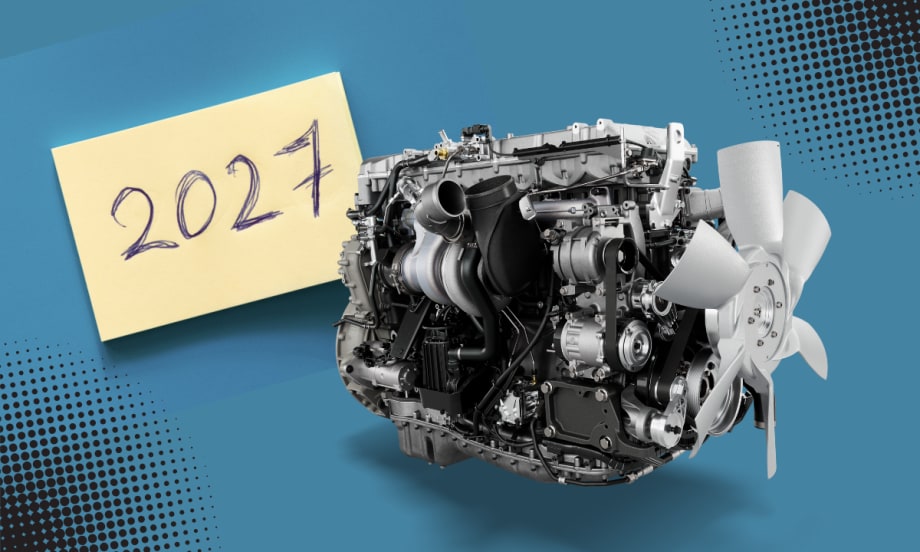
We may not have total clarity on EPA 2027 emissions regulations, but the NOx standards will most likely go into effect as scheduled a year from now.
HDT/International
International is marching ahead with updates to its S13 Integrated Powertrain to meet EPA emissions regulations expected to take effect at the beginning of 2027. Company officials told reporters they expect a non-disruptive transition due to the clean-sheet design of the S13, which International unveiled in 2022.
The 2027 S13 Integrated Powertrain carries over 90% of the hardware from the current platform. That means customers can expect similar fuel economy, driving experience, and powertrain weight, according to International. And it means more consistency in service tools, parts, and technician training.
International officials sat down with trucking reporters in a January 7 roundtable to discuss the changes.
But you can't talk about the new 2027 S13 Integrated Powertrain without a refresher on the current technology.
International used a clean-sheet approach to designing the S13 powertrain and designed it with the 2027 EPA emissions standards in mind.
The powertrain consists of three components, developed together:
S13 13L engine
T14 14-speed automated manual transmission
Dual Stage Aftertreatment with a dual-stage SCR catalyst system in a one-box design.
The S13 engine offers improved combustion efficiency, less friction, and fewer pumping losses for better fuel economy and performance.
Designed with selective catalytic reduction (SCR) as the primary emissions reduction technology, the S13 engine has no exhaust gas recirculation (EGR) cooler, meaning more power and fewer maintenance headaches.
The compact T14 transmission, with two more gears than the typical 12-speed, gives a better driving experience.
To keep temperatures at an optimal range and extend service intervals, the aftertreatment system includes a dual-stage SCR catalyst system in a one-box design. The compact design of the Dual Stage Aftertreatment offers easy access for serviceability, as well as significantly improved emissions control and fuel efficiency.
There are 700 million customer miles of on-road experience with the current S13 integrated powertrain.
Because the powertrain was designed from the get-go with the future EPA emissions regulations in mind, much of it remains unchanged, according to International.
S13 Engine: No EGR cooler, fixed-geometry turbo with smart DEF dosing, dual overhead cam design, 23:1 compression ratio.
T14 Transmission: Compact 14-speed with planetary gearset, electronic clutch actuator, integrated PTO options, and advanced oil lubrication system
Dual-Stage Aftertreatment: Same size and packaging, providing extended service intervals. While some of the sensors and wiring are being adapted for 2027, the aftertreatment module itself is not changing size or weight. And DPF service intervals are expected to actually increase in the 2027 version.
David Hillman, vice president, integrated technology sales, told reporters he’s often asked, “If taking off the EGR cooler was so great, why isn't everyone doing it?”
“It's because you've got to have a clean sheet design,” he said. “You've got to do all of these pieces at the same time, not least of which is the dual-stage aftertreatment.”
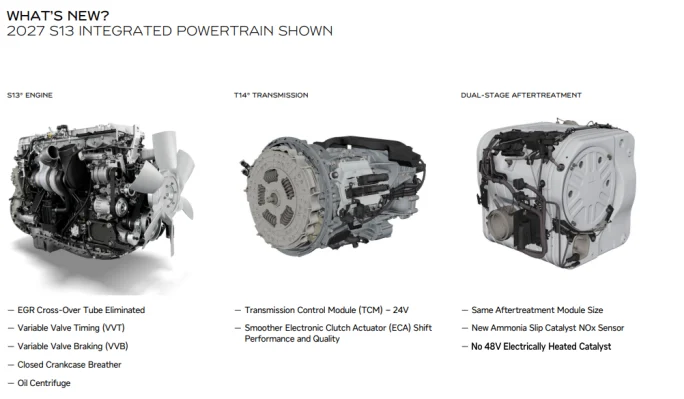
This slide shared with reporters by International illustrates the changes being made to the S13 Integrated Powertrain to meet EPA 2027 emissions regulations.
International
S13 Engine
While the current version of the S13 engine still has a small amount of EGR for idle or no-load applications, for 2027, EGR is fully eliminated. The engine will use variable valve timing, with the addition of a simple hydraulically actuated clutch feature to the valve actuation.
“VVT has been in the automotive industry since the 90s. It's been in the US commercial truck industry for almost the last decade,” Hillman explained. “So it's not necessarily new, but we're introducing it with the S13 for the first time.”
VVT, in turn, enables Variable Valve Braking for improved braking and exhaust brake performance. “The compression release brake performance is going to be noticeably better because of the variable valve technology that we're bringing to the bar,” Hillman said.
Because the 2027 regulations require that the engine no longer vent to atmosphere, Hillman explained, the new engine will have a closed crankcase breather.
“But as part of that, we've added a very simple oil centrifuge and filter, and that's to maintain our class-leading, or at least very competitive, oil drain intervals. We added the centrifuge to be able to maintain the same level of maintenance practices because our customers, frankly, demanded it.”
T14 Transmission
The T14 has fewer changes for 2027. It gets a 24V transmission control module with predictive shifting using GPS/topography data. Hillman said the change results in even faster and smoother shifts with the electronic clutch actuator.
Electrical Architecture
The 2027 version of the S13 powertrain reduces complexity by using a standardized 24V electrical architecture across the powertrain platform, while retaining a 12V cab-and-chassis electrical system for battery accessories and body controls.
The powertrain will have a 24V alternator, starter, and engine controllers for improved cold-crank performance and durability.
Unlike some competitors, International said, it is not adding a 48V electrically heated catalyst.
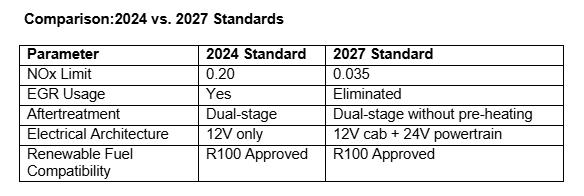
International
Hillman said International expects to still have the excellent fuel economy that current S13 Integrated Powertrain customers are enjoying.
“We do expect to have the lightest weight offering in the 13-liter space, while others are getting perhaps more complicated. We are simplifying our design and, finally, because of our investments, we believe we have the least disruptive technology to bring to the marketplace to meet the 2027 regulations. So we're ready for the regulations.”
Although there remains some uncertainty about the EPA 2027 regulations, with the Trump administration reviewing them for potential changes, the general expectation is that the core restrictions on Nitrogen Oxides (NOx) will go into effect as originally written.
One part of the 2027 regulations that is largely expected to be postponed or dropped from the rules would increase the defined useful life of regulated vehicles by 1.5 to 2.5 times from 435,000 miles out to 650,000 miles. Emissions system warranties were due to increase by 2.8 to 4.5 times, or from today’s 100,000 miles to 450,000 miles for MY2027 trucks.
Those requirements were expected to significantly increase the price of the new engines.
The S13 Integrated Powertrain is manufactured at International's Huntsville Powertrain Manufacturing Plant in Huntsville, Alabama, and the 2027 version will not require significant changes to the facility.

Volvo’s updated D13 promises lower emissions without sacrificing performance or fuel economy. Take a closer look at what changed inside the engine in this HDT Spotlight video.
Read More →
The Michelin X Multi Energy D2 is a regional haul drive tire engineered to help fleets improve fuel efficiency, durability and traction in demanding stop-and-go operations.
Read More →
ZF is expanding its North American commercial-vehicle presence with new transmission applications, electrification, trailer technology and autonomous-driving systems.
Read More →
Could Tesla’s camera-only autonomous driving technology work on an 80,000-pound Semi? In this commentary, HDT's Deborah Lockridge takes a look at Tesla, Cybercab, and how autonomous trucks see the road.
Read More →
Kodiak AI says its driverless long-haul safety case is 93% complete and it remains on track to begin commercial operations by year-end 2026.
Read More →
The U.S. Department of Transportation issued a new automated-vehicle strategy that outlines plans for driverless-truck regulations, cross-state freight corridors, and federal safety standards.
Read More →
The Port Authority of New York and New Jersey announced millions in incentives for zero-emission drayage trucks, yard tractors, and new charging hubs near the port.
Read More →
A SPAC deal could provide PlusAI with up to $300 million as it works toward a 2027 commercial launch of factory-built autonomous trucks.
Read More →
The National Highway Traffic Safety Administration says it lacks authority to regulate medium- and heavy-duty truck engines separately from complete vehicles, but the existing standards have not yet been eliminated.
Read More →
Detroit isn’t starting from scratch to meet EPA 2027 diesel emissions standards. Its Gen 6 DD13 and DD15 engines keep much of today’s platform while updating the fuel and aftertreatment systems.
Read More →