




How COVID is Still Affecting the Supply Chain and Where We Go From Here
With a severe driver shortage and a supply chain still in chaos from pandemic-induced shifts in consumer behavior, one industry observer is warning of likely hoarding as we get into the holidays. Longer term, vaccine distribution is “THE driver” for broader economy recovery and the post-2021 outlook.


More demand than supply has been pushing up freight rates while causing supply-chain headaches.
Image: Thermo King
With a severe driver shortage and a supply chain still in chaos from pandemic-induced shifts in consumer behavior, one industry observer is warning of likely hoarding as we get into the holidays. Longer term, vaccine distribution is “THE driver” for broader economy recovery and the post-2021 outlook.
Paul Kroes, market insight leader for Thermo King, shared his perspective on the state of the trucking and freight market in a Nov. 10 webinar.
“The freight environment is very cyclical, as we all are painfully aware,” he said. The most recent cycle was extended by the “Trump bump,” tax cuts largely driven by the current administration that favored the trucking environment.
When times are good, he said, freight-hauling companies tend to put money into capital expenditures, resulting in more capacity, from an equipment standpoint, than the industry really needed. So coming into 2020, most observers expected it to be a “rebalancing” year, with anemic freight rates.
The COVID-19 pandemic, of course, changed all that. There was a sharp demand spike in March, followed by a rapid decrease in April as states across the country largely shut down their economies in an attempt to slow the spread of the novel coronavirus. But once some states started reopening, it started slowly but steadily returning, to the point where freight volumes and rates even exceeded the banner year of 2018.
More Empty Store Shelves on the Way?
The demand for food and beverages that normally would be distributed via the wholesale chain to restaurants and venues was slashed, while grocery store shelves were often empty, and in many cases still are. E-commerce boomed.
“On the supply chain side, the chaos it created – and continues to create – is staggering,” Kroes said.
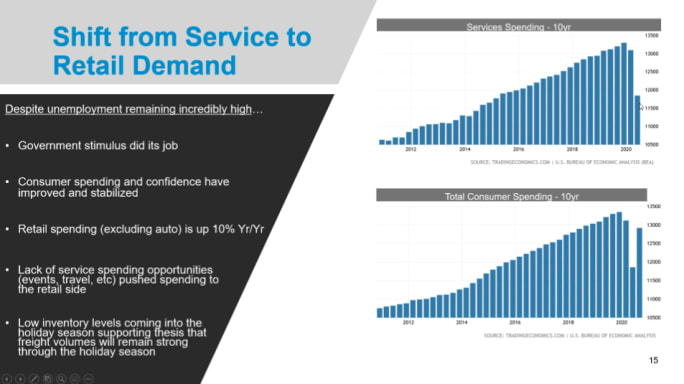
The COVID-19 pandemic has caused a shift from services to retail that is still affecting the supply chain.
Image: Thermo King
The pandemic has caused a big shift in consumer spending from the service sector to the retail sector. Because people can’t go to concerts or restaurants or travel the way they used to, they’re spending their money on “things” instead – stuff that needs to get where it’s going by truck. Government stimulus money has contributed to that. Retail spending (excluding auto) is up 10% year over year, he said.
In particular chaos is the food market, Kroes said, which Thermo King has a special interest in as a supplier of mobile refrigeration products.
“A lot of the apparatus that was set up to service the freight market and in particular the food market was really around the wholesale side of things,” he said. “When everybody stopped getting restaurant meals and stopped going to venues where they could get that kind of food, that were serviced by the wholesale side, now everyone had to go to the grocery store and get the small canned versions, and the supply chain wasn’t set up for that – and continues to not be.” The industry, he said, has for the most part not been willing to retool their supply chains to handle that.
Kroes pointed to the inventory-to-sales ratio. “This ratio shows how much the consumer needs vs. what’s on the shelves,” he explained. “When it’s higher, there’s more than enough, which leads to lower freight demand and lower rates.” When it’s lower, however, the opposite occurs – and it’s definitely still lower than usual. “This is a very clear-cut indicator for how much work the freight market still has to do to get things back to where they need to be, and so far, we’re still not there.”
As a result, he believes as we head into the holiday season with a supply chain already stressed and a driver shortage that is constraining the available capacity, people will start seeing products getting more scarce on shelves. Seeing that, he said, they will start hoarding again, and projects it will be as bad as or worse than it was in the spring when the pandemic first hit.
Supply and Demand Imbalance
The supply chain imbalance is causing record freight and rates, so fleets are again buying equipment. But the problem is getting drivers behind the wheel. Several factors have resulted in a driver workforce of about 80,000 fewer than there were a year ago:
Extra unemployment benefits from the federal government that were in effect until recently prompted some drivers to stay home.
The federal Drug and Alcohol Clearinghouse that went into effect in January prevents drivers from hiding negative drug tests. Close to 1% of drivers have failed or refused a test, he said.
The pipeline of new drivers has shrunk, with a 40% drop in the output from CDL training schools, as many schools have closed or had to operate at reduced capacity. An estimated one-fifth, or 20%, of truck driving schools are currently closed, he said.
A significant number of drivers, with spot rates soaring, decided to start their own companies. Although those trucks are still out there as capacity, that has ripples through the supply chain as well.
As a result of the tight capacity, we’ve seen spot rates rise rapidly since they plummeted back in April. In fact, they reached a point where they were higher than contract rates, which is unusual. Those higher spot rates tended to favor owner-operators and smaller fleets that depend on the spot market. However, Kroes said, that is reversing itself, as higher spot rates and tight capacity give large fleets negotiating power when it comes time to renew contracts.
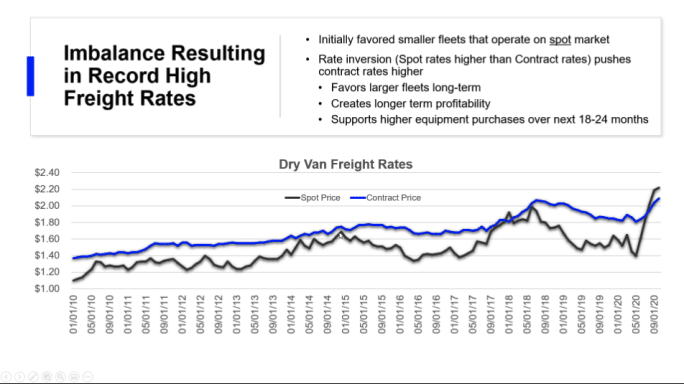
We've seen spot prices above contract rates, which is not the norm.
Image: Thermo King
“That creates long-term profitability and stability for those larger fleets and supports higher equipment purchases over the next 18-24 months. That’s why we have a very favorable outlook for the next two years.”
Kroes projects an overall 10% rise in contract rates next year.

The freight cycle was overdue for a correction - then COVID hit.
Image: Thermo King
Medium-Duty Market
When you look at the total numbers for medium-duty truck sales, they look good, Kroes said, driven by the rise in e-commerce.
“However, on the refrigerated side, it’s one of the hardest-hit segments, because food and beverage sales are the sole drivers of the refrigerated truck market. Until restaurants and venues start to open back up, you’re not going to see a revival.”
Other factors affecting the medium-duty market, he said, are:
New entrants into the market being more likely to rent than lease or buy trucks.
Continued downsizing of vehicle weight ratings to avoid the need to hire drivers with commercial drivers licenses.
Equipment doesn’t age out like Class 8 tractors and trailers that are on shorter trade cycles. “If it’s sitting idle, the clock basically stops. That clock [on the trade cycle] will restart when it gets put back into service.”
What Will 2021 Look Like?
There are a number of factors that will affect how 2021 looks for the overall economy and the freight market.
"Vaccine distribution is THE driver for broader economic recovery and post-2021 outlook," Kroes said. Pfizer recently announced preliminary results that its vaccine appears to be 90% effective, which was better than expected. It hopes to have emergency approval by the end of the month. If Pfizer and the other companies that have been working on vaccines are successful, they need to be manufactured and distributed quickly. Thermo King is part of the federal government’s Operation Warp Speed, which is planning for the logistics of vaccine distribution. “I’m very hopeful,” Kroes said. “It seems to be well organized, but time will tell.” Factors complicating the logistics are vaccines that require multiple doses and ultra-cold temperatures that are below what refrigerated trailers can provide.
The spread of COVID-19. “We’re hoping that COVID doesn’t get worse through the holiday season,” Kroes said. “If a lot of people have small gatherings that end up causing widespread infections we’re not equipped to deal with, we may end up with rolling shutdowns.” Those likely would be only a few weeks versus the approximately two-month shutdown we saw earlier this year, but would still have an impact.
A government stimulus, especially if we start to see COVID-19 lockdowns. “The government stimulus has really helped keep things from getting really bad,” Kroes said.
How fast the service sector will recover. Many small businesses may have been put out of business permanently by the lockdowns. However, Kroes said, “There’s a lot of money to be had in the service sector, and I think entrepreneurialism will succeed at the end of the day.”
More Fleet Management

Color Match Smarter: Tools That Restore & Perform
For fleet managers and collision repair professionals keeping heavy-duty trucks on the road, getting the color right the first time isn't just about appearance — it's about efficiency, turnaround time, and bottom-line results. Discover how today's digital color tools are transforming the repair process from guesswork to precision.
Read More →
FMCSA Pauses Biennial-Update Enforcement Amid Motus Transition
Carriers whose updates were due on or after June 1 have more time, while FMCSA works to stabilize its new registration system and warns of phishing sites impersonating its new carrier registration system, Motus.
Read More →
2026 Blueprint for Countering Smarter Supply Chain Theft
Cargo theft is no longer just the cost of doing business. It's a multi-billion-dollar criminal enterprise exploiting vulnerabilities across your fleet, drivers, and supply chain.
Read More →


How Telematics Improves Visibility, Control, and Performance in Refrigerated Fleets
Explore how telematics help refrigerated fleets improve visibility, uptime, efficiency, compliance, and cargo protection across connected cold chain operations.
Read More →
What the U.S.-Canada Trade War Means for Trucking
Escalating U.S.-Canada tariffs could disrupt cross-border freight, reduce truck volumes, raise costs, and create new uncertainty for carriers on both sides of the border.
Read More →
What Are Trucking’s Top Concerns for 2026?
The American Transportation Research Institute wants to know what's worrying trucking fleet managers, drivers, and other stakeholders in its annual Industry Issues survey.
Read More →
American Trucking Associations Looks for a New Leader
ATA President and CEO Chris Spear abruptly left his job at the association on August 21, at a pivotal time for the trucking industry.
Read More →
Public Wi-Fi Cybersecurity Risks: How Truck Drivers and Fleets Can Protect Their Data
Public Wi-Fi can expose truck drivers and fleets to credential theft, malware, and other cyber threats. Here’s how to reduce the risk on the road.
Read More →
For Nicky Cupp, Fleet Innovation Starts With Frustration
HDT Truck Fleet Innovator Nicky Cupp turns everyday pain points at Fraley & Schilling into opportunities for better technology and smarter processes.
Read More →
Adam Buttgenbach’s Approach to Electric Trucks: Start With Where They Fit
HDT Truck Fleet Innovator Adam Buttgenbach helped PepsiCo build one of North America’s largest EV fleets by focusing on where electric trucks make operational sense.
Read More →