





You Also May Like: 4 Ways to Accelerate Electric Truck Adoption
House Bill Would Repeal Federal Excise Tax
It's not the first time there's been an attempt to repeal the 12% federal excise tax, but today's focus on supply chain problems and emissions brings new urgency.
June 16, 2022
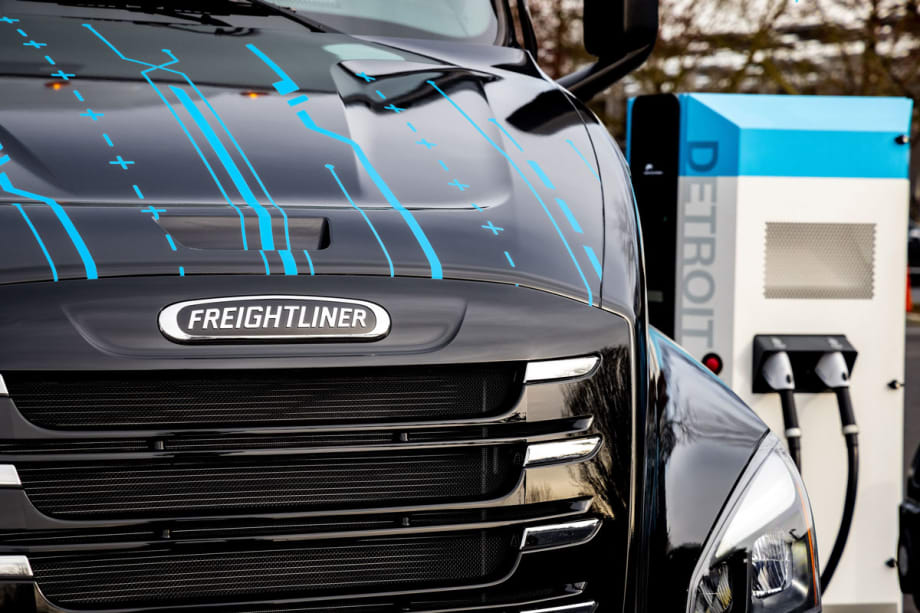
Critics of the federal excise tax say it discourages the purchase of newer, lower-emission trucks.
Photo: Daimler Truck North America/ACT Expo
3 min to read
A bill introduced in the U.S. House of Representatives would repeal the Federal Excise Tax on heavy trucks and trailers.
Rep. Chris Pappas from New Hampshire (D-N.H.) and Rep. Doug LaMalfa (R-Calif.) on June 16 introduced the Modern, Clean, and Safe Trucks Act of 2022. This bipartisan legislation would repeal the 12% FET.
A similar Senate bill (S. 2435) was introduced last year by Sen. Todd Young (R-Ind.) and Sen. Ben Cardin (D-Md.).
The FET was first enacted in 1917 to help pay for World War I, according to the American Truck Dealers association, which supports the bill. The tax is the highest excise tax on a percentage basis that Congress levies on a product, often adding as much as $22,000 to the price of a new heavy-duty truck, and as much as $50,000 to the price of an electric or hydrogen fuel-cell truck, given the higher price tag for these vehicles.
It's not the first time there's been an attempt to repeal the burdensome FET but today's focus on supply chain problems and emissions brings new urgency.
“As a small business owner, I’ve seen firsthand just how challenging it can be to operate a business, especially when costs rise,” said Pappas in a news release. “This is a time when we must do all we can to lower costs for small businesses and consumers, and cutting the federal excise tax on heavy trucks and trailers will help America's Main Street economy grow, address supply chain challenges and shortages, and lower costs for essential items that families need like groceries and gas.”
He pointed out that repealing the FET also would “facilitate the adoption of newer, safer, and greener trucks and reduce our dependency on foreign energy sources.”
“We need new and more environmentally friendly trucks deployed on our roadways,” said Scott McCandless, ATD chairman and president of McCandless Truck Center. “Half of the Class 8 trucks on the road are over 10 years old and lack the cleaner technologies and fuel efficiency gains of today’s new trucks. The FET is a barrier to our national goal to put more cleaner-emission trucks in service. For electric trucks, the FET is a counterproductive dead weight.
“Eliminating this outdated and punitive tax will spur turnover of our aging truck fleet and curb emissions. We must put an end to this tax that slows the deployment of new more environmentally friendly trucks.”
Saying the FET has outlived its original purpose by more than a century, LaMalfa added, “Between Sacramento and Washington, truckers have dozens of regulations on emissions and safety to follow. However, at the same time, our tax code disincentivizes them from purchasing the most up-to-date trucks… we should drop the burdensome tax preventing our truck drivers from having the most modern, highest technology and safest equipment on the road.”
More Equipment

How Volvo Updated Its D13 for EPA 2027 [Watch]
Volvo’s updated D13 promises lower emissions without sacrificing performance or fuel economy. Take a closer look at what changed inside the engine in this HDT Spotlight video.
Read More →
Michelin Tire Improves Efficiency and Durability for Regional Fleets
The Michelin X Multi Energy D2 is a regional haul drive tire engineered to help fleets improve fuel efficiency, durability and traction in demanding stop-and-go operations.
Read More →
ZF Expands Commercial Vehicle Push in North America
ZF is expanding its North American commercial-vehicle presence with new transmission applications, electrification, trailer technology and autonomous-driving systems.
Read More →
Tesla Wants a Self-Driving Semi. Are Cameras Enough?
Could Tesla’s camera-only autonomous driving technology work on an 80,000-pound Semi? In this commentary, HDT's Deborah Lockridge takes a look at Tesla, Cybercab, and how autonomous trucks see the road.
Read More →
Kodiak: Driverless Long-Haul Truck Launch on Track for 2026
Kodiak AI says its driverless long-haul safety case is 93% complete and it remains on track to begin commercial operations by year-end 2026.
Read More →
What DOT’s Automated Vehicle Strategy Means for Trucking
The U.S. Department of Transportation issued a new automated-vehicle strategy that outlines plans for driverless-truck regulations, cross-state freight corridors, and federal safety standards.
Read More →
East Coast Port Launches $45M Electric Truck Push
The Port Authority of New York and New Jersey announced millions in incentives for zero-emission drayage trucks, yard tractors, and new charging hubs near the port.
Read More →
PlusAI Going Public to Fund Autonomous Truck Launch
A SPAC deal could provide PlusAI with up to $300 million as it works toward a 2027 commercial launch of factory-built autonomous trucks.
Read More →
NHTSA Moves to Rewrite Truck Fuel-Economy Rules
The National Highway Traffic Safety Administration says it lacks authority to regulate medium- and heavy-duty truck engines separately from complete vehicles, but the existing standards have not yet been eliminated.
Read More →
Detroit Opens Orders for EPA 2027 Engines
Detroit isn’t starting from scratch to meet EPA 2027 diesel emissions standards. Its Gen 6 DD13 and DD15 engines keep much of today’s platform while updating the fuel and aftertreatment systems.
Read More →