




House Approves Pilot Program to Test Heavy Trucks in Maine, Vermont
The FY2010 Transportation Appropriations bill was approved in the House of Representatives Thursday, moving on to the Senate, which may take up the legislation as early as this weeken
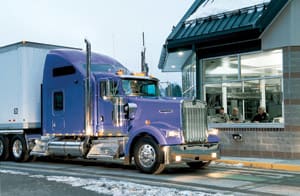
This provision of the bill would up the weight limits for big rigs in Maine and Vermont.
The FY2010 Transportation Appropriations bill was approved in the House of Representatives Thursday, moving on to the Senate, which may take up the legislation as early as this weekend
, according to the American Trucking Associations. The bill includes a provision that would launch a one-year pilot program to test heavier tractor-trailers in Maine and Vermont.
The bill, which would provide $122.1 billion in transportation, housing and development funding in 2010, was passed by the Senate in September, but had to be reconciled with the House version of the bill. It was unclear whether the Maine provision would survive. If the Senate approves the House's version, it would be send to the President for his signature.
The Maine/Vermont provision, Section 194, would allow 108,000 to 120,000-pound six-axle trucks to operate on interstate roads and bridges in Vermont and 100,000-pound six-axle trucks on all Maine Interstate highways. The current Vermont limit for truck weights is 80,000 pounds gross weight. In addition, trucks hauling certain commodities can be operated at up to 99,000 pounds.
"Vermont state policy and neighboring states' policies on truck weights have produced the reality that overweight trucks are here, and they will continue to operate in Vermont," said Senator Patrick Leahy (D-Vt.), who included the Vermont provision. "No one thinks that overweight trucks should rumble through our historic villages and downtowns on two-lane roads, putting people and our state's failing transportation infrastructure at risk. This step will get these trucks out of our downtowns in the short term. In the longer term it will help us determine, with real-world experience, whether it is safer and better for both our infrastructure and the environment to have these trucks use the Interstate system."
But safety advocates have been fighting the weight measure, saying that larger rigs damage interstate highways and threaten safety. Following Congress' recent activity, the Truck Safety Coalition, which is a partnership between the Citizens for Reliable and Safe Highways (CRASH) Foundation, and Parents Against Tired Truckers (P.A.T.T), issued a press release, warning against the weight increases. The Truck Safety Coalition is aimed at reducing the number of deaths and injuries caused by truck-related crashes.
"Motorists in Maine and Vermont deserve more than being human guinea pigs in this dangerous experiment," said John Lannen, executive director of the Truck Safety Coalition. "A report back to Congress on the effectiveness of this one-year program isn't even due for two years, which leads us to believe that this experiment will likely continue until the report is issued and analyzed by Congress."
The bill requires Vermont to submit a report to Congress evaluating the effects of the pilot program on highway safety, bridge and road durability, commerce, truck volumes, and energy use.
The coalition says this legislation will further deteriorate Vermont's interstate highways and bridges by adding the extra weight. The group also pointed to crash statistics related to trucks, claiming that a truck weighing 80,000 pounds is 50 to 100 percent more likely to be involved in a fatal crash than a truck weighing 50,000 to 65,000 pounds.
"The public understands the dangers of driving on the roads with overweight trucks and the roadway and bridge damage caused by them all too well," said Lannen.
More Drivers

From One Generation to the Next: How Mentorship Builds Safer Truck Drivers
After three decades in trucking, Harold Perry shares what he's learned about driver safety, mentorship, and helping the next generation build confidence behind the wheel.
Read More →
Truck Drivers Need More Than Another Alert
Fleets have more visibility into truck health, safety events, and driver activity than ever. The next challenge is turning all that information into useful guidance for the person who has to decide what to do next.
Read More →
FMCSA Removes 110 Truck Driver Training Schools from Certified ELDT List
Federal regulators also are targeting more than 160 additional training providers and launching a nationwide audit of third-party CDL skills testers as part of a broader crackdown on trucking fraud.
Read More →
Hours of Service Pilot Programs: FMCSA Readies for 2027 Rollout
Two pilot programs could eventually reshape hours-of-service rules, giving truck drivers options to pause their 14-hour clock or use longer split sleeper rest periods.
Read More →
Medical Cards, English Proficiency Reshape Roadcheck Violations
Medical-card violations jumped to the top of the driver out-of-service list during CVSA’s 2026 International Roadcheck, while English-language proficiency violations appeared among the leading violations for the first time.
Read More →
Driver Trust Can Make or Break the Success of Fleet Safety Technology
New Teletrac Navman research suggests that onboarding, transparency about driver data, and positive feedback can play a significant role in how commercial drivers respond to safety and coaching technology.
Read More →
EEOC Sues KLLM Over Alleged Sex Discrimination in Driver Training
KLLM is facing a federal sex-discrimination lawsuit over policies the EEOC alleges put female truck driver trainees at a disadvantage.
Read More →
FMCSA Moves to Codify English Language Requirements for Commercial Drivers
By changing regulations on English-language proficiency requirements for commercial drivers, rather than relying on a guidance memo, the FMCSA said future administrations won't be able to walk back the Trump administration's stricter enforcement with just a memo.
Read More →
Drivers Put Western Star Trucks to the Test at Star Nation Experience
Watch to get an inside look at the Western Star trucks, technology, and community behind the Star Nation Experience 2026!
Read More →
Trump Administration Looks to Put More Veterans Behind the Wheel
The Freedom Haulers program pulls together existing and expanded programs at several federal agencies to recruit veterans to drive commercial heavy-duty trucks and cut the red tape for them to get a CDL, training, and employment.
Read More →